
About Larry Eisenberg
Lived 1919 – 2018 (aged 99). Larry Eisenberg was an American science fiction writer and novelist.
Lawrence Eisenberg (December 21, 1919 – December 25, 2018) was an American biomedical engineer and science fiction writer. He is best known for his short story "What Happened to Auguste Clarot?", published in Harlan Ellison's anthology Dangerous Visions. He also wrote limericks, and later in life, he became known for the poems that he posted in the comments sections of various articles in The New York Times.
Eisenberg's stories have been printed in a number of leading science fiction magazines, including The Magazine of Fantasy & Science Fiction, Galaxy Science Fiction, and Asimov's Science Fiction. His stories have been reprinted in anthologies such as Great Science Fiction of the 20th Century, The 10th Annual of the Year’s Best S-F, and Great Science Fiction By the World's Great Scientists.
Life Eisenberg was born in the Bronx in 1919 to Sidney Eisenberg, a furniture salesman, and Yetta Yellen, and grew up during the Great Depression. Eisenberg graduated from James Monroe High School in the Bronx, then attended City College of New York, where he earned bachelor's degrees in electrical engineering and in mathematics, before going to Polytechnic Institute of Brooklyn, where he received a master's degree and a Ph.D. in electronics. After serving as a radar operator in the Army Air Forces during World War II, Eisenberg married Frances Brenner, a political scientist and social worker, in 1950; she died in 2017. They had one daughter and one son. where he and Dr. Robert Schoenfeld were co-heads of the Electronics Laboratory, and taught there until 2000. He designed the first transistorized radio-frequency coupled cardiac pacemaker circa 1960, in collaboration with Dr. Alexander Mauro. It is on display at Caspary Hall, Rockefeller University.
Meet Larry Eisenberg, a feature-length documentary about Eisenberg's life, is in production.
Writing Eisenberg published his first short story, "Dr. Beltzov's Polyunsaturated Kasha Oil Diet", in Harper's Magazine in 1962. His first science fiction publication was later that year with his story "The Mynah Matter" in the August 1962 Fantastic Stories of Imagination, with Eisenberg debuting alongside Roger Zelazny.
Shortly after that, Eisenberg began publishing his stories in many of the leading science fiction magazines of the day, including The Magazine of Fantasy & Science Fiction, Galaxy Science Fiction, and If. Eisenberg's science fiction takes a humorous approach to storytelling. As Eisenberg has said, "I enjoy wedding humor with science fiction, particularly where some unsavory aspect of our society can be pricked." with one of the professor's many inventions being "an addictive aphrodisiac clocking in at 150,000 calories per ounce —along with a propensity to turn those taking it into walking bombs." A number of the Duckworth stories were collected in Eisenberg's short story collection, The Best Laid Schemes, published in 1971 by MacMillan.
Eisenberg is best known for his short story "What Happened to Auguste Clarot?," which was published in the anthology Dangerous Visions edited by Harlan Ellison. His stories have also been reprinted in anthologies such as Great Science Fiction of the 20th Century, The 10th Annual of the Year’s Best SF, and Great Science Fiction By the World's Great Scientists.
He published two books of limericks (both with George Gordon) in 1965: Limericks for the Loo and Limericks for Lantzmen; and one collection of short stories, Best Laid Schemes. Latterly he gained a cult following for the limericks he posted in the comments sections of various New York Times articles, which numbered over 13,000 by the time of his death.
Eisenberg wrote the following limerick about his life A nonagenarian, I, A sometime writer of sci-fi, Biomed engineer, Gen’rally of good cheer, With lim’ricks in ready supply.
From a New York Times reader: "The Eisenberg Certainty Principle": There once was a poet named Larry Whose thoughts one could never quite parry For when Larry had spoken The mold it was broken Though the topics invariably vary.
Adaptations Eisenberg's short stories The Fastest Draw and Too Many Cooks were adapted for the second series of the BBC2 television science fiction anthology series Out of the Unknown, first broadcast on 8 and 15 December 1966 respectively. Both episodes are now lost.
Don’t just read it —
keep it.
Full-length biographies made to live with: read them, listen on the way to work, watch them tonight.
- E-book
- Audio
- Video
Instant download · yours to keep · every purchase keeps this site free
Important facts
People in Larry Eisenberg's life
Named in this biography and alive at the same time
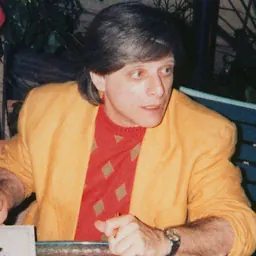


Related people
Same field, nearest in time
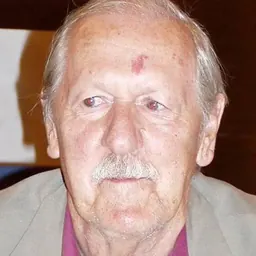
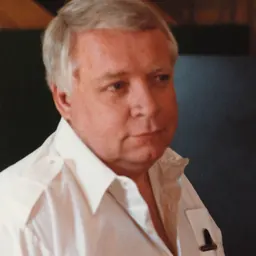

Contemporaries
People whose lives overlapped Larry Eisenberg's



Frequently asked questions
Who was Larry Eisenberg?
American writer
When was Larry Eisenberg born?
Larry Eisenberg was born on 21 December 1919 in New York City.
When did Larry Eisenberg die?
Larry Eisenberg died on 25 December 2018 in Lincoln.
What was Larry Eisenberg's occupation?
Larry Eisenberg was a science fiction writer and novelist.
What nationality was Larry Eisenberg?
Larry Eisenberg was American.
Sources & further reading
Cite this page
APA: Biography.guide. (2026). Larry Eisenberg. https://biography.guide/larry-eisenberg/
MLA: "Larry Eisenberg." Biography.guide, https://biography.guide/larry-eisenberg/.
Chicago: "Larry Eisenberg." Biography.guide. https://biography.guide/larry-eisenberg/.
Data last updated: 2026-09-20 · Spot an error? Report a correction.
Portrait: Wikimedia Commons · author & licence
Page generated 2026-09-27 04:57 UTC