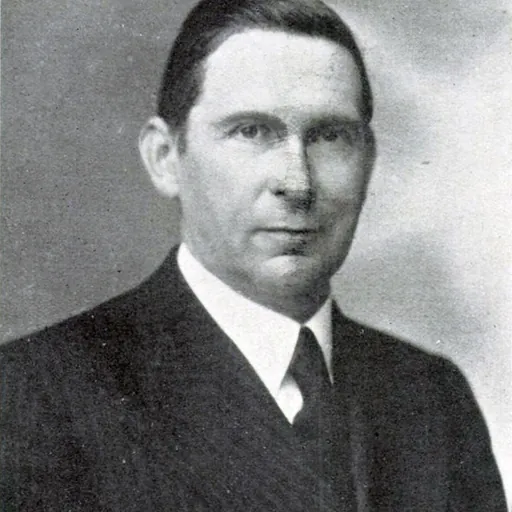
Lajos Áprily
Hungarian poet/translator/recipient:1954 Attila József Prize
About Lajos Áprily
Lived 1887 – 1967 (aged 79). Lajos Áprily was a Hungarian poet, translator and writer.
Commemorative plaque for Lajos Áprily and his son Zoltán Jékely at 21 Frankel Leó Street, Budapest District II. Lajos Áprily (birth name Lajos Jékely; 14 November 1887 – 6 August 1967) was a Hungarian poet and translator who won the 1954 Attila József Prize for his contributions to Hungarian literature. Áprily was born 14 November 1887 in Brassó, Austria-Hungary (now the city of Brașov in Romania) and died 6 August 1967 in Budapest; he was the father of Zoltán Jékely (1913-1982), also a poet and translator.
Áprily's poems usually made use of classical forms and versification; they are characterized by impressionistic descriptions of nature. Major themes of his poetry are nature, family, grief over the loss of loved ones, and the ideas of peace, humanity and mutual respect between individuals and nations. His basic mood is warm, melancholic, reserved and unpretentious. He was a champion of disciplined, tight forms; his style embodied elegance, taste and refinement. From 1921 to 1965 he published several collections of poems and translations from French and Russian; he also wrote verse dramas, translating Pushkin's Eugene Onegin, Ibsen's Peer Gynt and other works.
Biography Lajos Áprily's original name was Lajos Jékely. He attended elementary and secondary school in Parajd (now Praid, Romania) and Székelyudvarhely (now Odorheiu Secuiesc), two towns which still have Hungarian-speaking majority populations. From 1899, he studied at the Protestant Reformed College in Kolozsvár (now Cluj-Napoca). His teachers included famed musicologist and folklorist János Seprődi (1874–1923) and Hungarian writer and editor Dezső Kovács (1866–1935). To this day Cluj retains a sizable ethnic Hungarian minority population.
In 1909 Jékely earned his teacher's degree and became instructor of German and Hungarian language and literature at Bethlen Gábor Kollégium in Nagyenyed (Colegiul Național Bethlen, Aiud, Romania). In 1911 he married Ida Schéfer; in 1913, whilst they were still living in Nagyenyed, their eldest son, the poet, writer and translator Zoltán Jékely, was born.
After Kovács had reprimanded him over the supposed "modern tone" of some of his poems, Jékely refrained from publishing for several years. In 1918, however, he began using the pen name Lajos Áprily for his writings in the magazine Uj Erdély ("New Transylvania"). He soon became a member of three literary societies, Erdélyi Irodalmi Társaság, Kisfaludy Társaság and Kemény Zsigmond Társaság. By 1923 he had earned a degree in French language at the University of Burgundy in Dijon.
In 1926 he and his family returned to the town where he had studied from the age of 12, when it had been known as Kolozsvár, but in 1920, it became part of Romania. Here he taught languages and literature at the Reformed College. In 1928 he became editor of Erdélyi Helikon.
In 1929 the family moved from Romania to Budapest, where in 1934 the poet was named as director of Baár-Madas, at that time a boarding school for girls. One of his pupils there was the polyglot poet and translator Ágnes Nemes Nagy (1922-1991). In the fall of 1935 he began a half-year study tour in northern and western Europe. In 1942 the family moved back to Parajd in Transylvania (the Northern part of which returned to Hungary in 1940) for a short time, before they resettled in 1943 to Szentgyörgypuszta, a farm near Visegrád.
Works 1921: Falusi elégia ("Rural elegy"), poems 1923: Esti párbeszéd ("Evening dialogues"), poems 1926: Rasmussen hajóján ("Rasmussen's ship"), poems 1926: Vers vagy te is, poems 1926: Idahegyi pásztorok, verse drama 1934: Rönk a Tiszán, poems 1934: Úti jegyzetek. Egy pedagógiai vándorlás megfigyelései("Travel notes: Pedagogical observations"), travelogue 1939: A láthatatlan írás ("Invisible writing"), poems 1964: Az aranyszarvas ("The golden stag"), translations 1965: Fecskék, özek, farkasok ("Swallows, deer and wolves"), stories 1965: Jelentés a völgyből ("Report from the valley"), poems 1965: Ábel füstje ("Abel's Sacrifice"), selected poems
Selected poems in English translation Antigoné ("Antigone", Watson Kirkconnell, trans.) Március ("March in Transylvania", Ádám Makkai, trans.) Kolozsvári éjjel ("Night in Kolozsvár", Watson Kirkconnell, trans.) Kérés az öregséghez ("Plea to old age", Doreen Bell, trans.)
Don’t just read it —
keep it.
Full-length biographies made to live with: read them, listen on the way to work, watch them tonight.
- E-book
- Audio
- Video
Instant download · yours to keep · every purchase keeps this site free
Important facts
Family & relationships
People in Lajos Áprily's life
Named in this biography and alive at the same time


Related people
Same field, nearest in time
Contemporaries
People whose lives overlapped Lajos Áprily's






Frequently asked questions
Who was Lajos Áprily?
Hungarian poet/translator/recipient:1954 Attila József Prize (1887–1967)
When was Lajos Áprily born?
Lajos Áprily was born on 14 November 1887 in Brașov.
When did Lajos Áprily die?
Lajos Áprily died on 6 August 1967 in Budapest.
What was Lajos Áprily's occupation?
Lajos Áprily was a poet, translator and writer.
What nationality was Lajos Áprily?
Lajos Áprily was Hungarian.
Sources & further reading
Cite this page
APA: Biography.guide. (2026). Lajos Áprily. https://biography.guide/lajos-aprily/
MLA: "Lajos Áprily." Biography.guide, https://biography.guide/lajos-aprily/.
Chicago: "Lajos Áprily." Biography.guide. https://biography.guide/lajos-aprily/.
Data last updated: 2026-09-20 · Spot an error? Report a correction.
Portrait: Wikimedia Commons · author & licence
Page generated 2026-09-27 04:57 UTC