
La Meri
American dancer, choreographer, teacher, scholar, poet
About La Meri
Lived 1898 – 1988 (aged 89). La Meri was an American choreographer, dancer, artist, educator, dance teacher and poet.
La Meri (born Russell Meriwether Hughes Jr.; May 13, 1899 – January 7, 1988) was an American ethnic dancer, choreographer, teacher, poet, anthropologist and scholar. Her family moved several years later to San Antonio, where she began her dance training, studying ballet, Spanish, and Mexican dance forms. She also studied violin, wrote poetry and acted in amateur productions as a child.
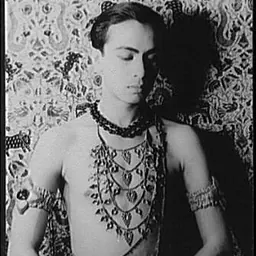
She continued her training in Hawaii, where she studied Hawaiian dance, and then New York, where she studied modern dance and ballet. As she began working professionally, she combined acting, singing, and playing the violin in her performances, including in "prologues", the short live stage productions presented by movie theatre owners before the main feature was shown in the silent film era. Her early programs included works of ballet and interpretive dance. In the 1930s, she studied with Indian classical dancer Ram Gopal, one of the early pioneers of the dance of India in the west, who toured with her extensively. Throughout the 1930s she toured and studied in areas such as Central and South America, Europe, North Africa, Australia, New Zealand, Tasmania, India, Burma, Indonesia, the Philippines, China, Japan, Ceylon, and Hawaii. As she traveled, La Meri learned the native dances of the different areas she visited, studying with local dance masters, and acquired recordings of the music and traditional costumes.
She went on to create her own dance works based on the steps and movement vocabularies she learned. Her research into the dance styles of Latin America, Spain, Africa, and Asia allowed her to bring authenticity to the stage in a way that rang true to the roots of each dance style.
When the outbreak of World War II made her international dance tours impracticable, she and her husband settled in New York City, where she and Ruth St. Denis founded the "School of Natya", which is Hindu dance, in 1940. Through the school, La Meri formed The Five Natyas, her first performing company. In 1945 she absorbed the school of Natya into the Ethnologic Dance Center and the Ethnologic Dance Theater, which operated from 1942 to 1956. and presented concert programs of young ethnic-dancers from across the globe. In 1944, she choreographed Swan Lake with the inclusion of Hindu dance movements and hand gestures. She did not change the ballet's music and plot, but added a prologue and a danced fight between the princess and Von Rothbart.
She moved from New York to Cape Cod in 1960, but continued to write extensively and give lecture-demonstrations. While nominally "retired", she founded Ethnic Dance Arts, Inc. and produced an annual summer ethnic dance festival from 1970 to 1979.
Writings In addition to her memoirs, La Meri published a number of magazine articles and books, including The Gesture Language of Hindu Dance (1941) and Spanish Dancing (1948). The latter book is considered to be a definitive text on the subject of Spanish dance.
In 1938 La Meri published a book Songs and Voyages, with 82 pages of poetry, now very rare. [Livorno -Arti Grafiche S. Belfort & C. 5 Dicembre 1938 - XVII, printed in Italy] According to the frontispiece, her poetry had appeared in American Poetry Magazine, Literary Digest, Braithwaite Anthology, L'Alouette, The Harp, The Dance Magazine, Independent Poetry Anthology, Lariat, Circle, Buccaneer, Contemporary Verse, Interludes, Gammadion, Texas Anthology, Bozart, American Anthology, Poetry Journal, Bright Scrawl, Unicorn, Home Magazine, Present Day Poets, and Wandering Eros.
Legacy and awards Overall, La Meri's extensive work in ethnic dance, a term she claimed to have created, earned her the reputation of being one of the foremost experts in the field. La Meri's work helped to inspire other choreographers to show respect for dances of cultures not their own, as well as educating the audience. Her anthropological work embodied the values of each ethnicity she used in her choreography and highlighted the importance of integrity in the dance world.
She received the Capezio Dance Award in 1972.
Don’t just read it —
keep it.
Full-length biographies made to live with: read them, listen on the way to work, watch them tonight.
- E-book
- Audio
- Video
Instant download · yours to keep · every purchase keeps this site free
Important facts
People in La Meri's life
Named in this biography and alive at the same time
Related people
Same field, nearest in time



Contemporaries
People whose lives overlapped La Meri's



Frequently asked questions
Who was La Meri?
American dancer, choreographer, teacher, scholar, poet (1898–1988)
When was La Meri born?
La Meri was born on 13 May 1898 in Louisville.
When did La Meri die?
La Meri died on 7 January 1988 in San Antonio.
What was La Meri's occupation?
La Meri was a choreographer, dancer, artist, educator, dance teacher and poet.
What nationality was La Meri?
La Meri was American.
Sources & further reading
Cite this page
APA: Biography.guide. (2026). La Meri. https://biography.guide/la-meri/
MLA: "La Meri." Biography.guide, https://biography.guide/la-meri/.
Chicago: "La Meri." Biography.guide. https://biography.guide/la-meri/.
Data last updated: 2026-09-20 · Spot an error? Report a correction.
Page generated 2026-09-27 05:22 UTC