
L. Sprague de Camp
American non- and speculative fiction writer
About L. Sprague de Camp
Lived 1907 – 2000 (aged 92). L. Sprague de Camp was an American writer, military officer, novelist, historian, essayist and literary critic.
Biography De Camp was born in New York City, one of three sons of Lyon de Camp (a businessman in real-estate and lumber), and of Emma Beatrice Sprague. His maternal grandfather was the accountant, banker, pioneering Volapükist and Civil War veteran Charles Ezra Sprague.
De Camp began his education at the Trinity School in New York, then spent ten years attending the Snyder School in North Carolina, a military-style institution. His stay at the Snyder School represented an attempt by his parents, who were heavy-handed disciplinarians, though he could, like his father,
An aeronautical engineer by education, de Camp undertook undergraduate studies at the California Institute of Technology (where his roommate was at one point noted rocket-fuel scientist John Drury Clark), He earned his Master of Science degree in engineering from the Stevens Institute of Technology in 1933. De Camp was also a surveyor and an expert in patents. with whom he collaborated on science fiction and nonfiction beginning in the 1960s.
De Camp (center) with Robert A. Heinlein and Isaac Asimov in 1944
During World War II, de Camp served as a researcher at the Philadelphia Naval Yard along with his fellow-writers Isaac Asimov and Robert A. Heinlein. De Camp eventually rose to the rank of lieutenant commander in the U.S. Navy as a reserve officer.
De Camp was a member of the all-male literary and dining club in New York City, the "Trap Door Spiders", which served as the basis of Asimov's fictional group of mystery-solvers the "Black Widowers". De Camp himself was the model for the character named "Geoffrey Avalon".
De Camp was a founding member of the Swordsmen and Sorcerers' Guild of America (SAGA), a loosely-knit group of heroic fantasy writers founded during the 1960s and led by Lin Carter, with entry by credentials as a fantasy writer alone.
The de Camps moved to Plano, Texas, in 1989, and Sprague de Camp died there on November 6, 2000 (seven months after his wife, on what would have been her birthday), at age 92. His ashes were inurned, together with hers, in the Arlington National Cemetery in Virginia.
De Camp's personal library of about 1,200 books was acquired for auction by Half Price Books in 2005. The collection included books inscribed by fellow writers, such as Isaac Asimov and Carl Sagan, as well as by de Camp himself.
Coinage of "extraterrestrial" and "E.T." "Extraterrestrial", a coinage from "extra" + "terrestrial", meaning from beyond earth, is attested as an adjective as early as 1868, according to the Oxford English Dictionary. Its first use in connection with life beyond earth was likely by H. G. Wells, in his 1898 novel The War of the Worlds. L. Sprague de Camp is credited with its first usage as a noun with the meaning of "alien life" and with coining the abbreviation "E.T." in the first part of his two-part article "Design for Life", published in the May 1939 issue of Astounding Science Fiction.
Body of work
De Camp was a materialist who wrote works examining society, history, technology and myth. He published numerous short stories, novels, non-fiction works and poems during his career. De Camp's explanatory tendency also carried over into his non-fictional writings, including advice to science fiction writers on handling the different states of languages in future worlds.
Science fiction De Camp's science fiction is marked by his interests in linguistics, ancient history, and the history and philosophy of science. His first published story was "The Isolinguals", in the September 1937 issue of Astounding Science Fiction He contributed ten novels (five as collaborations), much of it characterized by humor and dry wit. Lest Darkness Fall, "The Wheels of If" and "Aristotle and the Gun" have been recognized as seminal works in the field of alternate history.
His most extended work was his "Viagens Interplanetarias" series, set in a future where Brazil is the dominant power, particularly a sub-series of sword and planet novels set on the planet Krishna, beginning with The Queen of Zamba. His most influential Viagens novel was the non-Krishna work Rogue Queen, a tale of a hive society undermined by interstellar contact, which was one of the earliest science fiction novels to deal with sexual themes. De Camp and Pratt also wrote some stand-alone novels similar in tone to the Harold Shea stories, including Land of Unreason (1942). De Camp wrote a few more of this genre on his own. He also edited a series of fantasy anthologies credited with helping to spark the renaissance of heroic fantasy in the late 1960s.
De Camp also created three sword and sorcery sequences. The Pusadian series (from 1951), composed of the novel The Tritonian Ring and several short stories, is set in an antediluvian era similar to Howard's.
The larger Novarian series (from 1968) includes the Reluctant King trilogy, beginning with The Goblin Tower, continuing in The Clocks of Iraz, and concluding with The Unbeheaded King. The trilogy features the adventurer Jorian, ex-king of Xylar. Jorian's world is an alternate reality to which our own serves as an afterlife. Other novels in the sequence include The Fallible Fiend, a satire told from the point of view of a demon, and The Honorable Barbarian, a follow-up to the trilogy featuring Jorian's brother as the hero.
The Incorporated Knight series comprises some 1970s short stories by de Camp and two novels written in collaboration with Catherine Crook de Camp, The Incorporated Knight (1988) and The Pixilated Peeress (1991). Despite being a long-time writer of fantasy, de Camp did not believe in ghosts in the supernatural sense. His ghosts dwelt only in his mind as memories of his parents. His mother, he wrote in a New York Times Magazine article, died of an overdose of faith healing. De Camp's "warts and all" approach to his subjects has been branded by some fans as unflattering and unbalanced. For instance, Mark Finn, author of Blood & Thunder: The Life & Art of Robert E. Howard, contends that de Camp deliberately framed his questions in regard to Howard to elicit answers matching his Freudian theories about him.
De Camp also wrote nonfiction radio scripts for Voice of America. Isaac Asimov recalled de Camp finding the tendency of authors to portray human characters in outer-space science fiction as superior to aliens analogous to northern Europeans imagining they had some inherent superiority over other races.
Awards and honors De Camp and Willy Ley won the 1953 International Fantasy Award for nonfiction recognizing their study of geographical myths, Lands Beyond (Rinehart, 1952). CSI was previously known as the Committee for the Scientific Investigation of Claims of the Paranormal (CSICOP).
In popular culture L. Sprague de Camp has been depicted in fictional works by a number of other authors. Randall Garrett conflated him with J. R. R. Tolkien's Gandalf in the character of the magician "Sir Lyon Gandolphus Gray" in his Lord Darcy series. He was the model for the "Geoffrey Avalon" character in Isaac Asimov's fictional group of mystery solvers, the "Black Widowers", and in the novels In the Courts of the Crimson Kings (2008) by S. M. Stirling and The Astounding, the Amazing, and the Unknown (2011) by Paul Malmont.
A semi-fictionalized version of de Camp appears in the third episode of the 2017 TV series Manhunt: Unabomber, as one of several academics and authors consulted by the FBI on the basis of the citation of their work in the Unabomber Manifesto. In the scene depicting this meeting, de Camp's name appears on a placard as "L. Sprague de Camp, S.A.G.A. Author, The Ancient Engineers." De Camp's name does not specifically appear in the episode credits, which identify the roles of actors in the scene as composite characters. The Ancient Engineers is cited in endnote 18 of the manifesto.
Selected works
This selection is limited to books.
Science fiction Lest Darkness Fall (1939) – an early alternate history novel that helped define the genre and remains in print after more than 70 years. The Wheels of If and Other Science Fiction (1948) – early collection of de Camp's short fiction, including "The Wheels of If" Genus Homo (1950) (with P. Schuyler Miller) – first science fiction novel de Camp had a hand in, possibly the earliest work of fiction dealing with the "Planet of the Apes" theme The Hand of Zei (1950) – the best of the early Krishna novels Rogue Queen (1951) – one of the earliest science fiction novels to deal with sexual themes The Continent Makers and Other Tales of the Viagens (1953) – collection of most of the shorter works in the Viagens Interplanetarias series The Virgin of Zesh (1953) – Krishna novel noted for the early use (for science fiction) of a strong female protagonist and a possible influence on Daniel Keyes's Flowers for Algernon The Glory That Was (1960) – a tour de force incorporating most of de Camp's major interests into one work A Gun for Dinosaur and Other Imaginative Tales (1963) – collection of some of the best of de Camp's early fiction, including "A Gun for Dinosaur" and "Aristotle and the Gun" The Best of L. Sprague de Camp (1978) – a mid-career review collecting de Camp's best short works
Fantasy The Incomplete Enchanter (1941) (with Fletcher Pratt) – first of the de Camp/Pratt collaborations, including the earliest Harold Shea stories Land of Unreason (1942) (with Fletcher Pratt) – best of the non-series de Camp/Pratt collaborations The Undesired Princess (1951) – earliest of de Camp's major fantasies not written in collaboration with Pratt; set in an Aristotelian universe Tales from Gavagan's Bar (1953, exp. 1978) (with Fletcher Pratt) – collected edition of de Camp and Pratt's second major fantasy series The Tritonian Ring and Other Pusadian Tales (1953) – collection of the earlier works in the Pusadian series, including The Tritonian Ring Tales of Conan (1955) (with Robert E. Howard) – collection containing the first of de Camp's "posthumous collaborations" with Howard, marking the beginning of his successful promotion of Howard's "Conan the Barbarian" character Conan the Adventurer (1966) (with Robert E. Howard) – collection inaugurating the paperback Conan series, which ensured the success of the character and defined it for a generation The Goblin Tower (1968) – first of the Novarian series The Fallible Fiend (1973) – offbeat entry in the Novarian series presenting a satirical look at humanity through the eyes of a demon
Historical fiction
In chronological order:
The Dragon of the Ishtar Gate (1961) The Arrows of Hercules (1965) An Elephant for Aristotle (1958) The Bronze God of Rhodes (1960) The Golden Wind (1969)
Anthologies
Swords and Sorcery (1963) – pioneering sword and sorcery anthology, the first ever published The Spell of Seven (1965) – the second of de Camp's four sword and sorcery anthologies (followed by the volumes below) The Fantastic Swordsmen (1967) Warlocks and Warriors (1970)
Nonfiction Inventions and Their Management (1937; vt. Inventions, Patents, and Their Management (1959)) (with Alf K. Berle) – de Camp's first work of nonfiction
Don’t just read it —
keep it.
Full-length biographies made to live with: read them, listen on the way to work, watch them tonight.
- E-book
- Audio
- Video
Instant download · yours to keep · every purchase keeps this site free
Important facts
People in L. Sprague de Camp's life
Named in this biography and alive at the same time
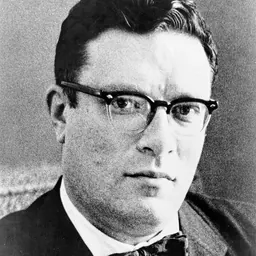






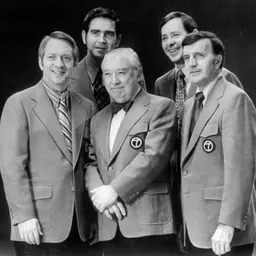
Related people
Same field, nearest in time




Contemporaries
People whose lives overlapped L. Sprague de Camp's

Frequently asked questions
Who was L. Sprague de Camp?
American non- and speculative fiction writer (1907–2000)
When was L. Sprague de Camp born?
L. Sprague de Camp was born on 27 November 1907 in New York City.
When did L. Sprague de Camp die?
L. Sprague de Camp died on 6 November 2000 in Plano.
What was L. Sprague de Camp's occupation?
L. Sprague de Camp was a writer, military officer, novelist, historian, essayist and literary critic.
What nationality was L. Sprague de Camp?
L. Sprague de Camp was American.
Sources & further reading
· Wikipedia: L. Sprague de Camp
Cite this page
APA: Biography.guide. (2026). L. Sprague de Camp. https://biography.guide/l-sprague-de-camp/
MLA: "L. Sprague de Camp." Biography.guide, https://biography.guide/l-sprague-de-camp/.
Chicago: "L. Sprague de Camp." Biography.guide. https://biography.guide/l-sprague-de-camp/.
Data last updated: 2026-09-20 · Spot an error? Report a correction.
Page generated 2026-09-27 05:31 UTC