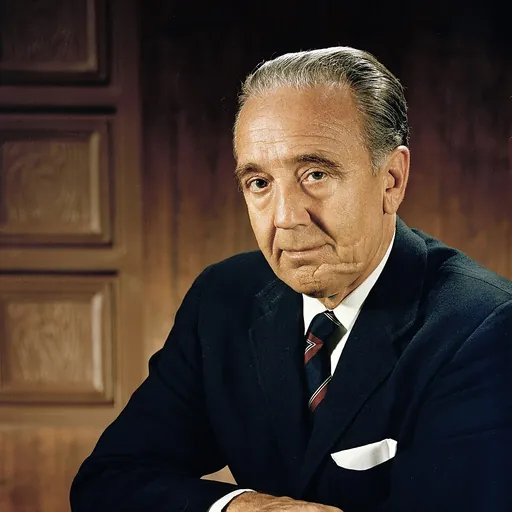
About Kurt H. Debus
Lived 1908 – 1983 (aged 74). Kurt H. Debus was a German and American physicist, military flight engineer and engineer.
Kurt Heinrich Debus in Frankfurt, German Empire, in 1908, Debus received all his academic education and credentials in Germany during the interwar period. He attended Technische Hochschule Darmstadt where he earned his initial and advanced degrees in electrical engineering. He served as a graduate assistant on the faculty for electrical engineering and high-voltage engineering while studying for his master's degree.
In 1939, he obtained his engineering doctorate with a thesis on surge voltages, and was appointed assistant professor at the university. During World War II, Debus was a member of the Nazi Party, and joined the SA in 1933 and the SS in 1940 [No 426.559].
Debus was appointed by Hitler as the V-weapons flight test director and was actively engaged in the rocket research program at Peenemünde and the development of the V-2 rocket, Debus led the Test Stand Group personnel at Peenemünde and was the engineer in charge at Test Stand VII.
At the end of the war, Debus and a small group of the V-2 engineers led by Wernher von Braun's brother sought out the advancing American 44th Infantry Division near Schattwald on May 2, 1945. Debus was detained by the U.S. Army with the rest of the Peenemünde scientists at Garmisch-Partenkirchen.
The arsenal became the focal point of the Army's rocket and space projects; larger rockets were launched first from White Sands Missile Range in New Mexico, and later from Cape Canaveral. The Army assigned von Braun as chairman of a Development Board, and Debus supervised the development program of the Guided Missile Branch until November 1951. The Army Ordnance Department reorganized the team and called it the Ordnance Guided Missile Center. By November 1951, the pace had picked up and a new missile program, the Redstone, was taking shape. Von Braun named Debus to lead a new Experimental Missiles Firing Branch.
On July 1, 1962, the Florida launch facility at Cape Canaveral was officially designated as NASA's Launch Operations Center (renamed to honor President John Kennedy after his assassination in 1963) and Debus was officially named its first director. In October 1965, he became responsible for NASA uncrewed launch operations at the Eastern and Western Ranges, assuming the additional title of Kennedy Space Center (KSC) director of launch operations until Rocco Petrone took the post in 1966.
Under Debus' leadership, NASA and its team of contractors built what was hailed as the Free World's Moonport — KSC's Launch Complex 39 — as well as tested and launched the Saturn family of rockets for the Apollo and Skylab programs. Debus retired as KSC director in November 1974. ). as is The Kurt Debus Conference Center at the Kennedy Space Center Visitor Complex. Debus was inducted into the National Space Hall of Fame in 1969. He was awarded an honorary Doctor of Law and Doctor of Engineering Science degrees by Rollins College in 1967 and Florida Technological University in 1969, respectively.
Since 1990, the National Space Club of Florida has presented its annual Debus Award to recognize significant aerospace achievements in Florida, including individuals associated with launch vehicles, spacecraft operations, ground support services, range activities, space education and spaceport research and development. The award was conceived as an adjunct to the Goddard Award given each year by the National Space Club in Washington, D.C. to an individual in the aerospace field on a national level.
Awards 1965: Pioneer of Wind Rose Award, order of the Diamond (International Committee of Aerospace Activities) 1967: Space Flight Award (AAS) 1968: Outstanding Achievement Award (U.S. Treasury) 1969: National Space Hall of Fame 1974: Louis W. Hill Space Transportation Award (AIAA)
Memberships Schutzstaffel (SS) Instrument Society of America (honorary) Hermann-Raketentechnik and Raumfahrt, e.V. (honorary) Marquis Biographical Library Society (advisory) Member of the Florida Council of 100 (ex officio) British Interplanetary Society (Advisory Board) American Ordnance Association (life)
Publications
Don’t just read it —
keep it.
Full-length biographies made to live with: read them, listen on the way to work, watch them tonight.
- E-book
- Audio
- Video
Instant download · yours to keep · every purchase keeps this site free
Important facts
People in Kurt H. Debus's life
Named in this biography and alive at the same time


Related people
Same field, nearest in time




Contemporaries
People whose lives overlapped Kurt H. Debus's


Frequently asked questions
Who was Kurt H. Debus?
rocket engineer and scientist (1908–1983)
When was Kurt H. Debus born?
Kurt H. Debus was born on 29 November 1908 in Frankfurt.
When did Kurt H. Debus die?
Kurt H. Debus died on 10 October 1983 in Cocoa Beach.
What was Kurt H. Debus's occupation?
Kurt H. Debus was a physicist, military flight engineer and engineer.
What nationality was Kurt H. Debus?
Kurt H. Debus was German and American.
Sources & further reading
Cite this page
APA: Biography.guide. (2026). Kurt H. Debus. https://biography.guide/kurt-h-debus/
MLA: "Kurt H. Debus." Biography.guide, https://biography.guide/kurt-h-debus/.
Chicago: "Kurt H. Debus." Biography.guide. https://biography.guide/kurt-h-debus/.
Data last updated: 2026-09-22 · Spot an error? Report a correction.
Portrait: Wikimedia Commons · author & licence
Page generated 2026-09-27 05:03 UTC