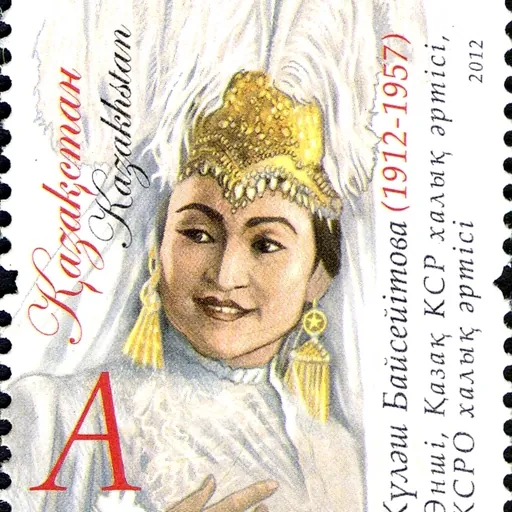
About Kulyash Baiseitova
Lived 1912 – 1957 (aged 45). Kulyash Baiseitova was a Russian and Kazakh opera singer and actor.
Küläş Jasynqyzy Baiseiıtova (; born Gülbahram, 1912 – 1957) was a Soviet and Kazakh opera singer and actress. People's Artist of the USSR.
Biography Kulyash Baiseitova (maiden name Beisova) was born on 2 May (19 April) 1912 (according to other sources – 12 January) in the steppes of Sary-Arka, in the village of the Karkaraly district of the Semipalatinsk Oblast (now in the Aktogay district of the Karaganda Region of Kazakhstan (According to official data in the city of Verny (now Almaty). She was born to a very simple family: mother Zibazhan, a washerwoman, father Zhasyn, a shoemaker. Her birth name was Gulbakhram; Kulya – her childhood nickname – gradually turned into the name Kulyash. Her parents were so broke that they could not feed two children. Therefore, Gulbakhram was sent to an orphanage even before school.
No matter how difficult it was for the parents, they decided to take the girl from the orphanage and send her to a boarding school. She was brought to Alma-Ata at the age of twelve, and for some time, she lived in a boarding school.
Since 1934 she has been a soloist of the Kazakh Musical Theater (now the Abay Kazakh State Academic Opera and Ballet Theater).
Political activity In 1938 she became a deputy of the Supreme Soviet of the Kazakh SSR. She continued her deputy career until the end of her life. She was also a member of the State Prize Committee in 1940 and the Peacekeeping Committee in 1951. Member of the CPSU (b) since 1943. Deputy of the Supreme Soviet of the Kazakh SSR of the 1–3 convocations.
Death In June 1957, Baiseitova went to a concert in Moscow. After the concert, complaining of headaches, the singer returned to the hotel. On the morning of 6 June, the maid found her lifeless body in the bathroom. Doctors later diagnosed intracerebral hemorrhage. Buried in Alma-Ata at the Central Cemetery. ), Karshyga Baiseitova (1942—1947). Kuralai – the eldest daughter died in 1974 at the age of 38. The middle one is Karlygash. Her youngest daughter Karshyga died of food poisoning in kindergarten at the age of five. The death of the youngest daughter was tragic period for the singer. After that, her health deteriorated, and her blood pressure continued to rise. Her sister Raikhan Beisova bore a girl named Raushan in 1947. With the permission of her sister, Kulyash adopted Raushan, gave her her last name. became a ballet dancer, People's Artist of the Kazakh SSR.
Creativity Her attraction to the arts was evident from childhood. The singer's father, Jasyn, was also a singer and spent much time singing and celebrating among the community. Although her father's interest did not bring income to the family, her father turned to other activities but did not forget the singing. It was the motivation for little Kulyash and opened for her an interest in this art..
During her studies, she showed an interest in the theatre, and she wanted to express herself in singing. But due to being expelled and falsely accused, she began to lose hope in her career. But she got noticed in the theatre when she and another actor began to play. After this case, her career took off.
She was 16 years old when she moved from Kyzyl-Orda to the big city Almaty. The actress's role in "My life is my art" was a big step for Kulyash Baisetova. Kulyash, who originally appeared in productions on crowd scenes with small minor roles, in a year or two showed her artistic skills and took her place among the outstanding actors of the theatre.
This theatre is known today as the M.O. Auezov Kazakh State Academic Drama Theatre. Trained as an actor and musician, she played small episodic roles in the theatre and soon became the main actress.
For the first time on the Kazakh opera stage, K. Baiseitova performed the classical repertoire: Tatiana, Tamara, Cio-Cio-San. She also performed as a concert singer. She performed Kazakh and Russian folk songs, works by Russian, Soviet and Western European composers. Baiseitova had a natural talent for music early on. She memorized and performed songs, zhyry and kyssa, which she heard from her father – Jasyn.
In 1933 K.Baiseitova joined the troupe of Musical theatre (nowadays the State Academic theatre of opera and ballet named after Abay) where she performed till the end of her life. The musical and stage talent of Baisseitova vividly manifested itself in the image of Aiman in a musical comedy of Auezov and I.V.Kotsyk "Aiman – Sholpan". The image of Shuga ("Shuga" by Mailin and Kotsyk) is the evidence of growing singer's skill; the role of Zhibek ("Kyz Zhibek" by Yevgeniy Brusilovskiy) enables the singer to reach the heights of classic opera, creating a whole gallery of characters.
Professional vocalists D. Dianti, Z. Pisarenko and others worked on staging Kulyash's voice. Starting with the performance Shuga after the play by B. Mailin, Kulyash sings in a high voice. She has consciously retained her affinity with the folk manner of singing – with an open voice. Kulyash's talent made it possible to combine the traditions of the Russian vocal school and the national features of singing in organic synthesis.
Success came to the singer in 1933 with the first production of the musical comedy "Aiman-Sholpan", where she sang as a lead character on the stage of the State Music Studio. The republic learned a new name – Kulyash, and the people, ahead of official recognition, gave her their "title" – the Kazakh Nightingale! And soon after, in 1934, the singer got her first honorary title, Honored Artist of the Kazakh SSR
The staging of the first Kazakh opera "Kyz-Zhibek" by E. Brusilovsky created specifically for Kulyash Baiseitova was a truly historic event in the Kazakh musical culture.
The programme lists it as folk music arranged by E. Brusilovsky. The music of the first Kazakh opera (it contained over 50 folk songs and cues) was selected by its first performers. Kulyash was one of them. Thanks to that very character – an unsurpassable Kyz-Zhibek – Kulyash conquered Moscow during the days of the Decade of Kazakh Art in 1936. Composer Brusilovsky wrote in his memoirs how once the three of them – Kulyash, her husband Kanabek Baiseitov and he in a cart loaded with hay – were returning from the village where they gave a concert. Kulyash, as always, was humming something. At one point she started to sing "ga-a", and then the cart bounced on a bump. The singer, almost biting her tongue, exhaled "k-ku-u-u". Brusilovsky, tormented at this time over the final aria of the heroine, instantly inflamed. This is how the famous "Gakku" – Zhibek's lament for the fallen Tulegen – appeared. People listened to it and wept, and Kulyash confessed that each performance cost her a year of her life.
Kulyash Bayseitova was named People's Artist of the USSR and received the Stalin Prize when she was just 24. It happened after Stalin, who heard Kulyash's wonderful lyric-coloratura soprano singing during the First Decade of Kazakh Art in Moscow, called her the "Kazakh nightingale".
People's memories to this day retain images of Kyz-Zhibek, Khadisha, Akzhunus, Azhar and Sary, created by Kulyash. Through Kulyash, Kazakh people became acquainted with classic opera heroines for the first time and grew to love them. As the singer herself said, when creating the roles of Kyz-Zhibek, Akzhunus, Khadisha or Maro in "Daisi" opera, or Butterfly in "Cio-Cio-San", or Tatyana in "Eugene Onegin", she was always singing about a man and his feelings.
in 2004, director Murat Musin at the Kazakhfilm film studio shot the film "Aul Kulyash" describing her life.
On 15 September 2011, in the square of the K. Baiseitova musical boarding school for gifted children, on the eve of the 100th anniversary of the singer's birth, a bronze monument to Kulyash Baiseitova was erected in Almaty. The opening of the monument took place as part of the celebration of the 20th anniversary of the Independence of the Republic of Kazakhstan.
In the year of the anniversary of the outstanding singer, solemn events were held throughout the republic. On 11 April 2012, in the temple of the National Archives of the Republic of Kazakhstan in Nur-Sultan, a solemn event dedicated to the 100th anniversary of Kulyash Zhasynkyzy Baiseitova's birth was held under the name "Kulyash – the nightingale of the century." This event was organized by the Culture minister and Information of the Republic of Kazakhstan, the National Archives of the Republic of Kazakhstan, the National Opera and Ballet Theater named after K. Baiseitova and the Republican Council of Women of Astana.
On 12 October 2012, a music festival dedicated to the 100th anniversary of the USSR People's Artist, laureate of the USSR State Prize Kulyash Baiseitova took place. In the singer's homeland, in Karaganda, which brought together the giants of the opera stage from Kazakhstan, Russia, Azerbaijan, raised the bar to the international level. The musical festival "Kazakh Gokkuі – Kulush" was held in the concert hall "Shalkyma". It was attended by Kazakh performers, including the People's Artist of the Republic of Kazakhstan, Laureate of the Republican Competition named after K. Baiseitova , Dina Khamzina, Medet Chotabaev, Zhupar Gabdullina, and others, as well as Viktor Aleshkov from Russia and Ilah Efendiev from Azerbaijan. The festival program was conducted by the Honored Art Worker of Kazakhstan, musicologist .
At the beginning of 2013, in Uralsk(Oral) and Moscow, a series of famous producer and TV presenter Bayan Yessentaeva was shot. The series, called "Kulyash Baiseitova", was about the life of the legendary opera singer. It was a new project of the Khabar Agency.
Don’t just read it —
keep it.
Full-length biographies made to live with: read them, listen on the way to work, watch them tonight.
- E-book
- Audio
- Video
Instant download · yours to keep · every purchase keeps this site free
Important facts
Related people
Same field, nearest in time



Contemporaries
People whose lives overlapped Kulyash Baiseitova's






Frequently asked questions
Who was Kulyash Baiseitova?
Soviet-Kazakh singer
When was Kulyash Baiseitova born?
Kulyash Baiseitova was born on 19 April 1912 in Almaty.
When did Kulyash Baiseitova die?
Kulyash Baiseitova died on 6 June 1957 in Moscow.
What was Kulyash Baiseitova's occupation?
Kulyash Baiseitova was an opera singer and actor.
What nationality was Kulyash Baiseitova?
Kulyash Baiseitova was Russian and Kazakh.
Sources & further reading
· Wikipedia: Kulyash Baiseitova
Cite this page
APA: Biography.guide. (2026). Kulyash Baiseitova. https://biography.guide/kulyash-baiseitova/
MLA: "Kulyash Baiseitova." Biography.guide, https://biography.guide/kulyash-baiseitova/.
Chicago: "Kulyash Baiseitova." Biography.guide. https://biography.guide/kulyash-baiseitova/.
Data last updated: 2026-09-23 · Spot an error? Report a correction.
Portrait: Wikimedia Commons · author & licence
Page generated 2026-09-27 05:06 UTC