
About Krishna Prasad Bhattarai
Lived 1924 – 2011 (aged 86). Krishna Prasad Bhattarai was a Nepali politician and journalist.
Krishna Prasad Bhattarai (13 December 19244 March 2011), popularly known as Kishunji, was a Nepalese revolutionary, statesman, politician, journalist, novelist, and one of the founding leaders of the Nepali Congress. He was one of the main leaders involved in transitioning Nepal from an absolute monarchy to democracy.
Bhattarai became the Prime Minister of Nepal in April 1990 after a popular democratic movement referred to as the Jana Andolan.
Bhattarai twice served as the Prime Minister of Nepal, once heading the interim government from 19 April 1990 to 26 May 1991, and then as elected Prime Minister from 31 May 1999 to 22 March 2000.
Bhattarai was the officiating President of the Nepali Congress for over 20 years, from 12 February 1976 to 11 May 1996, and was officially elected to the post of president of the party on 17 January 1992. He participated in the democratic movement of Nepal from its inception. The Constitution of Nepal (1990) was promulgated while he was interim Prime Minister and he was credited with successfully holding the parliamentary election in 1990, a milestone in Nepalese political history.
Early career In his youth, Bhattarai was a journalist. He was also one of the few foreign journalists to interview the General Secretary Nikita Khrushchev of the Communist Party of the Soviet Union.
First democratic movement of Nepal
Bhattarai had participated in a long struggle to modernize the Nepalese political system, aiming to transform a society that was isolated for centuries from the outside world.
He started politics to end the 104-year-rule of the Rana Dynasty. During the political movement of 1950 to overthrow the Rana autocracy, initiated by the Bairgania Conference of the Nepali Congress on 26–27 September 1950 (Ashvin 10–11, 2007 BS), he was in charge of armed group Congress Mukti Sena fighting in Gorkha district. This armed struggle was initiated by the Nepali Congress, of which he was founding member. The armed revolution by the Nepali Congress was supported by King Tribhuvan, who was in exile, and by Indian and Burmese socialists. The armed revolution ultimately brought an end to the 104-year-rule of the Rana Dynasty on 18 February 1951 (Falgun 7, 2007 BS). This day is celebrated as Democracy Day and is a public holiday in Nepal.
After the first parliamentary election of 1959, at the age of 36, he became Speaker of lower house of parliament, though he was not an elected member. After the coup of 1960, Bhattarai was held without trial for eight years at the Sundarijal Military Detention Camp.
Bhattarai was nominated as the officiating President of the Nepali Congress on 12 February 1976 (Falgun 1, 2025 BS) by then party President B. P. Koirala. He held this post for over 20 years, during which time he was a key figure in Nepal's democratic movement. He was elected President of the Nepali Congress by the Eighth National Conference of the Nepali Congress, held in January 1992 (Falgun 2049 B S).
Prime Minister of Nepal
Interim Prime Minister (1990–1991) Bhattarai was the Prime Minister of the Interim Government after the 1990 Nepalese revolution which brought democracy to the country, bringing an end to the 30-year-old Panchayati government, and to absolute monarchy in Nepal.
Bhattarai transformed the country from an absolute monarchy to a multi-party democracy without any major problems. He was prime minister when the 1990 constitution of Nepal was promulgated and successfully held the first multi-party election in 30 years. He was a popular leader but lost the election by a very narrow margin.
Prime Minister (1999–2000) He again served as Prime Minister of Nepal from 31 May 1999 to 22 March 2000. He also held the portfolio of foreign ministry from 1990 to 1991 and briefly during 1999 while he was prime minister.
Personal life Bhattarai was the youngest son of father Sankata Prasad Bhattarai and mother Lalita Devi Bhattarai. He was born on 13 December 1924, on Krishna Ekadashi, in Varanasi, Benares Estate of the British Raj. He belonged to the Khas Brahmin community and the Vasishtha gotra. Educated in Varanasi, he developed a strong interest in sports. Affectionately known as Kishunji, he was widely respected with his simple lifestyle and firm principles, earning the title Sānta nētā ("saintly leader") from the public.
He remained unmarried throughout his life, had no children or bank account, lived in a government-provided ashram and adopted a ascetic lifestyle.
Family history His great-grandfather, Gajadhar Bhattarai, served as a courtier of the Shah dynasty and accompanied King Prithvi Narayan Shah during the unification of Nepal. Following the conquest of kathmandu valley in 1768, he left his ancestral home in Liglig, located in Gorkha, and settled in Paknajol, Kathmandu.
Death Krishna Prasad Bhattarai passed away at Norvic International Hospital on 4 March 2011. He was the last surviving founding leader of Nepali Congress. The hospital reported that he died at 11:26 pm. Bhattarai had been in the critical care unit for three weeks. He was suffering from chronic bronchitis, chronic renal failure, and congestive heart failure.
Honors
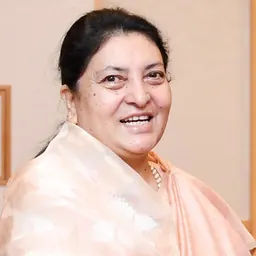
50px Nepal Ratna Man Padavi (2021) Posthumously awarded to Krishna Prasad Bhattarai by the then President of Nepal, Bidya Devi Bhandari.
Don’t just read it —
keep it.
Full-length biographies made to live with: read them, listen on the way to work, watch them tonight.
- E-book
- Audio
- Video
Instant download · yours to keep · every purchase keeps this site free
Important facts
People in Krishna Prasad Bhattarai's life
Named in this biography and alive at the same time




Related people
Same field, nearest in time




Contemporaries
People whose lives overlapped Krishna Prasad Bhattarai's


Frequently asked questions
Who was Krishna Prasad Bhattarai?
Nepalese politician (1924-2011)
When was Krishna Prasad Bhattarai born?
Krishna Prasad Bhattarai was born on 24 December 1924 in Varanasi.
When did Krishna Prasad Bhattarai die?
Krishna Prasad Bhattarai died on 4 March 2011 in Kathmandu.
What was Krishna Prasad Bhattarai's occupation?
Krishna Prasad Bhattarai was a politician and journalist.
What nationality was Krishna Prasad Bhattarai?
Krishna Prasad Bhattarai was Nepali.
Sources & further reading
· Wikipedia: Krishna Prasad Bhattarai
· DBpedia: Krishna Prasad Bhattarai
Cite this page
APA: Biography.guide. (2026). Krishna Prasad Bhattarai. https://biography.guide/krishna-prasad-bhattarai/
MLA: "Krishna Prasad Bhattarai." Biography.guide, https://biography.guide/krishna-prasad-bhattarai/.
Chicago: "Krishna Prasad Bhattarai." Biography.guide. https://biography.guide/krishna-prasad-bhattarai/.
Data last updated: 2026-09-26 · Spot an error? Report a correction.
Page generated 2026-09-27 05:16 UTC