
About Koun Ejō
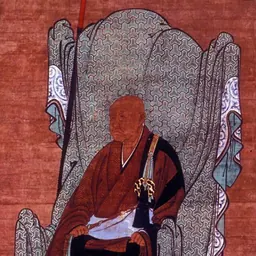
Lived 1198 – 1280 (aged 81–82). Koun Ejō was a Japanese buddhist monk.
(1198–1280) but later studied and received dharma transmission under the Sōtō schools founder Dōgen.
First encounters with Dōgen After the destruction of Kakuan's group in Tōnomine, Koun Ejō returned to Kyoto. It was during this visit in 1228 that Ejō met Dōgen at Kennin-ji, Before the construction of the new temple had been completed, the monks stayed at the temples Kippō-ji and Yamashibu. During this time, Ejō served Dōgen as before, continued a project managing the texts for what would become Dōgen's magnum opus, the Shōbōgenzō (not to be confused with the Shōbōgenzō zuimonki mentioned above), and also assisting in the planning of the new temple being constructed. In the summer of 1244 the hattō (法堂; dharma hall) of the new temple, originally called Daibutsu-ji, was completed. In June 1246, the temple name was changed to what it is still known as to this day: Eihei-ji. For these first years at the new temple, Ejō found himself taking on many of the responsibilities for the day-to-day functioning of the new temple. He simultaneously began work on Eihei kōroku (Broad Record of Eihei) and Eihei shingi (Pure Criteria of Eihei) with the help of the other students Gien and Sene.
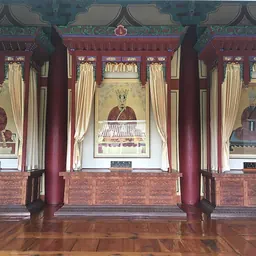
Dōgen's death and Ejō as second abbot of Eihei-ji Ejō accompanied Dōgen to Kamakura, then the capital of Japan, during a six-month visit starting in 1247 on which he taught Hōjō Tokiyori, the shōgun's regent. They returned in 1248, during which time Ejō continued his recordings of Dōgen's sermons, which increased in frequency during these years. By the fall of 1252, Dōgen had become sick. In expectation of his approaching death, in the summer of 1253 he passed Ejō's responsibilities on to Tettsū Gikai and installed Ejō as the second abbot of Eihei-ji. Dōgen left for Kyoto to seek medical assistance, but died a few days after his arrival there on 28 August, leaving Ejō as the sole leader of Eihei-ji. Ejō's first act was to have a pagoda built in Dōgen's honour.
Ejō's tenure as abbot attempted to keep things at Eihei-ji as they were. Unfortunately, he was not gifted with Dōgen's keen leadership abilities, and he had the most trouble with his former fellow students of the Darumashū, who saw him as an equal and not an authority figure. Problems also arose with the question of a successor. Dōgen had clearly considered Tettsū Gikai a preeminent disciple, which Ejō well knew. However, he disliked Gikai's desire to reintroduce aspects of Darumashū practice that Dōgen had rejected, and Dōgen himself had commented on his lack of compassion in his interactions with other monks. Nonetheless, Ejō formally made Gikai his heir in January 1256 after making him agree to uphold Dōgen's teachings above all else. After this, Ejō sent Gikai on a pilgrimage of Zen temples in Japan, which Gikai voluntarily extended to include a visit to China, whence he returned in 1262.
Start of sandai sōron and death Gikai's return marked the beginning of what is known as the sandai sōron, a schism that would split Dōgen's community into multiple competing factions. Because Gikai had an interest in architecture and had recorded temple constructions during his time in China, Ejō allowed him to take control of the ongoing building projects at Eihei-ji. In 1267, Ejō had become ill and decided to retire as abbot. He moved out of Eihei-ji to a nearby location, but continued to be considered the tōdōi, a rank for retired abbots. Two monks, Bussō and Dōson, are even said to have attained enlightenment under him during his stay outside the temple. At any rate, his health had improved within a short time of leaving Eihei-ji.
Meanwhile, Gikai was deeply unpopular at Eihei-ji. Despite his assurances to Ejō to the contrary, he attempted to reform the practices at Eihei-ji, which were generally seen by the monks as an affront to Dōgen's teachings. He focused on building projects and expansion of the physical aspects of the school while apparently ignoring Dōgen's preference for poverty. Especially unpopular was his attempt to introduce rituals from the Shingon school which Dōgen had expressly condemned. Rather than face a popular uprising, he decided to step down as abbot and Ejō was asked to return in that capacity in 1272. Ejō worked to reconcile the competing factions in the community. By 1280 he had become ill again and began to prepare for his death. He requested that no pagoda be built for him, but rather that he be buried next to Dōgen's pagoda. After he died, confusion surrounded who should next lead the community, culminating in the climax of the sandai sōron, with several of Dōgen's students, especially Gikai and Gien, claiming the right to the abbotship.
Don’t just read it —
keep it.
Full-length biographies made to live with: read them, listen on the way to work, watch them tonight.
- E-book
- Audio
- Video
Instant download · yours to keep · every purchase keeps this site free
Important facts
People in Koun Ejō's life
Named in this biography and alive at the same time
Related people
Same field, nearest in time
Contemporaries
People whose lives overlapped Koun Ejō's





Frequently asked questions
Who was Koun Ejō?
Japanese Buddhist monk
When was Koun Ejō born?
Koun Ejō was born in 1198 in Kyōto.
When did Koun Ejō die?
Koun Ejō died on 19 September 1280.
What was Koun Ejō's occupation?
Koun Ejō was a buddhist monk.
What nationality was Koun Ejō?
Koun Ejō was Japanese.
Sources & further reading
Cite this page
APA: Biography.guide. (2026). Koun Ejō. https://biography.guide/koun-ejo/
MLA: "Koun Ejō." Biography.guide, https://biography.guide/koun-ejo/.
Chicago: "Koun Ejō." Biography.guide. https://biography.guide/koun-ejo/.
Data last updated: 2026-09-20 · Spot an error? Report a correction.
Page generated 2026-09-27 05:19 UTC