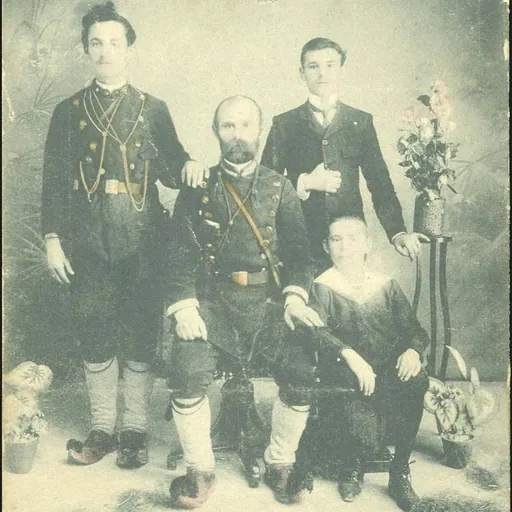
About Kottas
Lived 1863 – 1905 (aged 41–42). Kottas was a Turkish muhtar, military personnel and revolutionary.
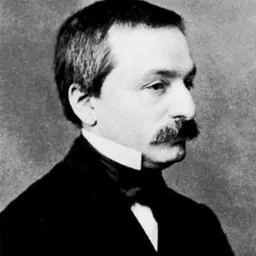
Kottas Christou or Kote Hristov (Bulgarian/Macedonian: Коте Христов), known simply as Kottas or Kote, and often referred to as Konstantinos Christou , was a Slavophone Greek revolutionary chieftain in Western Macedonia during the Macedonian Struggle.
A native of Roulia, Kottas served as its village elder and later was involved in anti-Ottoman rebel activity, killing several Ottoman officers. He was first associated with the pro-Bulgarian Internal Macedonian Revolutionary Organization (IMRO) and afterwards with the pro-Greek irregular Hellenic Macedonian Committee. He was captured by the Ottomans, convicted of robbery and hanged in Monastir in 1905.
Life His seal, in Greek, while member of the IMRO (1900). The slogan "Eleftheria i Thanatos (Freedom or Death), was the central slogan of Greek War of Independence. Kottas Christou was born in the Patriarchist village of Roulia (modern Kotas) and was an Orthodox Christian. who spoke Bulgarian His anti–Ottoman stance led to contact by the Internal Macedonian Revolutionary Organization (IMRO) The Greek bishop of Kastoria, Germanos Karavangelis played an important role in recruiting Kottas to join the Greek side after discussions with him about Bulgarian irredentism. An attack by the Ottoman army on Roulia in 1902 was resisted by Kottas, later Ottoman reinforcements made him flee and the inhabitants leave, while the village was looted.
Gotse Delchev had repeatedly pardoned and vainly tried to reform Kottas before he was finally outlawed by the IMRO, after entering the service of the Greek bishop. At the time of the Ilinden Uprising (1903), when all old wrongs were forgiven in the name of the common struggle, Kottas was received back by the IMRO at the insistence of Lazar Poptraykov, the same voivode he set out to kill. During the uprising, Poptraykov had been wounded and taken refuge with Kottas, who used the opportunity to kill him and present his head to the Greeks. The Greek bishop was wary of him because of his native Slavic tongue and hatred of Turks. His behavior toward the Ottomans was an obstruction to the Greek tactic, as it was often necessary to cooperate with the Ottoman officers against the Bulgarian enemy (IMRO).
Following the Ilinden Uprising, Kottas goes to Athens and sought Greek assistance against the Ottomans. In June 1904 Ottoman forces surrounded Roulia and conducted a search of the village.
Legacy
Kottas was married to Zoi Christou (née Sfektou), and together they had 8 children; Sofia Christou, Dimitrios Christou, Sotirios Christou, Vasiliki Christou, Christos Christou, Lazaros Christou, Paschalini Christou and Evangelos Christou. Kottas still has surviving descendants in Greece.
The village of Roulia was renamed after Kottas. His former house in the village is the Captain Kottas Museum dedicated in his honour. There is a bust of him in the village of his birth. There is a street named after him in Kastoria.
He is revered as a national hero in Greece, Kottas' objectives are not easily identifiable by contemporary historians. It seems that his chief goal was the rejection of Ottoman rule. From the beginnings of his insurgent action, without having a Greek or Bulgarian consciousness, he had formed the outlook of a Christian chieftain antagonizing Ottoman rule, whom IMRO was forced to coopt. After his distancing from the IMRO and the Exarchists -when they turned against other Christians-, his accession to the patriarchist camp and his recruitment in the Greek cause, his stance was characterized by fluidity, as he maintained relations with his former comrades, balancing between the two camps, but constantly opposed to Ottoman rule, contrary to Karavangelis.
Kottas is known for saying, "The difficult part is to kill the bear first, and then, it is easy to share the skin."
Gallery
Don’t just read it —
keep it.
Full-length biographies made to live with: read them, listen on the way to work, watch them tonight.
- E-book
- Audio
- Video
Instant download · yours to keep · every purchase keeps this site free
Important facts
People in Kottas's life
Named in this biography and alive at the same time
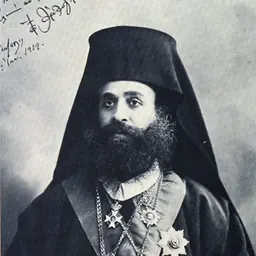
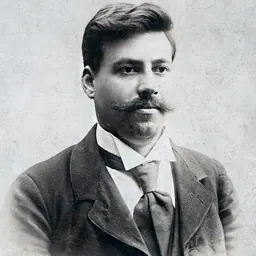
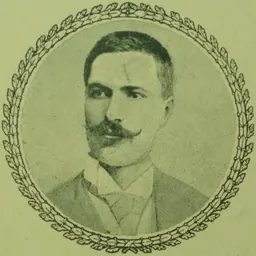
Contemporaries
People whose lives overlapped Kottas's





Frequently asked questions
Who was Kottas?
Slavophone chieftain (1863–1905)
When was Kottas born?
Kottas was born in 1863 in Kotas.
When did Kottas die?
Kottas died on 27 September 1905 in Bitola.
What was Kottas's occupation?
Kottas was a muhtar, military personnel and revolutionary.
What nationality was Kottas?
Kottas was Turkish.
Sources & further reading
Cite this page
APA: Biography.guide. (2026). Kottas. https://biography.guide/kottas/
MLA: "Kottas." Biography.guide, https://biography.guide/kottas/.
Chicago: "Kottas." Biography.guide. https://biography.guide/kottas/.
Data last updated: 2026-09-20 · Spot an error? Report a correction.
Portrait: Wikimedia Commons · author & licence
Page generated 2026-09-27 04:57 UTC