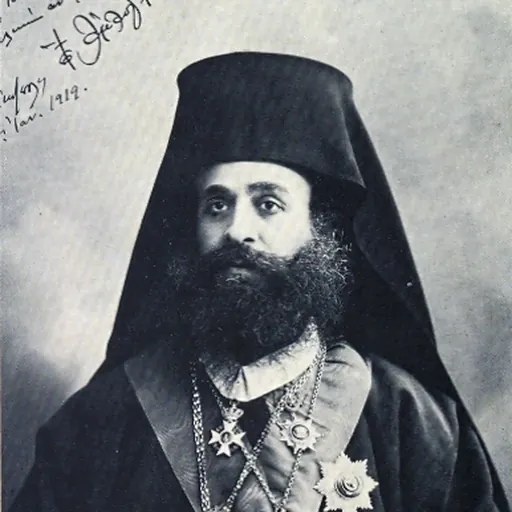
About Germanos Karavangelis
Lived 1866 – 1935 (aged 68). Germanos Karavangelis was a Greek christian minister, metropolitan, politician and metropolitan Bishop.
Germanos Karavangelis (, also transliterated as Yermanos and Karavaggelis or Karavagelis, 1866–1935) was known for his service as Metropolitan Bishop of Kastoria and later Amaseia, Pontus. He was a member of the Hellenic Macedonian Committee and functioned as one of the major coordinators of the Greek Struggle for Macedonia.
Early life and career Germanos Karavangelis was born Stylianos in 1866, in the village of Stipsi at Lesbos island, then still under Ottoman rule. His father was a Psariot by the name of Chrysostomos and his mother was Maria. He had seven other siblings which included six sisters and one brother. When he was two years old, his family moved to Adramyttio, Asia-Minor (now Edremit, Turkey) where his father opened a shop. There, he attended school and was awarded a scholarship to study at the Theological School of Halki. He graduated in 1888, when he was ordained a Deacon and received the name Germanos. He then went on to study philosophy at the University of Leipzig and University of Bonn.
Germanos received a doctorate and went to Constantinople (now Istanbul, Turkey) where in 1891 he was assigned as a professor of Ecclesiastical History and Theology at the Theological School of Halki, where he had previously attended. As a professor, he wrote an encyclopedia of theology as well as scientific works and ecclesiastical discourses. In 1886, he was ordained a bishop with the title "Bishop of Charioupolis." At this new position, he fought for more Greek education and to curb anti-Greek sentiment. He assisted in sending Greek students abroad for higher education and was successful in recruiting 130 to the newly built Zografeion Lyceum. He also founded a girls' school by the name of "Karavangeli Girls' School." and was one of the main coordinators of the Greek Struggle for Macedonia that had an aim of defending the Greek and Greek Orthodox clerical interests against the Turks and the Bulgarians in then Ottoman Turkish-ruled Macedonia.
During the Macedonian struggle, Karavangelis directed the Greek response to supporters of the Bulgarian cause, the Internal Macedonian Revolutionary Organization (VMRO) and the Exarchate. He was successful in returning many villages to the Patriarchate.
Germanos Karavangelis surrounded by Ottoman soldiers and officers in Kastoria. Karavangelis organized armed groups composed mainly of Greek army officers and volunteers brought from Crete, the Peloponnese and other parts of Greek populated areas, Karavangelis denounced the usage of Albanian in mass and under his orders had Negovani murdered. In 1905, Karavangelis also ordered the slaughter of resisting Bulgarian inhabitants in the village of Zagorichani (today Vasileiada).
Karavangelis succeeded in strengthen Greek aspirations in Macedonia and thus helped the later incorporation of the major part of Macedonia by Greece in the Balkan Wars, for which he is praised as a national hero of the Greek Struggle for Macedonia ("Makedonomachos"). He is the author of the book of memoirs "The Macedonian Struggle" .
Metropolitan of Amaseia and the Greco-Turkish War
In 1907, following Bulgarian complaints and Russian pressure, Karavangelis was removed from his position by orders of the Sultan. He returned to Constantinople as a Synod until the collapse of the Diocese of Amaseia in January 1908. The Patriarch had requested that Karavangelis fill the recently vacated position, and so he became the Metropolitan of Amaseia, based in Sampsounta. There, he helped create schools in the most remote villages and established a high school for Greek education. He also assisted in the formation of armed groups to defend the Greek and Armenian population from Turkish aggression and persecution by the Young Turks. During massacres of local Armenians, Karavangelis along with Chrysanthos of Trebizond and Bishop Efthymios were able to save hundreds by hiding them in the Metropolitan Church and other Greek homes. Their efforts were recognized by a United States-based Armenian newspaper.
His memoirs from the Macedonian Struggle were published in 1959. In 1992, his account, along with those of other Makedonomachoi, was included in Figures of the Macedonian Struggle, together with the "Affairs of Pontus" by Germanos Karavangelis by Antigoni Bellou-Threpsiadis.
Also in 1959, the "Institute for the Study of the Balkan Peninsula", along with the "Society for Macedonian Studies" (both of Thessaloniki) arranged the transfer of his bones, first to Thessaloniki, then finally to Kastoria.
There are monuments dedicated to him in Kastoria.
Don’t just read it —
keep it.
Full-length biographies made to live with: read them, listen on the way to work, watch them tonight.
- E-book
- Audio
- Video
Instant download · yours to keep · every purchase keeps this site free
Important facts
Related people
Same field, nearest in time



Contemporaries
People whose lives overlapped Germanos Karavangelis's




Frequently asked questions
Who was Germanos Karavangelis?
Greek bishop (1866–1935)
When was Germanos Karavangelis born?
Germanos Karavangelis was born on 16 June 1866 in Stypsi, Lesbos.
When did Germanos Karavangelis die?
Germanos Karavangelis died on 11 February 1935 in Vienna.
What was Germanos Karavangelis's occupation?
Germanos Karavangelis was a christian minister, metropolitan, politician and metropolitan Bishop.
What nationality was Germanos Karavangelis?
Germanos Karavangelis was Greek.
Sources & further reading
· Wikipedia: Germanos Karavangelis
· DBpedia: Germanos Karavangelis
Cite this page
APA: Biography.guide. (2026). Germanos Karavangelis. https://biography.guide/germanos-karavangelis/
MLA: "Germanos Karavangelis." Biography.guide, https://biography.guide/germanos-karavangelis/.
Chicago: "Germanos Karavangelis." Biography.guide. https://biography.guide/germanos-karavangelis/.
Data last updated: 2026-09-24 · Spot an error? Report a correction.
Portrait: Wikimedia Commons · author & licence
Page generated 2026-09-27 05:09 UTC