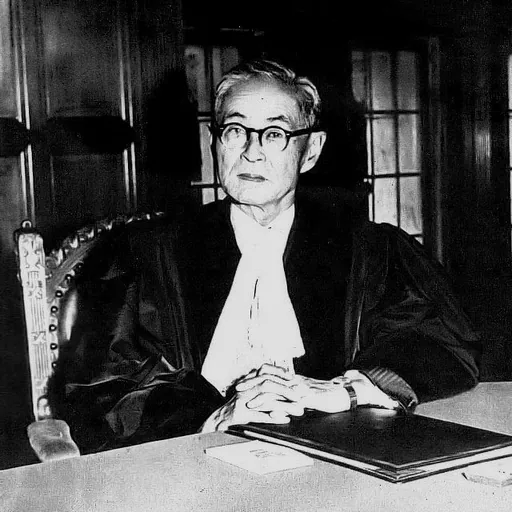
Kōtarō Tanaka
Japanese Japanese legal scholar and judge
About Kōtarō Tanaka
Lived 1890 – 1974 (aged 83). Kōtarō Tanaka was a Japanese judge, university teacher, legal counselor, politician and jurist.
Kōtarō Tanaka (; 25 October 1890 – 1 March 1974) was a Japanese jurist, professor of law and politician who served as the last Minister of Education of the Empire of Japan and the second postwar Chief Justice of Japan.
Early life Tanaka was born on 25 October 1890 in Kagoshima, the eldest son of judge Tanaka Hideo, who had been born in Takeo, Saga, in the present-day Saga Prefecture. After completing secondary school in Niigata, he completed high school in Fukuoka and went on to the Imperial Naval Academy. In 1914, he enrolled at the Faculty of Law at Tokyo Imperial University (University of Tokyo) and passed the advanced civil service examinations. He graduated the following year with honours, and was awarded a silver watch from Emperor Taisho. He then worked at the Home Ministry until 1917, when he was appointed an assistant professor at Tokyo Imperial University.
Following studies in Europe and the United States, he was promoted to full professor of commercial law at the university in 1923. The following year, he married Matsumoto Mineko, a devout Catholic who converted him to Catholicism. He was baptized in April 1926 by Fr. William Hoffman, the first president of Sophia University. Subsequently, Tanaka endeavoured to discover positive meanings in national laws, which until then had been regarded as a necessary evil, also working on a "theory of world law." He received his Juris Doctor in 1929 and became dean of the Faculty of Law at Tokyo Imperial University. In 1941, he was elected as an imperial academician (predecessor to the Japan Academy).
In the final months of World War II, Tanaka joined a group of Japanese intellectuals that sought peace with the Allies in opposition to Japan's militarist government.
Parliamentarian In October 1945, Tanaka became the Director of Education in the Ministry of Education, and joined the first Yoshida cabinet the following May as the last Minister of Education of the Empire of Japan. He was appointed to the House of Peers in June of same year, shortly before its abolition. In 1947, he stood for election to the House of Councillors and won. Among the signatories of the new Japanese Constitution, he was instrumental in drafting the Basic Education Law.
Chief Justice of Japan After resigning his seat in 1950, Tanaka was appointed Chief Justice of Japan, serving until 1960. He was the first Christian to hold this position, and drew upon his international legal training to interpret the new Japanese Constitution. In 1950, during the first year of his term, he led a Japanese judicial delegation that visited the United States Supreme Court and the New York Court of Appeals. The Tokyo District Court upheld the Supreme Court's decision in 2016, refusing to allow a retrial.
Tanaka wrote the 1957 Supreme Court decision that banned the book Lady Chatterley's Lover in Japan on the basis that it offended public standards of decency.
Tanaka is today most remembered for his dissenting opinion in 1966 regarding the South West Africa cases, in which he supported the applicants' argument (rejected by the broader Court) that international legal norms prohibited the South African practice of apartheid. Tanaka concluded that UN member states had "the legal obligation to respect human rights and fundamental freedoms." Writing in 1996, A.P. Vijapur described Tanaka's dissenting opinion as "probably the best exposition of the concept of equality in existing literature."
Later life and death Tanaka died in 1974 at St. Mary's Hospital in Tokyo, aged 83.
Honours Japanese Order of Culture (3 November 1960) Grand Cordon of the Order of the Rising Sun (29 April 1964) Grand Cordon of the Order of the Rising Sun with Paulownia Flowers (29 April 1970) Grand Cordon of the Order of the Chrysanthemum (3 March 1974; posthumous)
Order of precedence Senior second rank (3 March 1974; posthumous)
Foreign honours Italian Order of Merit for Culture and Art (1958) Grand Cross of Merit of the Order of the Federal Republic of Germany (1960)
Don’t just read it —
keep it.
Full-length biographies made to live with: read them, listen on the way to work, watch them tonight.
- E-book
- Audio
- Video
Instant download · yours to keep · every purchase keeps this site free
Important facts
People in Kōtarō Tanaka's life
Named in this biography and alive at the same time


Related people
Same field, nearest in time


Contemporaries
People whose lives overlapped Kōtarō Tanaka's





Frequently asked questions
Who was Kōtarō Tanaka?
Japanese Japanese legal scholar and judge (1890–1974)
When was Kōtarō Tanaka born?
Kōtarō Tanaka was born on 25 October 1890 in Kagoshima.
When did Kōtarō Tanaka die?
Kōtarō Tanaka died on 1 March 1974 in Tokyo.
What was Kōtarō Tanaka's occupation?
Kōtarō Tanaka was a judge, university teacher, legal counselor, politician and jurist.
What nationality was Kōtarō Tanaka?
Kōtarō Tanaka was Japanese.
Sources & further reading
· DBpedia: Kōtarō Tanaka (judge)
Cite this page
APA: Biography.guide. (2026). Kōtarō Tanaka. https://biography.guide/kotaro-tanaka/
MLA: "Kōtarō Tanaka." Biography.guide, https://biography.guide/kotaro-tanaka/.
Chicago: "Kōtarō Tanaka." Biography.guide. https://biography.guide/kotaro-tanaka/.
Data last updated: 2026-09-21 · Spot an error? Report a correction.
Portrait: Wikimedia Commons · author & licence
Page generated 2026-09-27 04:58 UTC