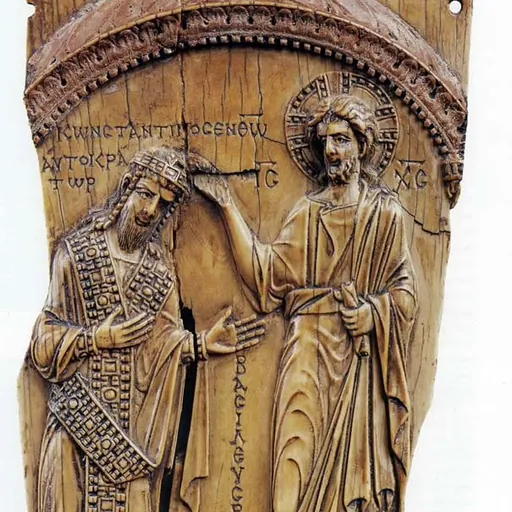
About Konstantinos VII
Lived 905 – 959 (aged 54). Konstantinos VII was a Byzantine writer and historian.
Constantine VII Porphyrogenitus (; 17 May 905 – 9 November 959) was the fourth Byzantine emperor of the Macedonian dynasty, reigning from 6 June 913 to 9 November 959. He was the son of Emperor Leo VI and his fourth wife, Zoe Karbonopsina, and the nephew of his predecessor Alexander.
Most of his reign was dominated by co-regents: from 913 until 919 he was under the regency of his mother, while from 920 until 945 he shared the throne with Romanos Lekapenos, whose daughter Helena he married, and his sons. Constantine VII is best known for the Geoponika (τά γεωπονικά), an important agronomic treatise compiled during his reign, and three, perhaps four, books; (bearing in Greek the heading Πρὸς τὸν ἴδιον υἱὸν Ῥωμανόν), (Περὶ τῆς Βασιλείου Τάξεως), De Thematibus (Περὶ θεμάτων Άνατολῆς καὶ Δύσεως), and Vita Basilii (Βίος Βασιλείου), though his authorship of the Vita Basilii is not certain.
The epithet porphyrogenitus alludes to the Purple chamber of the imperial palace, decorated with porphyry, where legitimate children of reigning emperors were normally born. Constantine was also born in this room, although his mother Zoe had not been married to Leo at that time. Nevertheless, the epithet allowed him to underline his position as the legitimate son, as opposed to all others who claimed the throne during his lifetime. Sons born to a reigning Emperor held precedence in the Eastern Roman line of succession over elder sons not born "in the purple".
Life Regency Constantine was born in Constantinople on 17/18 May 905, an illegitimate son of Leo VI before an uncanonical fourth marriage. To help legitimize him, his mother gave birth to him in the Purple Room of the imperial palace, hence his nickname Porphyrogennetos. He was elevated to the throne as a two-year-old child by his father and uncle on 15 May 908 (Whitsunday).
In early 913, as his uncle Alexander lay dying, he appointed a seven-man regency council for Constantine. It was headed by the Patriarch Nicholas Mystikos, the two magistroi John Eladas and Stephen, the rhaiktor John Lazanes, the otherwise obscure Euthymius and Alexander's henchmen Basilitzes and Gabrielopoulos. Following Alexander's death (6 June), the new and shaky regime survived the attempted usurpation of Constantine Doukas, and Patriarch Nicholas Mystikos quickly assumed a dominant position among the regents.
Patriarch Nicholas was presently forced to make peace with Tsar Simeon of Bulgaria, whom he reluctantly recognized as Bulgarian emperor. Because of this unpopular concession, Patriarch Nicholas was driven out of the regency by Constantine's mother Zoe. She was no more successful with the Bulgarians, who defeated her main supporter, the general Leo Phokas, in 917.
In March 919, she was replaced as regent by the admiral Romanos Lekapenos, who married his daughter Helena Lekapene to Constantine. Romanos used his position to advance to the ranks of basileopatōr in April 919, to kaisar (Caesar) on 24 September 920, and finally to co-emperor on 17 December 920. Romanos spent the last years of his life in exile on the Island of Prote as a monk and died on 15 June 948. Several months later, on 6 April (Easter), Constantine VII crowned his own son Romanos II co-emperor. It was rumored that he had been poisoned by his son or his daughter-in-law Theophano.
Madrid Skylitzes' depictions of Constantine
Literary activity
Constantine VII was recognized as a writer and scholar, surrounding himself with educated people of the Imperial Court. He wrote, or had commissioned, the works Geoponika ("On Agriculture", in Greek Τὰ γεωπονικά), a compilation of agronomic works from earlier Greek and Punic texts that are otherwise lost; ("On Ceremonies", in Greek, Περὶ τῆς βασιλείου τάξεως), describing the kinds of court ceremonies (also described later in a more negative light by Liutprand of Cremona); ("On the Administration of the Empire", bearing in Greek the heading Πρὸς τὸν ἴδιον ὑιὸν Ρωμανόν), giving advice on running the Empire internally and on fighting external enemies; a history of the Empire covering events following the death of the chronographer Theophanes the Confessor in 817; and Excerpta Historica ("Excerpts from the Histories"), a collection of excerpts from ancient historians (many of whose works are now lost) in four volumes (1. De legationibus. 2. De virtutibus et vitiis. 3. De insidiis. 4. De sententiis). In The Manuscript Tradition of Polybius, John Michael Moore (CUP, 1965) provides a useful summary of the commission by Porphyrogenitus of the Constantine Excerpts: He felt that the historical studies were being seriously neglected, mainly because of the bulk of the histories. He therefore decided that a selection under fifty-three titles should be made from all the important historians extant in Constantinople; thus he hoped to assemble in a more manageable compass the most valuable parts of each author. ... Of the fifty-three titles into which the excerpts were divided, only six have survived: de Virtutibus et Vitiis; de Sententiis; de Insidiis; de Strategematis; de Legationibus Gentium ad Romanos; de Legationibus Romanorum ad Gentes. The titles of only about half the remaining forty-seven sections are known.
Also amongst his historical works is a history eulogizing the reign and achievements of his grandfather, Basil I (Vita Basilii, Βίος Βασιλείου). These books are a source of information about nations neighbouring the Empire as well as into the Emperor himself.
In his book, A Short History of Byzantium, John Julius Norwich refers to Constantine VII as "The Scholar Emperor". Norwich describes Constantine: He was, we are told, a passionate collector—not only of books and manuscripts but works of art of every kind; more remarkable still for a man of his class, he seems to have been an excellent painter. He was the most generous of patrons—to writers and scholars, artists and craftsmen. Finally, he was an excellent Emperor: a competent, conscientious and hard-working administrator and an inspired picker of men, whose appointments to military, naval, ecclesiastical, civil and academic posts were both imaginative and successful. He did much to develop higher education and took a special interest in the administration of justice.
Family By his wife Helena Lekapene, the daughter of Emperor Romanos I, Constantine VII had several children: Leo ( 939–944), who died young. Romanos II (939–963), who succeeded as emperor. Zoe, sent to a convent. Theodora, who married emperor John I Tzimiskes. Agatha, sent to a convent. Theophano, sent to a convent. Anna, sent to a convent.
Legacy Constantine VII is still remembered in the Eastern Orthodox liturgy when the transfer of the Holy Mandylion is celebrated on 16 August in the Julian calendar which corresponds to 31 August in the Gregorian calendar. This feast is part of the Nut Feast of the Saviour for Slavs.
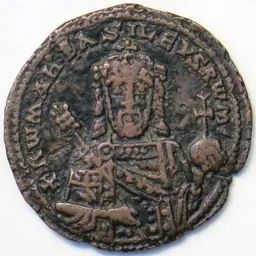
Solidi
Don’t just read it —
keep it.
Full-length biographies made to live with: read them, listen on the way to work, watch them tonight.
- E-book
- Audio
- Video
Instant download · yours to keep · every purchase keeps this site free
Important facts
Family & relationships
People in Konstantinos VII's life
Named in this biography and alive at the same time


Related people
Same field, nearest in time

Contemporaries
People whose lives overlapped Konstantinos VII's


Frequently asked questions
Who was Konstantinos VII?
Byzantine emperor
When was Konstantinos VII born?
Konstantinos VII was born on 18 May 905 in Constantinople.
When did Konstantinos VII die?
Konstantinos VII died on 9 November 959 in Constantinople.
What was Konstantinos VII's occupation?
Konstantinos VII was a writer and historian.
What nationality was Konstantinos VII?
Konstantinos VII was Byzantine.
Sources & further reading
Cite this page
APA: Biography.guide. (2026). Konstantinos VII. https://biography.guide/konstantinos-vii/
MLA: "Konstantinos VII." Biography.guide, https://biography.guide/konstantinos-vii/.
Chicago: "Konstantinos VII." Biography.guide. https://biography.guide/konstantinos-vii/.
Data last updated: 2026-09-23 · Spot an error? Report a correction.
Portrait: Wikimedia Commons · author & licence
Page generated 2026-09-27 05:05 UTC