
About Alexander
Lived 872 – 913 (aged 40). Alexander was a Byzantine sovereign.
Alexander (, 23 November 8706 June 913) was briefly Byzantine emperor from 912 to 913, and the third emperor of the Macedonian dynasty.
Life Born in the purple, Alexander was the third son of Emperor Basil I and Eudokia Ingerina. Unlike his older brother Leo VI the Wise, his paternity was not disputed between Basil I and Michael III because he was born years after Michael's death. As a child, Alexander was crowned as co-emperor by his father in early 879, following the death of Basil's son Constantine.
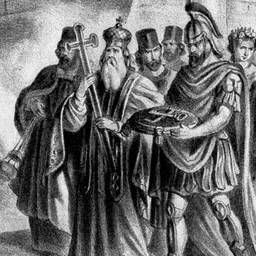
Upon the death of his brother Leo on 11 May 912, Alexander succeeded as senior emperor alongside Leo's young son Constantine VII. He was the first Byzantine emperor to use the term "autocrator" on coinage to celebrate the ending of his thirty-three years as co-emperor. Alexander promptly dismissed most of Leo's advisers and appointees, including the admiral Himerios, the patriarch Euthymios, and the empress Zoe Karbonopsina, the mother of Constantine VII, whom he locked up in a nunnery. The patriarchate was again conferred on Nicholas Mystikos, who had been removed from this position due to his opposition to Leo's fourth marriage. Emperor Alexander rebuffs the Bulgarian envoys, refusing to pay tribute. During his short reign, Alexander found himself attacked by the forces of Al-Muqtadir of the Abbasid Caliphate in the east, and provoked a war with Simeon I of Bulgaria by refusing to send the traditional tribute on his accession. Alexander died soon after, allegedly from a stomach disease caused by excessive eating and alcohol. On his deathbed, Alexander finally concedes power to his nephew Constantine VII. The sources are uniformly hostile towards Alexander, who is depicted as lazy, lecherous, drunk, and malignant; they also accuse him of idolatry, including making pagan sacrifices to the golden statue of a boar in the Hippodrome, and providing it with new teeth and genitals, in hope of curing his impotence. It was his rumored intention to castrate the young Constantine VII in order to exclude him from the succession. This did not happen, but Alexander did leave Constantine a hostile regent (Nicholas Mystikos) and the beginning of a long war against Bulgaria.
Don’t just read it —
keep it.
Full-length biographies made to live with: read them, listen on the way to work, watch them tonight.
- E-book
- Audio
- Video
Instant download · yours to keep · every purchase keeps this site free
Important facts
Family & relationships
People in Alexander's life
Named in this biography and alive at the same time


Related people
Same field, nearest in time


Contemporaries
People whose lives overlapped Alexander's

Frequently asked questions
Who was Alexander?
Byzantine emperor from 912 to 913
When was Alexander born?
Alexander was born on 23 November 872 in Constantinople.
When did Alexander die?
Alexander died on 6 June 913 in Constantinople.
What was Alexander's occupation?
Alexander was a sovereign.
What nationality was Alexander?
Alexander was Byzantine.
Sources & further reading
· DBpedia: Alexander (Byzantine emperor)
Cite this page
APA: Biography.guide. (2026). Alexander. https://biography.guide/alexander/
MLA: "Alexander." Biography.guide, https://biography.guide/alexander/.
Chicago: "Alexander." Biography.guide. https://biography.guide/alexander/.
Data last updated: 2026-09-20 · Spot an error? Report a correction.
Page generated 2026-09-27 05:25 UTC