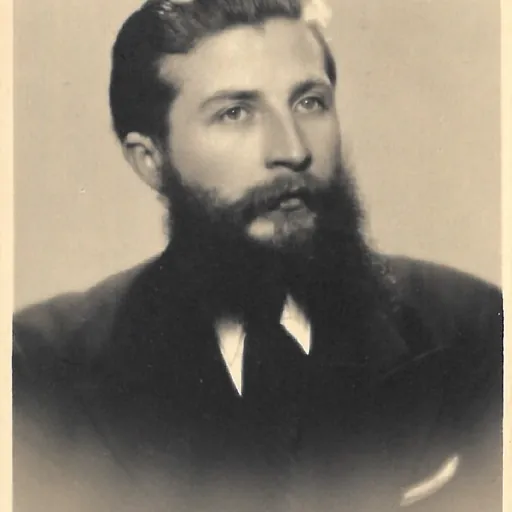
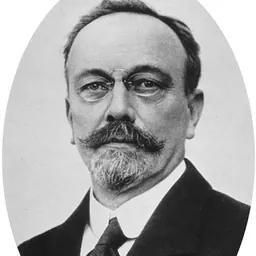
Konstantin Anisimovich Pavlov
Latvian-born iconographer and restorer
About Konstantin Anisimovich Pavlov
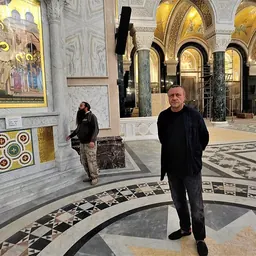
Lived 1907 – 1976 (aged 68). Konstantin Anisimovich Pavlov was a Russian iconographer and restorer.
Konstantin Anisimovich Pavlov (Russian: Константин Анисимович Павлов, Latvian: Konstantīns Pavlovs) (May 27, 1907, Jēkabpils, Russian Empire – January 25, 1976, Riga, Latvian SSR) was a Latvian-born iconographer and restorer.
He was one of the founders of the first icon-painting workshop and a member of the Grebenshchikov House of Prayer in Riga, the world's largest Old Believer church. Pavlov was also a founding member of the study group "Circle of Devotees of Russian Antiquity", After serving in the Latvian army, in 1930, Pavlov became a permanent singer at the Grebenstchikov House of Prayer, as well as one of the first members of the study group "Circle of Devotees of Russian Antiquity", established in 1927, in which he actively participated.thumb
Icon painting workshop, artistic style and philosophy At the initiative of the members of the study group, in 1928, an icon-painting workshop was established at the Grebenstchikov House of Prayer. The iconographers in the workshop aimed to preserve the ancient Russian traditions of icon painting, viewing the icons as a source of spiritual revival. The workshop worked in two directions: the restoration of ancient monuments and the study and revival of ancient iconographic traditions.
From 1928 to 1930, the workshop's artists studied under the prominent iconographer Pimen Maximovich Sofronov
In 1933, he restored icons at the Voitishskaya Old Believer Church. In 1935-1936, he worked on restoring the iconostasis at the Old Believer chapel of the Assumption of the Blessed Virgin in Jelgava,
Master of Arts, Victoria Alexandrovna, on Konstantin Anisimovich's iconography: "K. Pavlov... did not aim to paint saints to emphasize their earthly, bodily beauty. But following the traditions of ancient icon painting, he sought to depict the faces of saints so that the one praying could approach an understanding of the Divine and see the beauty of Heaven, the beauty of the image of God. It is also worth noting that, in accordance with the Pomor tradition of icon painting, Pavlov painted faces with 'moderate delicacy,' i.e., in the depiction of saints, he avoided excessive, intrusive asceticism, as well as the puffiness and corpulence that Protopope Avvakum noticed in icons painted in imitation of Western painting of the 17th century. Often, Pavlov's style also had a graphic character: the lines were clear, straight, dry, sometimes harsh. But Pavlov always painted strictly within the framework of the canon and iconography developed by Byzantine and ancient Russian iconographers (before the 17th century)".
In the 1930s, Pavlov was involved in teaching and educational activities, giving lectures as part of the program of the study group "Circle of Devotees of Russian Antiquity" and delivered two courses of lectures – "Basic Concepts of Faith" and "The History of Iconography" in a Sunday school for both children and adults at Grebenstchikov.
Marriage and children In September 1938, Pavlov married Ludmila Trifonova (1920, Riga, Latvia - 1988, Plainfield, New Jersey), the youngest daughter of a well-known wealthy Riga landlord and former chairman of the Grebenstchikov House of Prayer Council, Ananij Yerofeyevich Trifonov (1851–1937) (Russian: Ананий Ерофеевич Трифонов).
The couple had two sons: Daniel Carl Pavlov (Russian: Даниил Константинович Павлов) (December 16, 1940, Riga, Latvia - November 10, 2010, New Paris, Pennsylvania) and Vladimir Pavlov (1943, Riga, Latvia - 1950, Augsburg, Germany)
Soviet and Nazi occupations separated the family forever; Ludmila, along with her two young sons, her mother Anna Leontjevna Paija (née Terentjeva) (1895, Riga, Russian Empire - 1962, Plainfield, New Jersey, Hollywood Cemetery) and her stepfather, Voldemars Paija (1889 - 1976, Plainfield, New Jersey) fled to Germany in 1943 before the second Soviet occupation of Latvia. After the death of her younger son Vladimir, on January 20, 1950, in Augsburg, the family boarded the transport ship USS General R.M. Blatchford on October 13, 1950, and arrived at Ellis Island, New York, on October 24, 1950. Ludmila and Daniel later arrived at the train station in Summit, New Jersey, where they were welcomed and assisted by a group of volunteers from the Daughters of the American Revolution.
Life after war 1943 - 1976 To avoid being drafted into the Latvian legion, Pavlov worked as a draftsman at the railway administration. However, this did not help. He could not escape conscription. After Germany's surrender, the Soviet authorities exiled Pavlov to the Vorkuta Gulag. Fortunately, his medical knowledge proved useful, and he was able to become a feldsher (medical assistant) in the camp. Having practically never fought against the Soviets and never held a weapon, he was soon released in 1947.
Pavlov returned to his native Grebenstchikov community, deeply troubled by the lack of news from his family. He received no letters from his wife. When he asked for the return of at least one son, his wife refused, claiming he had allegedly died. He later learned that his wife and sons had permanently moved to the United States. Pavlov subsequently became lonely, paranoid, and pervaded by a sense of doom. (From the memories of Maria Timofeevna Yanson (Emelyanova), a member of the Riga "Circle of Devotees of Russian Antiquity" and a former classmate of Ludmila Trifonova at the Lomonosov Gymnasium).
In 1950, Pavlov returned to the Grebenstchikov community as a canonarch. He did not abandon icon painting but painted very little. In 1958, during the interior renovation of the Assumption Church of the community, Pavlov painted the image of the Lord Almighty on the ceiling of the church and the image of the Blessed Virgin Mary in the church vestibule.
The icons of Pavlov are highly valued by Latvian Old Believers, but much of the iconographer's legacy has been irretrievably lost. In 1992, the church of the Voitish community burned down. The iconostasis of the Tiskadi church was completely looted.
However, preserving what remains is the duty of today's Old Believers, so that the memory of a successor to the iconographers Gavriil Frolov and Pimen Sofronov, a devoted servant of Christ's Church, is not forgotten.
Don’t just read it —
keep it.
Full-length biographies made to live with: read them, listen on the way to work, watch them tonight.
- E-book
- Audio
- Video
Instant download · yours to keep · every purchase keeps this site free
Important facts
People in Konstantin Anisimovich Pavlov's life
Named in this biography and alive at the same time

Related people
Same field, nearest in time

Contemporaries
People whose lives overlapped Konstantin Anisimovich Pavlov's


Frequently asked questions
Who was Konstantin Anisimovich Pavlov?
Latvian-born iconographer and restorer (1907 - 1976)
When was Konstantin Anisimovich Pavlov born?
Konstantin Anisimovich Pavlov was born on 27 May 1907 in Jēkabpils.
When did Konstantin Anisimovich Pavlov die?
Konstantin Anisimovich Pavlov died on 25 January 1976 in Riga.
What was Konstantin Anisimovich Pavlov's occupation?
Konstantin Anisimovich Pavlov was an iconographer and restorer.
What nationality was Konstantin Anisimovich Pavlov?
Konstantin Anisimovich Pavlov was Russian.
Sources & further reading
· Wikipedia: Konstantin Anisimovich Pavlov
· DBpedia: Konstantin Anisimovich Pavlov
Cite this page
APA: Biography.guide. (2026). Konstantin Anisimovich Pavlov. https://biography.guide/konstantin-anisimovich-pavlov/
MLA: "Konstantin Anisimovich Pavlov." Biography.guide, https://biography.guide/konstantin-anisimovich-pavlov/.
Chicago: "Konstantin Anisimovich Pavlov." Biography.guide. https://biography.guide/konstantin-anisimovich-pavlov/.
Data last updated: 2026-09-21 · Spot an error? Report a correction.
Portrait: Wikimedia Commons · author & licence
Page generated 2026-09-27 04:58 UTC