
Konrad Püschel
German architect, town planner and university professor. Bauhaus student
About Konrad Püschel
Lived 1907 – 1997 (aged 89). Konrad Püschel was a German architect, known for Bauhaus Dessau building.
Friedrich Konrad Püschel (12 April 1907 – 20 January 1997) was a German architect, town planner and university professor who was educated at the Bauhaus design school. He worked in East Germany, the Soviet Union and North Korea.
Early life Konrad Püschel was born on 12 April 1907 in Wernsdorf, a village near Glauchau in the eastern state of Saxony. His father, Urban Richard Püschel, the village pastor, had studied at Leipzig University but was from a working-class background of miners, foresters, and farmers. Püschel had four brothers; Gottfried, Martin, Walter, and Georg. The three elder brothers served in World War I; Martin was killed in October 1914, aged 20. Walter, who was severely injured in the war, died in 1920.
The family finances were badly affected by hyperinflation in the Weimar Republic, so at 16 Püschel began an apprenticeship with a master carpenter in a firm in Glauchau in May 1923, which he completed in April 1926. There he learned a wide range of woodworking, furniture-making, and building skills, including reading the detailed architectural plans and drawings from which he had to work.
In 1929, also under the direction of Meyer, he did an internship at the ADGB Trade Union School building site in Bernau bei Berlin, which had the social-egalitarian aims of bringing students into contact with the building site workers and giving them experience with the practical aspects of building. "Meyer's was a holistic approach to architecture, making no distinction between masters and students, or site managers and skilled tradesmen."
Püschel received his Bauhaus Diploma, Diploma number 21, from Mies van der Rohe on 15 October 1930.
Seven former Bauhaus students, including Püschel, all of whom had studied architecture under Meyer, went to Moscow to join him. The group was informally known as the "Red Bauhaus Brigade" , or the "Brigade Rot Front".
Other foreign architects and planners were brought to the Soviet Union around this time, as the government was about to reach the end of its First Five-Year Plan in 1932, the aim of which was to transform the Soviet Union from an agriculture state to an industrial powerhouse. Up to 800 Germans then worked in the Soviet Union's building industry. The architect Ernst May was also working in Moscow leading a group of young European architects. He returned to Germany for a holiday in 1932, where he met up with his future wife Lieselotte, known as "Lilo", whom he had known since his days as a student. He returned to Moscow alone, but she joined him in December 1932, and they married in Moscow on 12 December 1933.
In May 1940, he was conscripted into the Wehrmacht and, after his training, was sent to North Africa and Italy. He had leave to return home in 1943, which resulted in the birth of his second daughter, Maria, in February 1944. In July 1944 he was sent to the Eastern Front in Poland. He was wounded in January 1945, captured by the Soviets and held as a German prisoner of war until December 1947.
Püschel was seconded from his job at the university to work on these projects from 1955 to 1959. He was accompanied by a group of about 175 members of the DAG. From 1955 to 1956, he was the head of city planning for the , and from 1956 to 1959, he worked on the sister project in Hŭngnam. In 1957, he was awarded the Order of Korean Labour for his work. On 2 December 1976, 50 years after it first opened, the building was officially reopened for use as a science and culture centre, which included an exhibition of items from the Bauhaus, including some of Püschel's own student work.
Püschel went to considerable trouble to contact all known living former Bauhaus students and staff (Bauhäusler) to invite them to the reopening of the restored building to which 18 of them came.
Death Püschel died in Weimar on 20 January 1997, at 89.
Legacy Lilo and Konrad Püschel, left, in the Haus am Horn, 26 Sept 1973, 50th jubilee of the Bauhaus "Werkschau" exhibition. Püschel bequeathed 1,700 items comprising architectural drawings, studies, photographs, and correspondence to the Bauhaus Dessau Foundation, which are held in its archives. The collection provides a significant record of the training given at the Bauhaus and on the specific classes and workshops that he attended. The collection also sheds light on the activities of Hannes Meyer's "Red Bauhaus Brigade" in the Soviet Union and of former Bauhaus students' careers in East Germany and North Korea.
He wrote an autobiography, Wege eines Bauhäuslers (Paths of a Bauhaus student), published in 1997 shortly after his death, that describes in some detail study and social life at the Bauhaus, the work of the 'Red Bauhaus Brigade' in Moscow, life as a soldier in the Wehrmacht and as a prisoner of war in the hands of the Red Army, the work of the Deutsche Arbeitsgruppe in 1950s North Korea, and the 1970s restoration of the Bauhaus Dessau building.
Exhibitions Ausstellung Konrad Püschel – Studienarbeiten am Bauhaus Dessau 1926–1930, Wissenschaftlich-kulturelles Zentrum Bauhaus Dessau vom 20.6.1981 bis 30.8.1981. This was an exhibition of Püschel's student work at the Bauhaus Examples of Püschel's student work were included in the MoMA exhibition Bauhaus 1919–1933: Workshops for Modernity, November 8, 2009 – January 25, 2010. bauhaus imaginista. Moving Away: The Internationalist Architect – Garage Museum of Contemporary Art, Moscow (12 September – 30 November 2018)
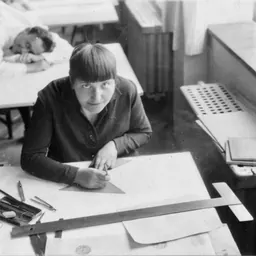
The Moving Away exhibition focused on students who were connected to the 'Red Bauhaus Brigade' with Hannes Meyer in the Soviet Union in the 1930s: architect and town planner Konrad Püschel; architect Philipp Tolziner, who spent the rest of his life in Moscow; and architect Lotte Stam-Beese, who was the first woman to study in the building department of the Bauhaus.
Don’t just read it —
keep it.
Full-length biographies made to live with: read them, listen on the way to work, watch them tonight.
- E-book
- Audio
- Video
Instant download · yours to keep · every purchase keeps this site free
Important facts
People in Konrad Püschel's life
Named in this biography and alive at the same time


Related people
Same field, nearest in time
Contemporaries
People whose lives overlapped Konrad Püschel's


Frequently asked questions
Who was Konrad Püschel?
German architect, town planner and university professor. Bauhaus student
When was Konrad Püschel born?
Konrad Püschel was born on 12 April 1907 in Wernsdorf.
When did Konrad Püschel die?
Konrad Püschel died on 20 January 1997 in Weimar.
What was Konrad Püschel's occupation?
Konrad Püschel was an architect.
What was Konrad Püschel known for?
Konrad Püschel was known for Bauhaus Dessau building.
What nationality was Konrad Püschel?
Konrad Püschel was German.
Sources & further reading
Cite this page
APA: Biography.guide. (2026). Konrad Püschel. https://biography.guide/konrad-puschel/
MLA: "Konrad Püschel." Biography.guide, https://biography.guide/konrad-puschel/.
Chicago: "Konrad Püschel." Biography.guide. https://biography.guide/konrad-puschel/.
Data last updated: 2026-09-22 · Spot an error? Report a correction.
Page generated 2026-09-27 05:09 UTC