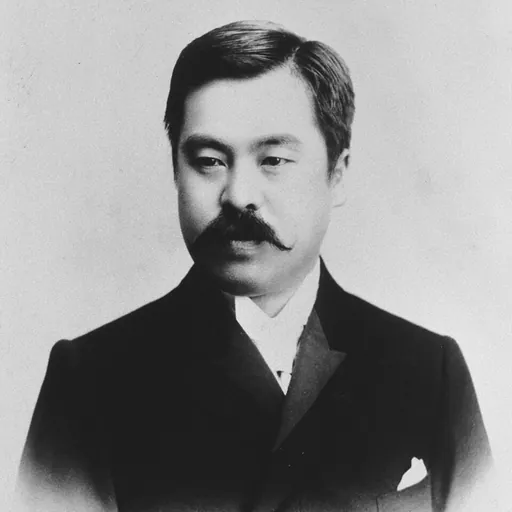
About Konoe Atsumaro
Lived 1863 – 1904 (aged 40). Konoe Atsumaro was a Japanese politician.
Prince was a Japanese politician and journalist of the Meiji era. He served as the 3rd President of the House of Peers and 7th President of the Gakushūin Peer's School in Meiji period Japan. He was the father of Prime Minister Fumimaro Konoe and the great-grandfather of Prime Minister Morihiro Hosokawa.
Political career After the Meiji Restoration, the Konoe family were devolved from the ranks of the nobility and given the peerage title of Prince or Duke (koshaku) under the new kazoku peerage system. From 1885 to 1890, Konoe visited Europe, attending the University of Bonn and University of Leipzig in Germany. After returning to Japan, he became a member of the House of Peers and in 1895 became president of Gakushuin Peer's School.
Later Konoe served as the 3rd President of the House of Peers, presiding over its 10th through 18th sessions from 3 October 1896 to 4 December 1903. From 1903 he concurrently served as a Privy Councillor.
Domestically, Konoe was a strong critic of clan-based politics, which continued to dominate the political scene in Japan. In terms of foreign policy, Konoe was a central figure in the Pan-Asian movement. He established a Pan-Asian political movement called the which promoted mutual understanding and improvement in relations between Japan and China after the First Sino-Japanese War. The society opened a college in Nanjing called the in 1900, which was relocated to Shanghai in 1901. The college recruited students from Japan wishing to learn the Chinese language and Chinese culture, and sponsored a school in Tokyo for Chinese students seeking higher education in Japan (its successor institution being that of ). The society also published a scholarly journal and an 11,000-page report, entitled A Comprehensive Book on the Economics Conditions in China. Graduates of both schools were highly sought after by the Japanese military, Japanese secret intelligence services and ultranationalist organizations for their language skills and in-depth knowledge of China. Many of its graduates later worked for the government of Manchukuo in the 1930s.
In August 1903, Konoe established the which pushed for a hard-line foreign policy towards the Russian Empire, which it perceived as a threat to the independence of China, Korea, and Japan. Konoe personally urged that Japan declare war on Russia, but died before the start of the Russo-Japanese War in late 1904.
His grave is at the Konoe family cemetery at Daitoku-ji in Kyoto.
Don’t just read it —
keep it.
Full-length biographies made to live with: read them, listen on the way to work, watch them tonight.
- E-book
- Audio
- Video
Instant download · yours to keep · every purchase keeps this site free
Important facts
People in Konoe Atsumaro's life
Named in this biography and alive at the same time

Related people
Same field, nearest in time




Contemporaries
People whose lives overlapped Konoe Atsumaro's



Frequently asked questions
Who was Konoe Atsumaro?
Japanese politician (1863-1904)
When was Konoe Atsumaro born?
Konoe Atsumaro was born on 10 August 1863 in Kyoto.
When did Konoe Atsumaro die?
Konoe Atsumaro died on 1 January 1904 in Tokyo.
What was Konoe Atsumaro's occupation?
Konoe Atsumaro was a politician.
What nationality was Konoe Atsumaro?
Konoe Atsumaro was Japanese.
Sources & further reading
Cite this page
APA: Biography.guide. (2026). Konoe Atsumaro. https://biography.guide/konoe-atsumaro/
MLA: "Konoe Atsumaro." Biography.guide, https://biography.guide/konoe-atsumaro/.
Chicago: "Konoe Atsumaro." Biography.guide. https://biography.guide/konoe-atsumaro/.
Data last updated: 2026-09-22 · Spot an error? Report a correction.
Portrait: Wikimedia Commons · author & licence
Page generated 2026-09-27 05:02 UTC