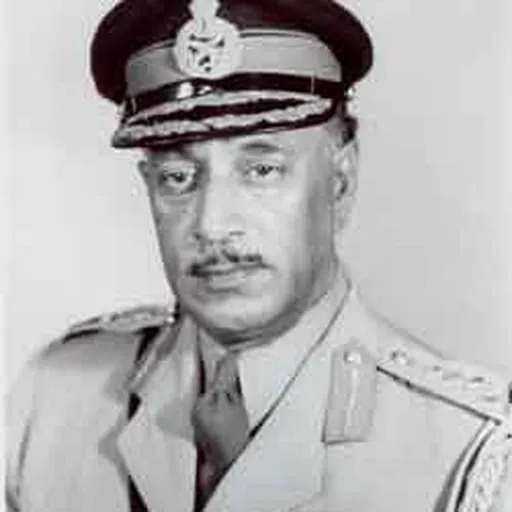
About Kodendera Subayya Thimayya
Lived 1906 – 1965 (aged 59). Kodendera Subayya Thimayya was a British military personnel.
Early life and education Kodandera Subayya Thimayya was born in Madikeri, the district town of Kodagu (formerly known as Coorg), Karnataka, on 31 March 1906, to Subayya and Sitamma into a Kodava family. Thimayya was subsequently attached to the Highland Light Infantry as was the norm then, prior to a permanent posting with a regiment of the British Indian Army. He was soon posted to the 4th Battalion of the 19th Hyderabad Regiment (now Kumaon Regiment), with date from 28 May 1927. Appointed the regimental adjutant in September 1930, Thimayya honed his soldiering skills on that famous training ground in the Northwest Frontier (present-day Pakistan), battling recalcitrant Pathan tribals.
In January 1935, Thimayya married Nina Cariappa (no relation to K M Cariappa). On 20 March 1936, they had a daughter, Mireille. The same April, Thimayya was posted as an Adjutant at the University Training Corps in Madras.
Second World War After this tenure, Thimayya was posted to his battalion in Singapore. In early 1941, he was promoted to the acting rank of Major, and at his request, was transferred to India in October. Thimayya was posted as the Second-in-Command of a new raising (8/19 Hyderabad, later 8 Kumaon and 4 Kumaon) at the Hyderabad Regimental Centre in Agra. He was then detailed to attend the Staff College at Quetta where he and his wife had earlier made a name for themselves by selfless service during the 1935 Quetta earthquake. He then served as GSO2 (Ops) (a Grade II Staff Officer) of 25th Indian Division, the first Indian officer to get this coveted staff appointment.
His infantry division was conducting jungle warfare training and was preparing to go into Burma to face the Japanese Army during the Second World War, serving in the Second Arakan campaign. In Burma, he was posted to his old regiment as Commanding Officer of 8/19th Hyderabad, which he led with outstanding success in battle of Kangaw. For a short while the battalion was under the command of the 3rd Commando Brigade, with Brigadier C. R. Hardy at the helm, who during the height of a battle presented a trophy to the battalion. It was a green beret — the commandos' head dress — with a little typed message on a card, "We cannot buy anything here but we would like you to accept this as a token of our great admiration for the bravery and achievement of your battalion." For his outstanding service in battle, he was awarded the much coveted Distinguished Service Order (DSO) and also a Mention-in-Dispatches.
Thimayya represented the country during the surrender of the Japanese in Singapore, followed by the surrender of the Japanese in the Philippines. At the ceremony of Japanese surrender in Singapore, he signed on behalf of India. He was awarded the 'Keys to Manila' when he was sent to the Philippines. His innate talents of professional soldiering and leadership were soon recognized by Field Marshal Sir Claude Auchinleck, the Commander-in-Chief of the Indian Army. He was specially selected to lead the 268th Indian Infantry Brigade as part of the British Commonwealth Occupation Force in Japan after World War II. He got this assignment due to his outstanding battle experience as a Brigadier and being the only Indian to command a battle formation in the field. As a matter of policy, the British avoided giving operational command to Indians. Thimmayya was the only exception.
As an independent brigade, the 268th had done excellent work in the Burma Campaign and was detailed as part of BRINDIV led by Maj Gen D. T. "Punch" Cowan. Brig. Thimayya proved to be an outstanding commander and his diplomatic skills emerged as he had to deal with General Douglas MacArthur, the Supreme Allied Commander of the Southwest Pacific Theatre, the other Allies and the vanquished Japanese. Thimayya's personality, charm of manners and unassailable reputation, impressed the Japanese of the calibre of Indian commanders. Thimayya was called on to defuse the sit-down strike by the 2nd Battalion, 5th Royal Gurkha Rifles at the palace of the Emperor of Japan in Tokyo when the battalion refused to obey its British officers.
As Indian Independence approached, he was recalled to India by then Commander-in-chief of British India, Field Marshal Sir Claude Auchinleck.
Role in independent India He returned to India in 1947, during the Partition, as member of the committee to agree to the allotment of weapons, equipment and regiments that were to remain in India, or to be allotted to Pakistan. Soon after the commission was completed, he was promoted to the acting rank of Major-General in September 1947 and was then assigned the command of the 4th Infantry Division and also to take over the Punjab Boundary Force, dealing with the exodus and intake of refugees fleeing to their respective countries. In 1948 he was one of the active officers in the actions against the forces of Pakistan in the conflict over Kashmir. His next appointment was command of the 19th Infantry Division in Jammu & Kashmir where he succeeded in driving the raiders and the Pakistan Army out of the Kashmir Valley. Personally leading the attack in the forward-most tank, the surprise attack on Zoji La on 1 November 1948 by a brigade with Stuart Light Tanks of the 7th Light Cavalry, succeeded in driving out the entrenched raiders and Pakistan Army regulars and the eventual capture of Dras, Kargil and Leh. For his service, he was mentioned in dispatches.
Thereafter, Thimayya served as the Commandant of the Indian Military Academy, Dehra Dun. On 1 January 1950, he was promoted to substantive major-general from his rank of brigadier. On 1 October 1951, Thimayya was appointed Quartermaster General. The experience gained by him in Japan stood him in good stead when he was specially selected by the United Nations to head the Neutral Nations Repatriation Commission in Korea. It was a very sensitive and delicate task dealing with unruly Chinese and Korean prisoners. Here again, through sheer charisma, impartiality, firmness and diplomacy, he completed this task to the satisfaction of the world body. He returned to India and was promoted to General Officer Commanding-in-Chief, Southern Command, with the rank of Lieutenant-General, in January 1953. In 1954, he was awarded the Padma Bhushan for Civil Service. He took over the reins of the Indian Army on 7 May 1957.
Chief of Army Staff
Tenure General Kodandera Subayya Thimayya assumed charge of the Indian Army, as the 3rd Chief of the Army Staff, on 7 May 1957. He briefly resigned his post in 1959 however he later withdrew resignation and continued serving until his retirement on 7 May 1961, almost 15 months before the Chinese invasion of India in November 1962, by then he had completed 35 years of distinguished military service. as he believed that such promotions would undermine army's professional ethos.
On 31 August 1959, he sent a resignation letter to Nehru that read: "“A few days ago, I mentioned to you how impossible it was for me and the other two Chiefs of Staff to carry out our responsibilities under the present Defence Minister… under these circumstances you will understand how impossible it is for me to carry out my duties as Chief of the Army Staff under Mr. Krishna Menon. I, therefore, have no alternative but to submit my resignation.”
Upon hearing this prime minister Jawaharlal Nehru refused to accept his resignation and persuaded him into withdrawing it. In the immediate service that followed, little action was taken on Thimayya's recommendations and Nehru ensured he was checked. Exercise Lal Qila which happened in NEFA during that time also witnessed Menon shelving recommendations of Thimayya.
After retirement
After retirement from the Indian Army, the United Nations sought his services yet once again when he was appointed the Commander of UN Forces in Cyprus (UNFICYP) in July 1964. He died during his tenure at UNFICYP in December 1965 and his mortal remains were flown to Bangalore for the last rites.
The street perpendicular to East Street (a road parallel to MG road), Richmond Road in Bangalore, and the main road through Larnaca/Cyprus (East to West) were renamed as Gen Thimmayya Road in his memory. The road perpendicular to Hunsur Road in Mysore is also named as General Thimmayya Road. The Republic of Cyprus, also honored him by issuing a commemorative stamp in his memory in 1966. The General K.S. Thimayya Memorial Trust, a Trust instituted by some Old Boys of Bishop Cotton Boys' School, annually hold the General K S Thimayya Memorial Lecture Series in his memory. General Thimayya enjoys an unmatched legacy in the Indian Army. Of all the eulogies for him, the late Lieutenant General Premindra Singh Bhagat, VC (Retd.) summed it up best, "A General Thimayya is not born in every generation. The likes of him there will seldom be a soldier. The General is a man's man, the Army his soul and his soul the Army." General Thimayya's house "Sunny Side" in Madikeri has been converted into a museum and a war memorial. It was inaugurated in February 2021 in the presence of the President and Chief of Defence Staff.
Awards and decorations
Dates of rank
Don’t just read it —
keep it.
Full-length biographies made to live with: read them, listen on the way to work, watch them tonight.
- E-book
- Audio
- Video
Instant download · yours to keep · every purchase keeps this site free
Important facts
People in Kodendera Subayya Thimayya's life
Named in this biography and alive at the same time


Related people
Same field, nearest in time




Contemporaries
People whose lives overlapped Kodendera Subayya Thimayya's
Frequently asked questions
Who was Kodendera Subayya Thimayya?
Indian Chief of Army staff (1906-1965)
When was Kodendera Subayya Thimayya born?
Kodendera Subayya Thimayya was born on 31 March 1906 in Madikeri.
When did Kodendera Subayya Thimayya die?
Kodendera Subayya Thimayya died on 18 December 1965 in Cyprus.
What was Kodendera Subayya Thimayya's occupation?
Kodendera Subayya Thimayya was a military personnel.
What nationality was Kodendera Subayya Thimayya?
Kodendera Subayya Thimayya was British.
Sources & further reading
· Wikipedia: Kodendera Subayya Thimayya
· DBpedia: Kodandera Subayya Thimayya
Cite this page
APA: Biography.guide. (2026). Kodendera Subayya Thimayya. https://biography.guide/kodendera-subayya-thimayya/
MLA: "Kodendera Subayya Thimayya." Biography.guide, https://biography.guide/kodendera-subayya-thimayya/.
Chicago: "Kodendera Subayya Thimayya." Biography.guide. https://biography.guide/kodendera-subayya-thimayya/.
Data last updated: 2026-09-22 · Spot an error? Report a correction.
Portrait: Wikimedia Commons · author & licence
Page generated 2026-09-27 05:02 UTC