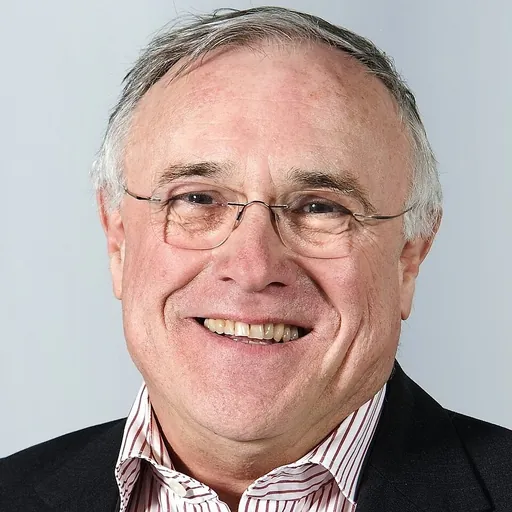
About Klaus Müllen
Born 1947. Klaus Müllen is a German chemist and university teacher.
Klaus Müllen (born 2 January 1947) is a German chemist working in the fields of polymer chemistry, supramolecular chemistry and nanotechnology. He is known for the synthesis and exploration of the properties of graphene-like nanostructures and their potential applications in organic electronics.
Early life and education Müllen was born in Cologne. He studied chemistry there and was awarded a PhD in 1971 under the supervision of Fabian Gerson at the University of Basel. He specialized in electron spin resonance (ESR) spectroscopy and his dissertation was on nuclear resonance and electron spin resonance spectroscopic studies on bridged annulenes. He completed post-doctoral studies at the ETH Zurich under Jean François Michel Oth (1926–2003) and received his habilitation in 1977 with a thesis on dynamic NMR spectroscopy and electrochemistry.
Research career In 1979, he became professor of organic chemistry at the University of Cologne, and in 1983, he went to the University of Mainz as a professor. Since 1989, he has been director and scientific member of the Max Planck Institute for Polymer Research. In 2016, he became emeritus. Since 1995, he has been honorary professor at the University of Mainz and at the Gutenberg Research College of the University of Mainz.
His research interests are in the field of preparative macro- and supramolecular chemistry. Among other things, his group has succeeded in synthesizing and characterizing hitherto unattainable large polycyclic aromatics such as superphenalene, which has a molecular mass of 1182 g·mol−1 and consists of 34 condensed benzene rings.
He has developed small disc-like organic building blocks using alkyl-substituted hexabenzocoronene, and in particular HBC-C12 – which self-assembles into crystalline liquid-phase structures (columnar liquid crystals) as potential organic field-effect transistors. The considered two-dimensional benzene ring structures are examples of subunits of graphene lattices (graphene nanostructures). The graphene-like structures synthesized and investigated by Müllen include two-dimensional bands of less than 50 nanometers width with jagged edges. Of interest here are the electronic conduction properties and spintronics properties with a view to future replacement of silicon-semiconductor technology. In synthesis, he introduced a new method in graphene polymer chemistry: soft-landing mass spectrometry. Applications include synthetic light-emitting organic materials (such as OLEDs) and incorporation of molecular defects (defect engineering) organic analogues of semiconductor technology.
Selected awards and honorary posts 2001: Honorary Doctorate, University of Sofia 2017: (shared with Xinliang Feng) 2023: Member of Chinese Academy of Sciences
Selected publications Books K. Müllen: Kernresonanz- und elektronenspinresonanzspektroskopische Untersuchungen an überbrückten Annulenen, Dissertation, Basel 1971
e-book: ISBN 978-3-86225-572-6 (autobiography)
Articles
Don’t just read it —
keep it.
Full-length biographies made to live with: read them, listen on the way to work, watch them tonight.
- E-book
- Audio
- Video
Instant download · yours to keep · every purchase keeps this site free
Important facts
Related people
Same field, nearest in time




Contemporaries
People whose lives overlapped Klaus Müllen's



Frequently asked questions
Who is Klaus Müllen?
German chemist
When was Klaus Müllen born?
Klaus Müllen was born on 2 January 1947 in Cologne.
What is Klaus Müllen's occupation?
Klaus Müllen is a chemist and university teacher.
What nationality is Klaus Müllen?
Klaus Müllen is German.
Sources & further reading
Cite this page
APA: Biography.guide. (2026). Klaus Müllen. https://biography.guide/klaus-mullen/
MLA: "Klaus Müllen." Biography.guide, https://biography.guide/klaus-mullen/.
Chicago: "Klaus Müllen." Biography.guide. https://biography.guide/klaus-mullen/.
Data last updated: 2026-09-23 · Spot an error? Report a correction.
Portrait: Wikimedia Commons · author & licence
Page generated 2026-09-27 05:06 UTC