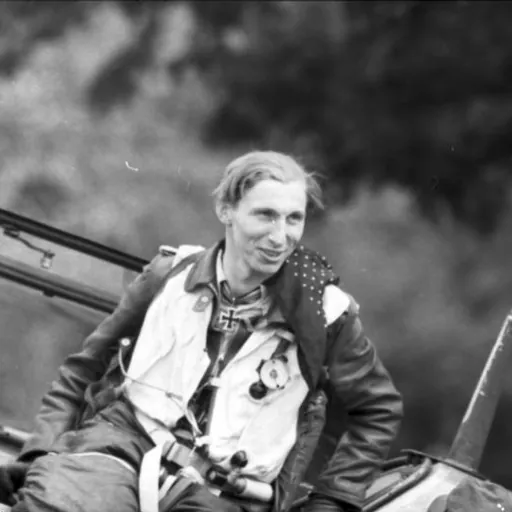
About Klaus Mietusch
Lived 1918 – 1944 (aged 26). Klaus Mietusch was a German military personnel.
Klaus Mietusch (5 August 1918 – 17 September 1944) was a German Luftwaffe military aviator and fighter ace during World War II. He is credited with 72 aerial victories achieved in 452 combat missions. This figure includes 15 aerial victories on the Eastern Front, and further 57 victories over the Western Allies, including 13 four-engined bombers.
Born in Posen, Mietusch grew up in the Weimar Republic and Nazi Germany. He joined the military service in the Luftwaffe in 1937. Following flight training, he was posted to Jagdgeschwader 26 "Schlageter" (JG 26—26th Fighter Wing) in 1939. Flying with this wing, Mietusch claimed his first aerial victory on 31 May 1940 on the Western Front during the Battle of France. In early 1941, he fought in the Mediterranean theater. He was made Staffelkapitän (squadron leader) of 7. Staffel (7th squadron) of JG 26 in September 1941 and in January 1943, was posted to the Eastern Front. In July 1943 he was appointed Gruppenkommandeur (group commander) of III. Gruppe of JG 26. Following his 60th aerial victory, he was awarded the Knight's Cross of the Iron Cross on 26 March 1944. Mietusch claimed his last aerial victory on 17 September 1944 during the Operation Market Garden. He was killed in action that day, shot down by a North American P-51 Mustang fighter from the 361st Fighter Group. Posthumously, Mietusch was awarded the Knight's Cross of the Iron Cross with Oak Leaves on 18 November 1944.
Early life and career Mietusch was born on 5 August 1918 in Posen in the Province of Posen, part of the Kingdom of Prussia, present-day Poznań in west-central Poland. At birth, his last-name was Mitusz which was later changed to Mietusch to sound more German. Following graduation from school with his Abitur (university-preparatory high school diploma), Mietusch joined the military service in the Luftwaffe in 1937, as a Fahnenjunker (officer cadet).
Jagdgeschwader 26 "Schlageter" (JG 26—26th Fighter Wing) was created on 1 May 1939 in Düsseldorf by renaming Jagdgeschwader 132 (JG 132—132nd Fighter Wing) and was commanded by Oberst Eduard Ritter von Schleich, a flying ace of World War I. Mietusch, who was promoted to Leutnant (second lieutenant) in 1939, was among the first pilots assigned to this unit following his training as a fighter pilot.
World War II World War II in Europe began on Friday 1 September 1939 when German forces invaded Poland. Mietusch, who was serving as a technical officer with the Geschwaderstab (headquarters unit), was replaced in this capacity by Leutnant Walter Horten on 14 December. Serving with 7. Staffel (7th squadron) of JG 26, he crashed his Messerschmitt Bf 109 E-3 (Werknummer 1202—factory number) during takeoff at Chièvres Airfield on 27 May. At the time 7. Staffel was headed by Oberleutnant Georg Beyer. III. Gruppe (3rd group), to which his squadron was subordinated, was commanded by Major Ernst Freiherr von Berg who was replaced by Hauptmann Adolf Galland on 11 June.
Mietusch claimed his first aerial victory during the Battle of France on 31 May 1940. In combat with the fighters from No. 213 and No. 264 Squadron from the Royal Air Force (RAF), he shot down a Hawker Hurricane fighter near Dunkirk. On 8 June, Mietusch made a forced landing in his Bf 109 E-1 (Werknummer 2746) behind enemy lines. He was shot down in combat with a Hurricane near Neufchâtel. Although uninjured in the landing, he was shot by a French civilian and taken prisoner of war. Following the armistice of 22 June 1940, he was sent to hospital in Germany.
Malta, Balkans and North Africa in 1941 On 22 January 1941, 7. Staffel received orders to relocate to Sicily in support of X. Fliegerkorps, under the command of General der Flieger (General of the Flyers) Hans Geisler, for actions against the strategically important island of Malta. With the opening of a new front in North Africa in mid-1940, British air and sea forces based on the island could attack Axis ships transporting vital supplies and reinforcements from Europe to North Africa. To counter this threat the Luftwaffe and the Regia Aeronautica (Italian Royal Air Force) were tasked with bombing raids in an effort to neutralise the RAF defences and the ports. That day the unit and a 40-strong detachment of ground crews departed Wevelgem. Following a brief stopover in Rome, 7. Staffel arrived in Gela on Sicily on 9 February 1941. There, the unit received factory new Bf 109 E-7 aircraft.
Mietusch claimed his first victory in the Siege of Malta on 26 February over a No. 261 Squadron Hurricane south of Malta. He became a fighter ace on 22 March, taking his total to five aerial victories. In combat north of Malta, Mietusch had shot down two No. 261 Squadron Hurricanes. On 5 April, 7. Staffel moved to Grottaglie airfield near Taranto in Apulia to support the Invasion of Yugoslavia by the Wehrmacht. On the first day of the campaign, Mietusch claimed a Yugoslav Hawker Fury, which in fact was an Avia BH-33, in combat northeast of Podgorica. On 8 April, 7. Staffel returned to Gela and resumed operations over Malta. On 13 April, Mietusch was credited with shooting down two Hurricanes from No. 261 Squadron, one of which was piloted by Flight Officer Ernest "Imshi" Mason who was wounded in the encounter.
On 18 June, 7. Staffel flew together with I. Gruppe of Jagdgeschwader 27 (JG 27—27th Fighter Wing) and intercepted Hurricane fighters belonging to No. 1 Squadron of the South African Air Force (SAAF) covering the British retreat after Operation Battleaxe. In this encounter, No. 1 Squadron lost three Hurricanes, two were claimed by JG 27 and a third was shot down by Mietusch in combat southeast of Sidi Omar. On 21 August, twelve Martin Maryland bombers from the SAAF No. 12 and No. 24 Squadron attacked the Luftwaffe airfields at Kambut. The bombers were escorted by RAF Hurricane fighters from No. 229 Squadron. Bf 109s from JG 27 and 7. Staffel of JG 26 intercepted the flight, some attacking the bombers while others engaged the escort fighters. Mietusch claimed the probable destruction of a Maryland bomber which was not confirmed. This was his last claim on the North African Theater. 7. Staffel was then withdrawn from North Africa and returned France. During its six-month tenure in the Mediterranean Theater, 7. Staffel claimed 52 aerial victories without losing a single pilot nor aircraft in combat.
7. Staffel was reunited with III. Gruppe of JG 26 at Ligescourt. The Gruppe had just been equipped with the Bf 109 F-4. Mietusch, who had been on vacation before rejoining his unit, flew his next combat mission on 16 September. On 18 September, the RAF flew "Circus" No. 99 targeting Rouen. Defending against this "Circus", Mietusch shot down a Royal Australian Air Force (RAAF) No. 452 Squadron Spitfire fighter.
Squadron leader Mietusch was appointed Staffelkapitän (squadron leader) of 7. Staffel on 19 September 1941. He succeeded Hauptmann Joachim Müncheberg in this command position. Müncheberg had led the Staffel since 22 August 1940 and had been given command of II. Gruppe after its former commander, Hauptmann Walter Adolph was killed in action. On 20 September, 7. Staffel began conversion training to the then new Focke-Wulf Fw 190 fighter aircraft at their airfield in Ligescourt. Full transition from the Bf 109 F-4 to the Fw 190 was not completed until mid-November.
The RAF ordered "Circus" No. 102 to their targets at Béthune and Gosnay on 21 September. The "Circus", consisting of twelve Bristol Blenheim bombers and escorted by fourteen squadrons of Hurricanes and Spitfires, was intercepted by Luftwaffe fighters from Jagdgeschwader 2 (JG 2—2nd Fighter Wing) and JG 26. Mietusch was credited with the destruction of his 12th and 13th aerial victories that day. He shot down two Spitfire fighters from either the New Zealand No. 485 (NZ) Squadron or No. 602 Squadron. The first Spitfire was claimed at 16:23 near Berck-sur-Mer while the second Spitfire was shot down at 16:30 northwest of the Baie de Somme. Following combat with a Spitfire near Boulogne-sur-Mer on 13 October, Mietusch made an emergency landing in his Bf 109 F-4 (Werknummer 7220) at Saint-Omer. Command of III. Gruppe was passed on from Hauptmann Gerhard Schöpfel to Hauptmann Josef Priller on 6 December. Two days later, Mietusch claimed a Spitfire fighter in combat near Berck-sur-Mer but lost his wingman, Leutnant Walter Thorn who was shot down and killed by two Spitfires from No. 603 Squadron south of Montreuil.
On 14 April 1942, Mietusch flew Fw 190 A-2 (Werknummer 5215) in combat. His aircraft sustained minor damage, resulting in an emergency landing at Wevelgem. At the time, Mietusch dated Lieselotte Hays, a Luftwaffenhelferin (female air force helper). During the Dieppe Raid on 19 August, Mietusch claimed two aerial victories in the vicinity of Dieppe. He shot down two Spitfires at 10:34 and 10:35 from either No. 19 Squadron or No. 121 (Eagle) Squadron. Mietusch claimed his first two aerial victories over the United States Army Air Forces (USAAF) on 9 October though neither claim was confirmed by the Luftwaffe. The VIII Bomber Command flew a mission to Lille, targeting the locomotive works and steel factory. That day, Mietusch attacked a Short Stirling bomber which in fact was a misidentified Boeing B-17 Flying Fortress bomber from the 301st Bombardment Group which made it back to England. He attacked another B-17 bomber from the 301st Bombardment Group which later made a forced landing in the English Channel. Credited with 23 aerial victories, Mietusch was presented the German Cross in Gold on 16 October 1942.
Eastern Front In January 1943, the Luftwaffe planned to move JG 26 to the Eastern Front. The idea was to exchange JG 26 with Jagdgeschwader 54 (JG 54—54th Fighter Wing) which supported Army Group North. In order to keep up operations, the exchange was planned by rotating each Gruppe by Gruppe and every Staffel by Staffel. In this context, Mietusch's 7. Staffel was attached to I. Gruppe of JG 54 which was commanded by Hauptmann Hans Philipp and was based outside of Leningrad. On 17 February, 7. Staffel left Courtrai, heading east by train. Following a stop at Heiligenbeil, the unit was based at the airbase at Krasnogvardeysk, present day Gatschina, which is located approximately southwest of Leningrad. At Heiligenbeil, 7. Staffel received 13 new Fw 190 A-4 and A-5 fighters. The combat area of I. Gruppe of JG 54 was predominantly over the front of 18th Army, on the left flank of Army Group North, and on the Volkhov River.
In early May, 7. Staffel moved to an airfield at Siverskaya. Mietusch claimed his first aerial victories on the Eastern Front on 21 May. The Staffel was scrambled at 05:25 and ordered to intercept a flight of Petlyakov Pe-2 bombers, escorted by Lavochkin-Gorbunov-Gudkov LaGG-3 fighters, on a mission to bomb a railway bridge at Narva. 7. Staffel claimed five aerial victories on this mission, two Pe-2 bombers and three LaGG-3 fighters shot down, including a Pe-2 and two LaGG-3s by Mietusch.
On 13 June on the Western Front, the Gruppenkommandeur (group commander) of III. Gruppe, Hauptmann Kurt Ruppert was killed in action. Command of the Gruppe was temporarily given to Hauptmann Rolf Hermichen. On 29 June, Geschwaderkommodore Priller informed Mietusch that he had been chosen as new commander of III. Gruppe. Mietusch passed command of 7. Staffel to Hauptmann Günther Kelch and returned to Germany.
Group commander and death On 5 July, Mietusch arrived at Cuxhaven-Nordholz Airfield where III. Gruppe was based and took over command from Hermichen. In July, the Gruppe received the Bf 109 G-4 and G-6 variants and the pilots began familiarizing themselves with this aircraft type while flying in Defense of the Reich. On the night of 24/25 July, the RAF and USAAF launched Operation Gomorrah, the attack on Hamburg during the last week of July 1943. The RAF initiated the attack at night which created a firestorm in the city. The following day, the USAAF attacked Hamburg with 100 B-17 bombers, spreading the destruction. Further 118 B-17 bombers bombed Kiel that day. Defending against these attacks, Mietusch claimed his first aerial victory as Gruppenkommandeur when he shot down a B-17 north of Hamburg. III. Gruppe transferred from Cuxhaven-Nordholz to Amsterdam-Schiphol Airfield on 13 August. The USAAF targeted the German aircraft industry on 17 August in the Schweinfurt–Regensburg mission. Mietusch led his Gruppe against the bombers and shot down two B-17 bombers, the first southeast of Schleiden in the Eifel hills, and the second south of Laacher See. On 8 September, III. Gruppe moved to an airfield at Lille-Vendeville in France. On 13 November, the Gruppe relocated to an airfield at Mönchengladbach. On 29 November, VIII Bomber Command attacked Bremen. III. Gruppe intercepted the bombers prior to their bomb run and Mietusch shot a B-17 from its combat box west of Oldenburg. This was referred to as a Herausschuss (separation shot) and denoted a severely damaged heavy bomber which was forced to separate from its combat box and was counted as an aerial victory.
Combat box of a 12-plane B-17 squadron. Three such boxes completed a 36-plane group box. On 9 January 1944, III. Gruppe returned to France with Gruppenstab, 9. and 11. Staffel at Lille-Vendeville, and 10. and 12. Staffel at Denain. On 8 March, Mietusch claimed his 60th aerial victory. That day, the Eighth Air Force, formerly known as VIII Bomber Command, targeted the ball bearings works at Erkner near Berlin. Mietusch led his III. Gruppe in the attack which intercepted the bombers on their target approach between Steinhuder Meer and Braunschweig. Due to the defending escort fighters, Mietusch attacked the bombers from the rear with only a few of his Bf 109 fighters. He was credited with a Herausschuss of a B-17 bomber from the 381st Bombardment Group south of Braunschweig before coming under attack by P-47 fighter from the 352nd Fighter Group. His Bf 109 G-6 (Werknummer 162032) was hit at close range, forcing him to bail out. Although injured, he landed safely near Steinhuder Meer. His victor may have been Captain Virgil Meroney who claimed his eighth aerial victory that day. Mietusch, who was hospitalized for next weeks, was awarded the Knights Cross of the Iron Cross on 26 March for 60 aerial victories claimed. During his absence from the Gruppe, Hauptmann Hermann Staiger temporarily replaced him as commander of III. Gruppe.
On 1 April, he was promoted to Major (major). On 12 April, Mietusch was injured in a landing accident and was again hospitalized, this time for three weeks. His Bf 109 G-6 (Werknummer 162345) ran into a bomb crater during landing at the Étain-Rouvres Airfield. On 12 May, the USAAF flew a mission against the German fuel industry, 886 bombers, escorted by 735 fighters, attacked six oil refineries. Mietusch intercepted the bombers on their return to England and claimed a Herausschuss of a B-17 bomber from the 452d Bombardment Group near Bastogne.
After the Allies launched Operation Overlord, the invasion of Normandy on 6 June, Luftflotte Reich sent additional units to the invasion front. By 8 June, Jagdgeschwader 1, Jagdgeschwader 3, Jagdgeschwader 11 and III. Gruppe of JG 54 had arrived in France and were subordinated to Fliegerkorps II. III. Gruppe of JG 26 was based at Villacoublay Airfield and flew missions to Le Havre that day. In the early morning hours, Mietusch claimed the destruction of two Republic P-47 Thunderbolt fighters from the USAAF 371st Fighter Group. The P-47s had been attacking ground targets east of Le Havre. On 17 July, Mietusch shot down a No. 602 Squadron Spitfire southwest of Caen. Shortly after, he ignored the warning of his wingman Unteroffizier Heinz Gehrke and was shot down in his Bf 109 G-6/U4 (Werknummer 440640) near Argentan-Alençon by another Spitfire from the Royal Canadian Air Force (RCAF) No. 411 Squadron. Mietusch bailed out and was wounded, returning to his unit the next day.
Mietusch was killed in action on 17 September 1944 during the first day of Operation Market Garden, the operation to secure a bridgehead over the River Rhine. In an attempt to defend against Allied airborne landings in the Netherlands, Mietusch led a flight of 15 Bf 109s to the Allied landing zones. Near the German border to the Netherlands, Mietusch flight intercepted a squadron of North American P-51 Mustang fighters. In the resulting aerial combat, Mietusch shot down one of the P-51 fighters north of Mönchengladbach before he came under attack by another P-51, piloted by Lieutenant William Beyer from the 376th Fighter Squadron, assigned to the 361st Fighter Group. Mietusch was shot down in his Bf 109 G-6/U4 (Werknummer 441646) by Beyer, crashing at 15:11 near Aldekerk.
Posthumously, Mietusch was awarded the Knight's Cross of the Iron Cross with Oak Leaves on 18 November 1944. He was the 653rd member of the German armed forces to be so honored. Mietusch was buried in the honor section of the Düsseldorf Northern Cemetery (Field 112-Section 0-Grave 117). Caldwell characterized Mietusch as a very nervous man with limited social skills. According to Caldwell's account, Mietusch never interacted with non-commissioned officers, overcoming his lack of self-confidence by an act of will. Command of III. Gruppe was temporarily passed on to Hauptmann Paul Schauder before Hauptmann Walter Krupinski officially succeeded Mietusch on 27 September.
Summary of career
Aerial victory claims According to US historian David T. Zabecki, Mietusch was credited with 72 aerial victories. The authors Heaton, Lewis, Olds and Schulze list him with 76 aerial victories. Mathews and Foreman, authors of Luftwaffe Aces — Biographies and Victory Claims, researched the German Federal Archives and found records for 72 aerial victory claims, plus six further unconfirmed claims. This figure includes 15 aerial victories on the Eastern Front and 57 over the Western Allies, including 13 four-engined bombers.
Victory claims were logged to a map-reference (PQ = Planquadrat), for example "PQ 26 Ost 80364". The Luftwaffe grid map covered all of Europe, western Russia and North Africa and was composed of rectangles measuring 15 minutes of latitude by 30 minutes of longitude, an area of about . These sectors were then subdivided into 36 smaller units to give a location area in size.
Chronicle of aerial victories Claim Date Time Type Location Claim Date Time Type Location – 7. Staffel of Jagdgeschwader 26 –Battle of France — 10 May – 25 June 1940 1 31 May 1940 15:40 Hurricane Dunkirk – 7. Staffel of Jagdgeschwader 26 "Schlageter" –At the Channel and over England — 26 June 1940 – 20 August 1941 2 31 August 1940 10:10? Spitfire Chelmsford – 7. Staffel of Jagdgeschwader 26 "Schlageter" –Sicily, Balkans and North Africa — February – September 1941 3 26 February 1941 14:17 Hurricane south of Malta 8 13 April 1941 10:34 Hurricane northeast of Kalafrana 4 22 March 1941 16:24 Hurricane north of Malta 9 13 May 1941 14:00 Hurricane southwest of Ta' Vnezja 5 22 March 1941 16:26? Hurricane north of Malta 10 17 June 1941 10:30 Hurricane southeast of Sidi Omar 6 6 April 1941 12:10 Fury northeast of Podgorica 17 June 1941 Hurricane southeast of Sidi Omar 7 11 April 1941 11:50 Hurricane north of Malta 21 August 1941 Maryland 167 Kambut – 7. Staffel of Jagdgeschwader 26 "Schlageter" –On the Western Front — September – 31 December 1941 11 18 September 1941 16:15 Spitfire southeast of Le Paradis 13 21 September 1941 16:30 Spitfire northwest of the Baie de Somme 12 21 September 1941 16:23 Spitfire Berck-sur-Mer 14 8 December 1941 12:55 Spitfire Berck-sur-Mer – 7. Staffel of Jagdgeschwader 26 "Schlageter" –On the Western Front — 1 January – 31 December 1942 15 12 April 1942 13:34 Spitfire southeast of Saint-Omereast of Arques 20 19 August 1942 10:35? Spitfire northwest of Dieppe 16 12 April 1942 13:51? Spitfire north-northwest of Dunkirk 21 27 August 1942 15:10 Spitfire southwest of Calais 30 April 1942 19:30 Spitfire off of the Baie de Somme 22 27 August 1942 15:16 Spitfire west-northwest of Cap Gris-Nez 17 3 May 1942 16:05 Spitfire Calais 23 22 September 1942 13:15 Boston east of Ostend 18 5 May 1942 15:35? Spitfire northwest of Poperinge 9 October 1942 10:35 Stirling* Lille 19 19 August 1942 10:34 Spitfire northeast of Dieppe 9 October 1942 10:45 B-17 northeast of Lille – 7. Staffel of Jagdgeschwader 26 "Schlageter" –On the Western Front — 1 January – 17 February 1943 13 January 1943 14:35 B-17 Lille south of Margate 25 20 January 1943 13:12 Spitfire Ardres 24 20 January 1943 12:42 Spitfire south of Margate 26 22 January 1943 15:15 Spitfire north of Gravelines – 7. Staffel of Jagdgeschwader 26 "Schlageter" –Eastern Front — 17 February – 29 June 1943 27 21 May 1943 05:47? LaGG-3 PQ 26 Ost 80364, Lake KhabolovoKoporski Bight, near Dolgovo 35 18 June 1943 06:13? LaGG-3 PQ 36 Ost 20752forest in the vicinity of Kinderovo 28 21 May 1943 05:47? LaGG-3 PQ 26 Ost 80364, Lake Khabolovonorthern area of Lake Khabolovo 36 18 June 1943 06:18? La-5? 62 14 June 1944 07:35 P-38 PQ 05 Ost UE-7/04 Ost N/AE-1northwest of Paris 3 October 1943 18:25 Spitfire northeast of Beauvais 63 14 June 1944 08:00 B-17 PQ 05 Ost UG/04 Ost N/AGeast of Paris 47 20 October 1943 14:10 B-17 Cambrai 64 15 June 1944 07:00 B-24 PQ 04 Ost N/CB/DCsouthwest of Chartres 48 29 November 1943 14:30 B-17* west of Oldenburg 65 23 June 1944 13:58? P-38 PQ 04 Ost N/CD/CEeast of Chartres 49 30 November 1943 11:45? P-38 North Sea 66 23 June 1944 14:00 P-38 PQ 04 Ost N/CEsoutheast of Chartres 50 1 December 1943 11:45 P-38 Freilingen-Vorneburg 67 4 July 1944 14:50 P-38 PQ 04 Ost UBwest of Évreux 51 20 December 1943 12:25 B-17 northwest of Wilhemshaven 68 17 July 1944 16:40 Spitfire PQ 15 West UT-2/6southwest of Caen 52 14 January 1944 11:50 Spitfire northwest of Saint-Omersouth of Saint-Omer 69 18 August 1944 14:06? P-47 PQ 05 Ost UD-7/8northwest of Paris 53 14 January 1944 15:35 P-47 St Pol 70 26 August 1944 14:50? P-47 PQ 05 Ost TC-4Rouen 54 25 February 1944 12:15 B-17 southwest of Charleville 71 26 August 1944 15:00? P-47 PQ 05 Ost TB-6west of Rouen 55 25 February 1944 15:00 B-17* PQ 05 Ost UQ-3, east of Pirmasens 72 17 September 1944 14:55 P-51 PQ 05 Ost LN-1north of München-Gladbach 56 6 March 1944 13:05 Typhoon PQ 05 Ost QE-8/9, north of Amiens
Awards Iron Cross (1939) 2nd and 1st Class Honor Goblet of the Luftwaffe (26 April 1941) German Cross in Gold on 15 October 1942 as Oberleutnant in the 7./Jagdgeschwader 26 "Schlageter" Front Flying Clasp of the Luftwaffe for Fighter Pilots in Gold with Pennant "400" (10 July 1944) Knight's Cross of the Iron Cross with Oak Leaves Knight's Cross on 26 March 1944 as Hauptmann and Gruppenkommandeur of the III./Jagdgeschwader 26 "Schlageter" 653rd Oak Leaves on 18 November 1944 as Major and Gruppenkommandeur of the III./Jagdgeschwader 26 "Schlageter"
Don’t just read it —
keep it.
Full-length biographies made to live with: read them, listen on the way to work, watch them tonight.
- E-book
- Audio
- Video
Instant download · yours to keep · every purchase keeps this site free
Important facts
People in Klaus Mietusch's life
Named in this biography and alive at the same time

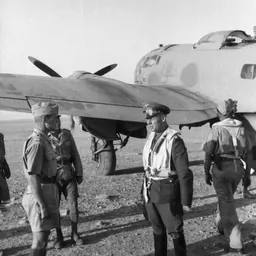



Related people
Same field, nearest in time




Contemporaries
People whose lives overlapped Klaus Mietusch's


Frequently asked questions
Who was Klaus Mietusch?
German fighter ace and Knight's Cross recipient
When was Klaus Mietusch born?
Klaus Mietusch was born on 5 August 1918 in Poznań.
When did Klaus Mietusch die?
Klaus Mietusch died on 17 September 1944 in Kerken.
What was Klaus Mietusch's occupation?
Klaus Mietusch was a military personnel.
What nationality was Klaus Mietusch?
Klaus Mietusch was German.
Sources & further reading
Cite this page
APA: Biography.guide. (2026). Klaus Mietusch. https://biography.guide/klaus-mietusch/
MLA: "Klaus Mietusch." Biography.guide, https://biography.guide/klaus-mietusch/.
Chicago: "Klaus Mietusch." Biography.guide. https://biography.guide/klaus-mietusch/.
Data last updated: 2026-09-24 · Spot an error? Report a correction.
Portrait: Wikimedia Commons · author & licence
Page generated 2026-09-27 05:08 UTC