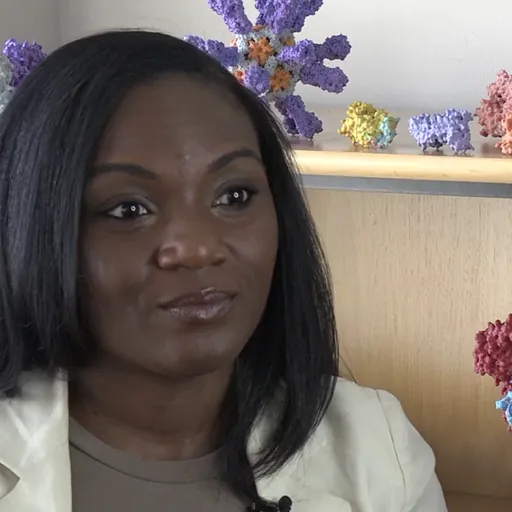
About Kizzmekia Corbett
Born 1986. Kizzmekia Corbett is an American immunologist, researcher and vaccinologist.
Kizzmekia "Kizzy" Shanta Corbett-Helaire (née Corbett, born January 26, 1986) is an American viral immunologist. She is an assistant professor of immunology and infectious diseases at Harvard T.H. Chan School of Public Health and the Shutzer Assistant Professor at the Harvard Radcliffe Institute since June 2021, and was named a Howard Hughes Medical Institute Freeman Hrabowski Scholar in 2023.
She joined Harvard following six years at the Vaccine Research Center (VRC) at the National Institute of Allergy and Infectious Diseases, National Institutes of Health (NIAID NIH) based in Bethesda, Maryland. She earned a PhD in microbiology and immunology from the University of North Carolina at Chapel Hill (UNC-Chapel Hill) in 2014. with research efforts aimed at COVID-19 vaccines. In February 2021, Corbett-Helaire was highlighted in Time's "Time100 Next" list under the category of Innovators, with a profile written by Anthony Fauci.
Early life and education Corbett-Helaire was born in Hurdle Mills, North Carolina on January 26, 1986, to Rhonda Brooks. where she had a large family of step-siblings and foster siblings. and A.L. Stanback Middle School in Hillsborough. Her fourth grade teacher, Myrtis Bradsher, recalls recognizing Corbett-Helaire's talent at an early age and encouraging Kizzy's mother to place her in advanced classes. "I always thought she is going to do something one day. She dotted i's and crossed t's. The best in my 30 years of teaching," Bradsher said in a 2020 interview with The Washington Post. In 2014, Corbett-Helaire received a PhD in microbiology and immunology from the University of North Carolina at Chapel Hill. For her doctoral work, Corbett-Helaire worked in Sri Lanka to study the role of human antibodies in dengue virus pathogenesis.
Career While in high school, Corbett-Helaire realized that she wanted to pursue a scientific career, and as part of an American Chemical Society-sponsored program called Project SEED, spent her summer holiday working in research laboratories, one of which was at UNC's Kenan Labs with organic chemist James Morkin. She studied how people produce antibodies in response to dengue fever, and how the genetics of dengue fever impact the severity of a disease. From April to May 2014, as part of her research for her dissertation, Corbett-Helaire worked as a visiting scholar at Genetech Research Institute in Colombo, Sri Lanka. During this time, she identified a simple way to make coronavirus spike proteins that are stabilized in a conformation that renders them more immunogenic and manufacturable, in collaboration with researchers at Scripps Research Institute and Dartmouth College. She developed methods for rapidly producing antigen proteins that could be modified to match different viruses, as well as methods for delivering the genetic instructions for these proteins to cells via messenger RNA—work that would prove directly applicable to COVID-19.
Prior to the COVID-19 pandemic, Corbett-Helaire's laboratory work on Middle East Respiratory Syndrome (MERS) coronavirus yielded a structural insight that would later prove critical to multiple COVID-19 vaccines. In 2017, she and colleagues published work in the Proceedings of the National Academy of Sciences describing a method of stabilizing coronavirus spike proteins in their prefusion conformation using two proline (2P) amino acid substitutions. These "2P" mutations, which prevent the spike protein from collapsing before it can trigger an immune response, were subsequently incorporated into the sequence of mRNA-1273 and other COVID-19 vaccines including Pfizer-BioNTech's BNT162b2. This prefusion stabilization technology is the subject of , granted in March 2021, on which Corbett-Helaire is a named inventor.
During this same period, she contributed to influenza vaccine research, co-authoring work on nanoparticle-displayed hemagglutinin stem antigens designed to elicit broadly neutralizing antibody responses across influenza strains, as part of a broader effort toward a universal influenza vaccine.
Development of COVID-19 vaccine At the onset of the COVID-19 pandemic, Corbett-Helaire started working on a vaccine to protect people from coronavirus disease. S proteins form a "crown" on the surface of coronaviruses and are crucial for engagement of host cell receptors and the initiation of membrane fusion in coronavirus disease. This makes them a particularly vulnerable target for coronavirus prophylactics and therapeutics. Based on her previous research, Corbett-Helaire's team, in collaboration with Jason McLellan and other investigators at The University of Texas at Austin, transplanted stabilizing mutations from SARS-CoV S protein into SARS-CoV-2 spike protein. Her prior research suggested that messenger RNA (mRNA) encoding S protein could be used to excite the immune response to produce protective antibodies against coronavirus disease 2019.
To manufacture and test the COVID-19 vaccine Corbett-Helaire's team partnered with Moderna, a biotechnology company, to rapidly enter animal studies. Subsequently, the vaccine entered Phase 1 clinical trial only 66 days after the virus sequence was released. The trial, to be completed in at least 45 people, is a dose escalation study in the form of two injections separated by 28 days. In December 2020, the Institute's Director, Anthony Fauci said: "Kizzy is an African American scientist who is right at the forefront of the development of the vaccine." In Time Magazine's profile, Fauci wrote that Corbett-Helaire has "been central to the development of the Moderna mRNA vaccine and the Eli Lilly therapeutic monoclonal antibody that were first to enter clinical trials in the U.S." and that "her work will have a substantial impact on ending the worst respiratory-disease pandemic in more than 100 years." When asked about her involvement with the development of the COVID-19 vaccine, Corbett said, "To be living in this moment where I have the opportunity to work on something that has imminent global importance...it's just a surreal moment for me". Corbett stated she cried when the efficacy results showed the mRNA-1273 Moderna vaccine worked.
Eli Lilly therapeutic antibody work Alongside her mRNA vaccine research, Corbett-Helaire contributed to the development of two therapeutic monoclonal antibodies that became authorized COVID-19 treatments in collaboration with Eli Lilly and Company and AbCellera.
The first, bamlanivimab (LY-CoV555), was identified from a blood sample taken from one of the first U.S. patients to recover from COVID-19. Scientists at the NIH Vaccine Research Center, including Corbett-Helaire, tested the antibody on behalf of the Lilly–AbCellera partnership. Bamlanivimab became the first anti-SARS-CoV-2 monoclonal antibody to enter clinical trials, doing so in June 2020—only three months after discovery efforts began.
The second antibody, bebtelovimab (LY-CoV1404), was co-developed to address the limitation that many earlier therapeutic antibodies lost effectiveness against SARS-CoV-2 variants of concern. Corbett-Helaire is listed as a co-author on the paper characterizing bebtelovimab's activity. The antibody received U.S. Food and Drug Administration Emergency Use Authorization in February 2022 and was shown to retain potent neutralizing activity against the Omicron variant and its subvariants. Anthony Fauci specifically highlighted Corbett-Helaire's role in both the vaccine and the Eli Lilly therapeutic antibody work, writing that she had been "central to the development of the Moderna mRNA vaccine and the Eli Lilly therapeutic monoclonal antibody that were first to enter clinical trials in the U.S.
In December 2021, Corbett-Helaire was assigned to Boston's COVID-19 advisory committee by Mayor Michelle Wu.
Patents Corbett-Helaire is a named inventor on multiple U.S. patents arising from her research at the NIH Vaccine Research Center. Her most foundational patent, co-invented with Barney S. Graham, Jason McLellan, Andrew Ward, and others, covers prefusion coronavirus spike proteins and their use in vaccines. U.S. Patent No. 10,960,070 B2 was granted on March 30, 2021, and is assigned to Dartmouth College, the Scripps Research Institute, and the U.S. Department of Health and Human Services. It covers coronavirus ectodomain trimers stabilized in their prefusion conformation—the core molecular technology underlying mRNA-1273 and multiple other authorized COVID-19 vaccines.
Beyond mRNA-1273, Corbett-Helaire's patent portfolio also includes universal coronavirus and influenza vaccine concepts and novel therapeutic antibodies.
Laboratory and ongoing research In June 2021, Corbett-Helaire joined Harvard T.H. Chan School of Public Health as an assistant professor in the Department of Immunology and Infectious Diseases, holding the Melvin J. and Geraldine L. Glimcher endowed chair and the Shutzer Assistant Professorship at the Harvard Radcliffe Institute. She is also an Associate Member of the Ragon Institute. In 2023, she was selected as a Howard Hughes Medical Institute Freeman Hrabowski Scholar, an award recognizing outstanding early-career scientists from underrepresented backgrounds.
The Corbett Lab at Harvard focuses on pandemic preparedness through understanding how the immune system responds to coronavirus spike proteins. According to the HHMI, a central question driving the lab is how B cell and antibody responses can be directed toward epitopes shared across multiple coronavirus strains—cross-reactive responses that would form the basis of a universal coronavirus vaccine.The lab is also working to map the antigenic landscape of endemic coronaviruses—the strains that circulate continuously and cause common cold-like illness—which may inform broader protective immunity strategies.
Public statements related to COVID-19 Corbett-Helaire called for the public to be cautious and respectful of one another during the COVID-19 pandemic, explaining that regular hand washing and sneezing into one's elbow can help to minimize the spread of the virus. She has also emphasized that we should not stigmatize people who may be from areas where the virus started. For example, she presented education about the COVID-19 vaccine development to Black Health Matters in October 2020. Her race has been a focus of government outreach; after a study released by the NAACP and others revealed that only 14% of black Americans believe a COVID-19 vaccine will be safe, NIAID Director Fauci was explicit: "the first thing you might want to say to my African American brothers and sisters is that the vaccine that you're going to be taking was developed by an African American woman."
Controversial tweets In May 2020, The Washington Post reported that Corbett-Helaire had been scrutinized for tweets lamenting the lack of diversity on the White House Coronavirus Task Force, as well as for her responses to other tweets about data that African Americans were disproportionately dying from the virus. Responding to a tweet in which someone else claimed that the virus "is a way to get rid of us", Corbett-Helaire responded: "Some have gone as far to call it genocide. I plead the fifth.". After the controversy, Corbett scaled back her use of social media and stopped appearing on television.
She believes it is important to retain one's identity when working in science and in academia: "Keeping those cultural markers prominent—playing Jeezy in the lab, wearing braids to PhD interviews, as Corbett-Helaire recalled—is a way of showing that Black people and Black culture absolutely belong in academic spaces. 'We need to be ourselves and allow the institutions to shape around who we are'". 2002–2004: American Chemical Society, Project SEED at UNC-Chapel Hill 2006: National Institute of Health, NIH Undergraduate Scholarship University of Maryland, Baltimore County, Meyerhoff Scholar 2020: Co-recipient of the Golden Goose Award with Barney Graham, Emmie de Wit and Vincent Munster for excellence in federally funded research 2021: Highlighted by Time magazine in the 2021 "Time100 Next" list, under the category of Innovators 2021: Received the Dean's Medal from the Johns Hopkins Bloomberg School of Public Health, the school's highest recognition for public health leaders. 2021: Named Federal Employee of the Year by the Partnership for Public Service at the Samuel J. Heyman Service to America Medals ceremony, shared with Barney S. Graham, for their research that led to the development of COVID-19 vaccines in record time. 2021: Recipient of the North Carolina Award for Science, the state's highest civilian honor, presented by Governor Roy Cooper, in recognition of her contributions to COVID-19 vaccine development. 2021: Received the Clinton Global Citizen Award from the Clinton Global Initiative, recognizing her leadership and contribution to public health during the COVID-19 pandemic. 2021: Received the Benjamin Franklin NextGen Award from the Franklin Institute for her contributions to viral immunology research and the foundational design for the mRNA COVID-19 vaccine. 2022: National Honoree, USA TODAY's Women of the Year 2022: Received the Rising Star Award from the Sabin Vaccine Institute, in recognition of her contributions to vaccine development and her efforts to build public confidence in vaccines. 2022: AAAS Early Career Award for Public Engagement with Science 2023: Co-recipient (with Anthony Fauci) of the 2022 J. William Fulbright Prize for International Understanding, awarded by the Fulbright Association in recognition of their leadership in combating the COVID-19 pandemic and contributions to global public health. 2023: Selected as a Freeman Hrabowski Scholars by the Howard Hughes Medical Institute 2024: Received the Hans Sigrist Prize by the University of Bern 2025: Selected by the Pew Charitable Trusts for her early-career work in viral immunology and pandemic preparedness 2025: Recognized for advocacy in health research and infectious diseases with a Research!America Building the Foundation Advocacy Award 2026: Named a TED Fellow in the 2026 class of the TED Fellows program, recognized for visionary leadership in viral immunology and pandemic preparedness. 2026: Inducted as an honorary member of Alpha Kappa Alpha Sorority, Inc.
Selected works and publications
Don’t just read it —
keep it.
Full-length biographies made to live with: read them, listen on the way to work, watch them tonight.
- E-book
- Audio
- Video
Instant download · yours to keep · every purchase keeps this site free
Important facts
People in Kizzmekia Corbett's life
Named in this biography and alive at the same time





Related people
Same field, nearest in time



Contemporaries
People whose lives overlapped Kizzmekia Corbett's



Frequently asked questions
Who is Kizzmekia Corbett?
American immunologist (1986-)
When was Kizzmekia Corbett born?
Kizzmekia Corbett was born on 26 January 1986 in Hurdle Mills.
What is Kizzmekia Corbett's occupation?
Kizzmekia Corbett is an immunologist, researcher and vaccinologist.
What nationality is Kizzmekia Corbett?
Kizzmekia Corbett is American.
Sources & further reading
· Wikipedia: Kizzmekia Corbett
· DBpedia: Kizzmekia Corbett-Helaire
Cite this page
APA: Biography.guide. (2026). Kizzmekia Corbett. https://biography.guide/kizzmekia-corbett/
MLA: "Kizzmekia Corbett." Biography.guide, https://biography.guide/kizzmekia-corbett/.
Chicago: "Kizzmekia Corbett." Biography.guide. https://biography.guide/kizzmekia-corbett/.
Data last updated: 2026-09-22 · Spot an error? Report a correction.
Portrait: Wikimedia Commons · author & licence
Page generated 2026-09-27 05:03 UTC