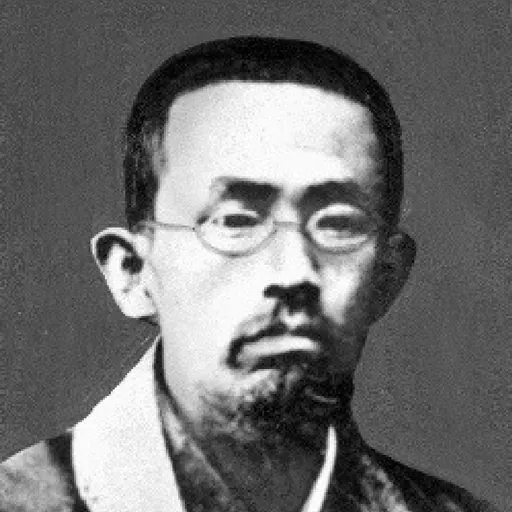
Kiyozawa Manshi
Japanese Shin Buddhist reformer
About Kiyozawa Manshi
Lived 1863 – 1903 (aged 39). Kiyozawa Manshi was a Japanese philosopher, priest and philosopher of religion.
was a Japanese Shin Buddhist thinker, academic and reformer of the Ōtani-ha branch. He is one of the most influential figures of Shin Buddhist modernism, known for his articulation of the philosophy of Seishinshugi (精神主義), which can be translated as “Cultivating Spirituality.” Seishinshugi thought prioritized personal religious experience and was influenced by Western philosophies like religious existentialism, Hegel and Stoicism.
Biography Kiyozawa studied at Tokyo University. Among various topics, he studied Western philosophy under the American philosopher Ernest Fenollosa. Many Higashi Hongan-ji scholars trace their line of thought to Kiyozawa Manshi, including such men as Akegarasu Haya (1877–1954), Kaneko Daiei (1881–1976), Soga Ryōjin (1875–1971) and Maida Shuichi (1906–1967). Some of his essays were translated into English, such as the book December Fan, and have found a Western readership.
Kiyozawa himself died quite young of tuberculosis in 1903, and therefore some consider his thought to be immature and incomplete. Even today, many conservative Shin thinkers see Kiyozawa as being emblematic of what had gone wrong with the Ōtani school. While his thought remains controversial, he is still seen as one of the most influential figures in modern Shin thought. Kiyozawa's movement continued after his death, and led to the Dobokai movement (同朋会運動), a reform group formed in 1947 composed of many disciples of Kiyozawa, including Kurube Shin'yū. Akegarasu Haya, Soga Ryōjin.The conflicts between this movement and traditional Honganji leadership led to the Ohigashi schism (お東騒動).
Thought Kiyozawa Manshi's articulation of Seishinshugi emerged at the turn of the twentieth century within the context of his small intellectual community, the Kōkōdō, established near Tokyo University in 1900. The group gathered around a rented house used for communal study and religious inquiry, and soon produced the journal Seishinkai to present their ideas to a broader audience. Through the efforts of the Seishinkai contributors, especially Akegarasu's serialized commentaries from 1903 to 1911, the Tannishō gradually became one of the most widely read Buddhist texts in Japan, helping shape modern understandings of Shinran's thought.
Kiyozawa's Seishinshugi thought was articulated in three interrelated domains: the internal–personal, the external–religious, and the external–social. The internal dimension centered on naikan, a practice of reflective meditation whose goal is self-understanding. Naikan focuses on understanding how suffering emerges primarily from internal causes and on understanding our own perceptions of the world. The religious dimension balanced this subjectivism with two overarching ideas: "the truth of the unity of all phenomena" (which resembles the Huayan conception of interdependence) and the necessity of “absolute other-power” (zettai tariki), in which the individual relinquishes all things to Amida Buddha. Kiyozawa saw the other-power, Amida Buddha, as a symbol pointing to the ultimate principle of the universe. According to Dobbins, "Kiyozawa borrowed from Hegelian idealism—describing Amida as absolute spirit and as the single great principle underlying the universe." According to Kiyozawa, "Amida Buddha is an expedient expression signifying the infinite, the universe as a whole, or the law that courses through and animates that universe."
Seishinshugi's social dimension, the most contentious one to Shin tradition, reflected Kiyozawa's deep mistrust of ethical systems and social norms detached from personal spiritual grounding. He held that the religious individual must maintain inner equilibrium even within oppressive social conditions, subordinating all conventional obligations to the pursuit of religious truth. This synthesis of introspective subjectivity, cosmic interrelationship, and radical reliance on Amida formed the distinctive worldview of Seishinshugi, marking it as one of the seminal developments in modern Shin Buddhist thought.
Works translated to English Two translations has been made of Manshi's essays:
Don’t just read it —
keep it.
Full-length biographies made to live with: read them, listen on the way to work, watch them tonight.
- E-book
- Audio
- Video
Instant download · yours to keep · every purchase keeps this site free
Important facts
People in Kiyozawa Manshi's life
Named in this biography and alive at the same time


Related people
Same field, nearest in time




Contemporaries
People whose lives overlapped Kiyozawa Manshi's




Frequently asked questions
Who was Kiyozawa Manshi?
Japanese Shin Buddhist reformer (1863–1903)
When was Kiyozawa Manshi born?
Kiyozawa Manshi was born on 10 August 1863 in Nagoya.
When did Kiyozawa Manshi die?
Kiyozawa Manshi died on 6 June 1903.
What was Kiyozawa Manshi's occupation?
Kiyozawa Manshi was a philosopher, priest and philosopher of religion.
What nationality was Kiyozawa Manshi?
Kiyozawa Manshi was Japanese.
Sources & further reading
Cite this page
APA: Biography.guide. (2026). Kiyozawa Manshi. https://biography.guide/kiyozawa-manshi/
MLA: "Kiyozawa Manshi." Biography.guide, https://biography.guide/kiyozawa-manshi/.
Chicago: "Kiyozawa Manshi." Biography.guide. https://biography.guide/kiyozawa-manshi/.
Data last updated: 2026-09-22 · Spot an error? Report a correction.
Portrait: Wikimedia Commons · author & licence
Page generated 2026-09-27 05:00 UTC