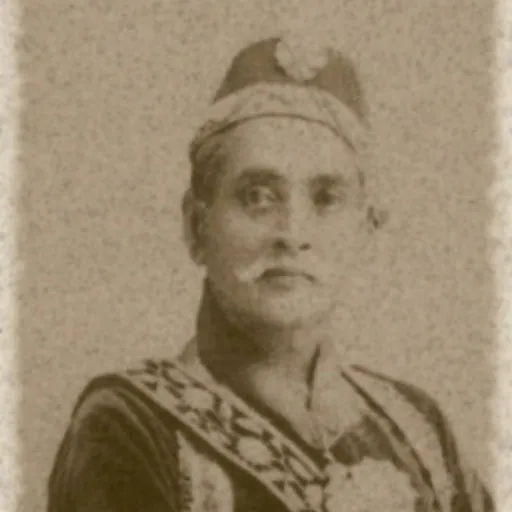
About Khwaja Ahsanullah
Lived 1846 – 1901 (aged 55). Khwaja Ahsanullah was an Indian writer.
Nawab Bahadur Sir Khwaja Ahsanullah KCIE (22 August 1846 – 16 December 1901) was the third Nawab of Dhaka. He was notable for his philanthropic works in Bengal, notably his donations to the present Bangladesh University of Engineering and Technology and for introducing electricity in his native city of Dhaka. He also authored books in Persian and Urdu under the pen name of Shaheen. The palace Ahsan Manzil is named after him by his father, Khwaja Abdul Ghani.
Early life Ahsanullah was born in 1846 to Khwaja Abdul Ghani and Ismatun Nesa. As a young child, he learned Urdu, Arabic and Persian, and the Islamic education of Quran, Hadith, and Fiqh. He was noted as being a very gifted child and mastered the religious Islamic doctrine at a very young age.
Literature Ahsanullah wrote widely in Urdu under the pen name Shaheen, and much of his spare time was spent composing literature in Urdu and Persian. Those around him noted his talent for composing spontaneous poetry, which generally evoked sunny imagery. He spent over 50,000 rupees on famine relief in Barisal District, Mymensingh District and Dhaka District in 1896. He was also one of the chief backers of the Comilla building. Electricity was introduced to Dhaka, Bangladesh, on December 7, 1901. Khwaja Ahsanullah financed the project. He funded and constructed many hospitals, including the Patuankali Begam Hospital, Lady Dufferin Women's Hospital, and the Mitford Hospital.
Islamic activities Ahsanullah was an ardent advocate for Muslims. He created several mosques and madrasas, including the Madaripur and Begambari mosques and madrassas. He also restored and rebuilt over 15 dargahs and mosques. He was a member of the Central Northern Muhammadan Association, which played a large role in his works.
Ahsanullah had a hobby of maintaining zoos. He had three zoos in Dhaka – Begunbari, Dilkhusa, and Shahbagh. The zoos held peacocks, deer, and other exotic animals.
Awards and titles Ahsanullah was awarded a Khan Bahadur in 1871, a Nawab in 1875, a Companion of the Order of the Indian Empire (CIE) in 1891, a Nawab Bahadur in 1892, a Knight Commander of the Order of the Indian Empire (KCIE) in 1897, and a member of the Governor-General's Legislative Council in 1890 and again in 1899.
Death and legacy Ahsanullah died on 16 December 1901 of heart failure.
Ahsanullah was married to Wahidunnesa Begum, Farhat B. Nawab Begum, Kamrunnesa Bibi (d. 1900) and Khodeja Begum (d. 1900). His only son, Khwaja Salimullah, and a grandson, Khwaja Habibullah, became Dhaka's 4th and 5th nawabs. Ahsanullah's other grandson, through his daughter Bilqis Banu, Khawaja Nazimuddin, served as the governor general (1948–1951) and Pakistan's prime minister (1951–1953).
Don’t just read it —
keep it.
Full-length biographies made to live with: read them, listen on the way to work, watch them tonight.
- E-book
- Audio
- Video
Instant download · yours to keep · every purchase keeps this site free
Important facts
Family & relationships
People in Khwaja Ahsanullah's life
Named in this biography and alive at the same time

Related people
Same field, nearest in time


Contemporaries
People whose lives overlapped Khwaja Ahsanullah's



Frequently asked questions
Who was Khwaja Ahsanullah?
Nawab of Dhaka
When was Khwaja Ahsanullah born?
Khwaja Ahsanullah was born on 22 August 1846 in Dhaka.
When did Khwaja Ahsanullah die?
Khwaja Ahsanullah died on 16 December 1901.
What was Khwaja Ahsanullah's occupation?
Khwaja Ahsanullah was a writer.
What nationality was Khwaja Ahsanullah?
Khwaja Ahsanullah was Indian.
Sources & further reading
· Wikipedia: Khwaja Ahsanullah
Cite this page
APA: Biography.guide. (2026). Khwaja Ahsanullah. https://biography.guide/khwaja-ahsanullah/
MLA: "Khwaja Ahsanullah." Biography.guide, https://biography.guide/khwaja-ahsanullah/.
Chicago: "Khwaja Ahsanullah." Biography.guide. https://biography.guide/khwaja-ahsanullah/.
Data last updated: 2026-09-20 · Spot an error? Report a correction.
Page generated 2026-09-27 05:10 UTC