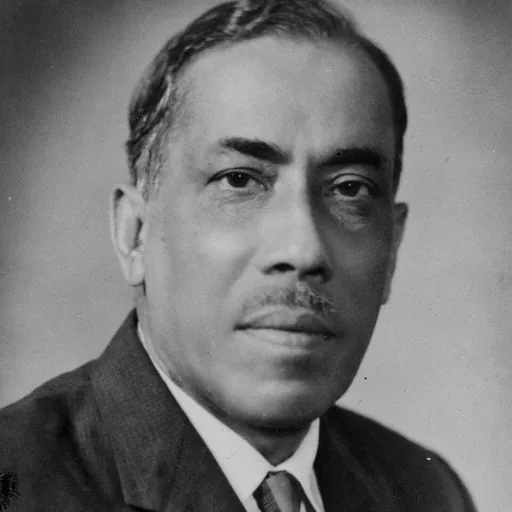
Khuda Buksh
Bangladeshi life insurance salesman and humanitarian
About Khuda Buksh
Lived 1912 – 1974 (aged 62). Khuda Buksh was a Bangladeshi middle management.
Khuda Buksh (1 February 1912 – 13 May 1974) was a Bengali life insurance salesman and humanitarian from the Indian subcontinent. For four decades he represented the "life and soul of the insurance industry" throughout the region, leaving a mark on the business in three separate countries: British India (specifically in East India), Pakistan, and Bangladesh. Buksh, or "Insurance Giant," as he became known, gained fame in the 1940s for his salesmanship in East India. From the 1950s to 1960s, he helped build one of Pakistan's top insurance companies from scratch. He was the pioneer of life insurance industry growth and development in Bangladesh; his name became "synonymous with the life insurance industry," and he is even referred to, in Bangladesh, as the "Father of Insurance."
Early life and education (1912–1935) Buksh was born in Damodya, a remote village in the Shariatpur District of East Bengal in British India. He was the oldest of six children born to Shonabuddin Hawladar and Arjuta Khatun. As a child, Buksh was known to be friendly, respectful, religious, generous, kind-hearted, and ethical. Being affected by the poverty and destitution he witnessed in his village, Buksh tried to help those who were less fortunate than he was. In grade school, he repurchased the same math textbook for class to give it to classmates who could not afford their own books. He was recognized as a talented student and obtained scholarships at all levels of schooling. He stood first in his class from primary to middle school and in high school he stood first or second. He was the captain of his football team playing the center-forward position. His team was successful, competing outside of its sub-division and winning many trophies. Additionally, Buksh possessed an ingenious mind and exceptional interpersonal skills. He was enthusiastic and confident, and he held his hopes high and was determined to succeed. His charm, passion for understanding people, and business savvy helped to win the hearts of Muslims and Hindus. He established himself as reputable insurance salesman and "made a name for himself as a first class insurer." In 1946, the OGSLAC promoted him to inspector. After gaining 17 years of field experience, Buksh moved back to his homeland, East Bengal, to take on a prestigious position at the Eastern Federal Union Insurance Company Limited (EFU).
Life insurance leader, East Pakistan (1952–1968) At the EFU, located at Dacca, Buksh became the life manager in charge of East Pakistan in July 1952. At the time, there was widespread fundamentalist propaganda against insurance, which portrayed it as being un-Islamic. The general public, from solvent businessmen to the lower-middle class, also believed insurance to be associated with death. Moreover, the educated were reluctant to join the insurance profession due to the negative religious and culturally prejudiced views against life insurance workers. of young people every year in the insurance business, particularly a "huge section of the unemployed, ambition-less" young people. During this period, he helped provide jobs to the children of numerous poverty stricken Bengali Muslim families. In order to develop a salesman's confidence, improve sales talks, and build enthusiasm for the job, he freely shared his practical knowledge and field experience gained over many years and imparted to the newly recruited agents for their training. He gave them an objective analysis of the career: While working to employ them, he also developed the kind of positive competition that would challenge employees to excel at work and in social interactions. He excelled at turning novice trainees into efficient insurance agents. He visited every agent's home and inspired them with his enthusiasm, motivational words, and kindness. He also offered to mitigate their financial and personal problems. He often helped them with his "extra-ordinary convincing capability" to secure business by accompanying them to meet with prospective clients. At the same time, he continued to forge close connections with professional, social, cultural, and education organizations, such as Rotary Club of Rotary International, to increase awareness of life insurance in the greater society. "He devised inventive techniques and motivated his sales force to challenge the public's negative perception of life insurance."
Initially, the insurance policies were issued from the head office in Karachi, with clients in Dacca, Chittagong and other places. This caused unusually long delays and to avoid these, Buksh convinced management to have policy renewals, premiums and other arrangements done from Dacca. He increased manpower in Dacca regional office and other divisional and sub-divisional towns. Thus a new class of insurance workers were created and the insurance business grew in East Pakistan because of his "extra-ordinary foresight."
A "workaholic," Buksh created a large number of field organizations, built a strong force across East Pakistan and became a "champion in the life insurance business." Nevertheless, he fiercely protected the interests of insured people and settled life insurance claims without delay. He would sometimes attend the funeral services of an insured person, hand-delivering an insurance benefit check to the surviving family members in order to raise their morale. Under Buksh's leadership the company business showed an upward trend with a paid-for business from Rs. 25.4 million in 1953 to Rs. 42.8 million in 1957. By March 1958, the EFU proudly announced in a newspaper that "Eastern Federal was the largest Pakistani Insurance Company." The EFU and Buksh became a household name and under his leadership, in 1959, East Pakistan accounted for 65 percent of the EFU's life insurance business. In 1960, Buksh was promoted to the position of life manager of East and West Pakistan and moved to the company's head office in Karachi, West Pakistan.
Life insurance leader, Pakistan (1960–1968)
A "dynamic leader" with a "charismatic personality," Buksh planned and sought to do in the entire country what he had done in East Pakistan. His strategy was to bring more people into the life insurance business and expand business across both parts of the country. Buksh had a unique capability to recognize a promising salesman. His persuasive skills enabled him to convince many key producers from various other companies to join the EFU. He personally hired all administrative and key marketing people including development officers, inspectors and managers for the company. Through "deliberate actions," Buksh developed a highly motivated and dedicated sales force. He created, organized, and managed four zones: Central Zone (Karachi, head office), Western Zone (Lahore, regional headquarters), Rawalpindi Zone (Rawalpindi), and Eastern Zone (Dacca, regional headquarters).
Buksh frequently travelled to all the EFU zones to attend meetings, conferences and prize distribution ceremonies. He had an excellent style of speaking, and a surprising technique to win others' hearts. "His mode of speaking was polished, everyone listened with a pin-drop silence." He mostly delivered extempore speeches and "inspired his agents through fascinating speech to bring in more business, more successes," said Mujibur Rahman. While in the office in Karachi, Lahore, Dacca, Chittagong or Rawalpindi he kept in touch with his field force in all zones on a daily basis through telephone calls, and he was aware of what was going on, what each field officer was doing, and what their achievements were, regardless of whether they were was an agent, a sales manager or a chief manager. He applied his personal touch in his dealings with his field force and this "made a significant difference in the enthusiasm of both field and office staff." Buksh worked hard himself and could get the work done. He was instrumental in setting sales targets and ensuring that the large team he developed reached their goals. According to Rizwan Ahmed Farid, Buksh had the respect, love, and trust of his coworkers: Despite his busy schedule, Buksh maintained an open door policy. Anyone could walk into his office and freely discuss about various problems. From 1962 to 1965, under Abbas Khaleeli's leadership at the EFU's life department, Buksh sold more policies than all four foreign insurers in Pakistan. Due in large part to Buksh's efforts, the total market share of in-force policies for foreign insurers at the end of 1965 was less than that of Eastern Federal. From 1963 to 1966, EFU management introduced two training schemes at Karachi. One was an executive officer's training scheme and the other was a three-month officer's training scheme. The trainees were exposed to Buksh's style of speaking and motivation. Buksh was instrumental in making [each] scheme a success on the practical side.
By 1966, the company had 600 organization officers and 11,000 agents, about 50 percent of whom belonged to the Eastern Zone. His value being measured by the amount of business he produced, Buksh secured so many clients that the company was able to "advertise that every second person having life insurance policy in the country was insured with EFU." Buksh visited London in 1963, 1964 and 1967 and was the main driving force of the EFU's business in London. "His hard work and tremendous expertise had mobilized the nation’s economy, even if infinitesimally." As business grew, Buksh became deputy general manager in December, 1963 and general manager in January, 1966 expanding the EFU's sales and influence throughout the region. Buksh competed fiercely with rival companies and did everything within his power to keep good performers from leaving the company. The prompt settlement of life insurance claims was a cornerstone of his mission. Whenever a death claim came in, he paid the money quickly, thus "saving many families from possible ruination." EFU's management credited Buksh's leadership for the company's remarkable progress. He also played a pivotal role in inducting new leaders into the insurance industry. His leadership helped to grow EFU into the largest company, not only in Pakistan, but in all Afro-Asian countries, excluding Japan. Starting from scratch, he developed the business to such heights that he became a "household name." The stories of his leadership style and compassion for others are inspiring.
Role in East Pakistan's life insurance growth and expansion Khuda Buksh and his team receiving P.M. Robello at Tejgoan airport, Dacca, 1963. Robello of Life Insurance Corporation of India was invited by the EFU to train senior life insurance field officers at Dacca and Karachi. As a leader of life department of the EFU, Buksh travelled across Pakistan. While staying six months or more in a year in East Pakistan, he continued his "untiring efforts" for the expansion of business growth and development with positive attitude encouraging his field force, telling them: Although his dream was to spread life insurance in every home, recruitment, training, field force organization and management, motivation, and team building continued to play a challenging role during this time. Buksh could realize the qualities of a person at every onset and knew how to select the person who fit a position best. During this period, he recruited more salesmen, including many educated Bengalis in the insurance profession. He often visited district towns on official duties. On such occasions, he would host gorgeous tea parties attended by students and university teachers. From there he took many to the insurance business. Buksh's motivation in selecting insurance profession as a career helped to change the lives of common marketing people. They earned more money from selling life insurance policies. Their economic status improved, quality of life changed and they were able to own cars, houses, and move to wealthy sections of the city.
He brought P.M. Robello, a reputed insurance personality from India to teach a six-week training course to senior officers of the EFU in Dacca and Karachi. When EFU management introduced two training schemes at Karachi, Buksh sent several Bengali officers there for training. At the same time, he focused on the full-fledged training scheme at Dacca through his senior sales officers and A.F.M Safiyyullah, director of planning and development. According to Safiyyullah, Buksh played a role, "as an educator to the vast number of field force who placed faith in his leadership and took insurance as a career." In about a decade's time, quite a number of new recruits in the profession wrote crores of rupees worth of business per year. Buksh used his honesty, sincerity, devotion, and organizing skills. to lead his marketing team in expanding the life insurance business across the region. Although the life insurance business in West Pakistan was concentrated on the upper-class in large cities (Lahore, Karachi, Rawalpindi, Sind and Baluchistan), under his leadership, the business in East Pakistan was spread out all over the region (Dacca, Chittagong and the other 15 districts) at a grassroots level. Buksh personally generated business, and brought many successful salesmen into the industry, all while continuing to expand the company's clientele.
During that era, all insurance documents were in English. As a result of his love for the mother tongue, Buksh was instrumental in translating all paperwork related to the insurance industry into Bengali, including booklets and premium records. Buksh, often called a "Wizard of Insurance," transformed insurance into a social movement. He was credited with employing more Bengali people in the insurance industry than anyone before him. From 1951 to 1967, the number of life insurance policy holders more than tripled. The number of policies written by the EFU in 1967 was almost 40 percent of the total policies written by all Pakistani insurance companies. This development in the insurance industry signaled a significant shift in the culture: the life insurance industry had overcome ingrained religious beliefs in less than two decades. Fundamentalist propaganda diminished and "People of all backgrounds and income levels stopped viewing insurance as an invitation for their early demise and began to see it as protection for their families." Members of the general population who had once avoided insurance agents now came forward with the intent of buying insurance policies. This success was the realization of the national awareness campaigns on life insurance by Buksh from the beginning of his career. According to Buksh: Buksh is recognized as having "popularized life insurance in East Pakistan among the intellectuals" and transformed insurance into a "respectable profession." His circle of friends and contacts extended across Pakistan. He hosted dinners in large hotels not only in Dacca and Chittagong (East Pakistan) but also in Karachi, Lahore and other cities in West Pakistan. Some parties were called "Ladies Nights." Buksh often said, "Without women's cooperation, it is difficult to survive in such an unpopular occupation, let alone make headway." Faizur Razzaque said that "by entertaining acquaintances and friends he cultivated a fine brand of public relations." He was nominated twice as the president of Dacca Insurance Institute. Buksh, being a popular figure in both parts of the country commended a great deal of respects in both private and government circles and wherever he went, everyone regarded him highly. Due to his love for his mother tongue, each year on the first day of Pohela Boishakh (Bengali New Year) he would invite VIPs and journalists for lunch at his Dacca residence where only Bengali dishes were served. He was a popular Rotarian. "His noble disposition, simplicity in life, unflinching fidelity, and stern sense of duty won love and respect from everybody, whoever came in contact with him." His vast and extensive public relations experience helped expand the reach of the insurance business from the lower-middle class, to the educated sector to, finally, many influential "big guns of the society." Under Buksh's supervision, JBC sold upwards of 40,000 life insurance policies, with an approximate total assured sum of Tk. 400 million. As always, Buksh's goal was the settlement of claims without delay, and JBC succeeded in settling approximately 10,000 death claims from January 1972 to June 1974. This figure is remarkable given the number of deaths resulting from the Bangladesh War of Liberation. During this time, Buksh faced a highly hostile political foe in the JBC trade union. Clear conflicts arose between him and the union leaders due to their various illegal demands. Buksh did not budge from his position nor comply with these demands. He did not "compromise his principles even under tremendous political pressure of the unruly trade union leaders . . . Instead of leashing the unruly trade union leaders", the government dismissed him from JBC on 27 November 1973. Buksh was an important figure in the insurance industry of Pakistan and Bangladesh. He was widely known and well-respected while he was alive, became a life insurance icon in the years after he died. Despite winning only limited acclaim in his lifetime, he has been described as the "most magnetic and dynamic insurance executive" in Pakistan. At the time of his death, Buksh was "hailed as one of the great sons of Bengal soil." After he was nearly forgotten for about three decades, Wolfram Kornowski, a German colleague revived his legacy through his book The EFU Saga (2001). He was the first person who had "a materialistic discussion in national and international circles on the life and career of Khuda Buksh," under subchapter entitled "Khuda Buksh: Life insurance was his mission." In 2003, Buksh's family established the Khuda Buksh Memorial Trust and Foundation to keep his legacy alive. From 2009 to 2011, three books were published on Buksh's life and work. Buksh's lifelong work was to raise the standard of living of the common people by increasing insurance awareness. According to Shafique Khan, "His work towards the betterment of the Bengali Muslim community made him immortal . . . he will be remembered with deep respect as the man behind the resurrection of the Bengali Muslim community." Since his death, Buksh has been widely praised by his contemporaries in Pakistan and Bangladesh for his contributions in life insurance development. Harunur Rashid, said: "There is no denying [the] fact that it was [because of] Khuda Buksh's untiring efforts that the insurance industry made a mark in Bangladesh. I don't think that the insurance industry could have made such a sharp rise without him." Karnowski wrote: Iftekher Hanfi and Rizwan Farid viewed him as a role model insurance personality. While in a discussion about erecting a monument in memory of Khuda Buksh, a renowned journalist commented, "There is no necessity to build a memorial for him. The history of insurance in Bangladesh itself is his memorial. He had no equal, no parallel and no rival. Insurance and Khuda Buksh are synonymous." Today, Buksh's legend lives on in both Bangladesh and Pakistan.
Controversy Buksh received many accolades for his contributions in life insurance development, but he was not immune from criticism by his contemporaries. His exit from the insurance industry came at the expense of an unruly trade union influenced by political parties.
As far as promotion of [the] life insurance business in Pakistan is concerned, I think — especially in the '50s and '60s — Mr. Khuda Buksh's role was undoubtedly the greatest. —Joseph A. Pereira
Khuda Buksh had displayed exceptional caliber as a life insurance man in EFU. He was extremely successful as a business planner, salesman, sales executive . . . The business volume of EFU in life had reached at such a level that the company could advertise that every second person having life insurance policy was insured with EFU. It was no mean success, in my view, and the credit goes almost entirely to Khuda Buksh . . . Khuda Buksh died relatively early and deprived Bengal of his immense value as a life insurance man. The man was a genius. —Mohammed Choudhury
Awards In 1963, Buksh received Gold Medal from EFU at its first conference held at Karachi, Pakistan. In 1965, Buksh received Silver Replica of Lahore Shalimar Garden for Managing Director's Award in West Pakistan, Lahore. In 1973, Buksh was commissioned a Kentucky Colonel, Governor of Kentucky, USA. In 2008, Buksh was awarded for his best contribution in insurance industry (posthumous) by Bank & Bima Magazine (28 February, Bank-Bima Award 2007). In 2008, Buksh was awarded Bima Padak 2008 (posthumous) by Bangladesh Insurance Executive Club.
Selected list of works Articles Buksh, Khuda. (18 April 1961) Selling Life Insurance Successfully — A Career. Pakistan Observer, 18 April 1961. Buksh, Khuda. (5 March 1963) 30 Progressive Years — EFU 1932 to 1962. Pakistan Observer Supplement. Buksh, Khuda.(July 1965) Life Insurance Selling — A Profession. Eastern Federal News Bulletin, Vol II, no. 6, July 1965. Buksh, Khuda. (9 February 1967) A Reminiscence: When I look Back. Pakistan Observer. Buksh, Khuda (June 1967) Aamar Smritikatha (My Memoir). EFU Eastern Zone Field Force Review. (Bengali) (note: The article has been translated in English and presented in the book MOALIIKB) Buksh, Khuda. (July 1967) Your Duty Onerus. Symposium Life Insurance Pakistan. Buksh, Khuda (1967, August) Foreword. On to Ultima Thule: A Loud Thinking of Life Insurance in Pakistan. Buksh Khuda. (1972, June) Nationalization of Insurance— An Appraisal. Business Chronicle, University of Dacca, First Issue.
Don’t just read it —
keep it.
Full-length biographies made to live with: read them, listen on the way to work, watch them tonight.
- E-book
- Audio
- Video
Instant download · yours to keep · every purchase keeps this site free
Important facts
People in Khuda Buksh's life
Named in this biography and alive at the same time


Related people
Same field, nearest in time

Contemporaries
People whose lives overlapped Khuda Buksh's






Frequently asked questions
Who was Khuda Buksh?
Bangladeshi life insurance salesman and humanitarian
When was Khuda Buksh born?
Khuda Buksh was born on 1 February 1912 in British India, Shariatpur.
When did Khuda Buksh die?
Khuda Buksh died on 13 May 1974 in Dhaka.
What was Khuda Buksh's occupation?
Khuda Buksh was a middle management.
What nationality was Khuda Buksh?
Khuda Buksh was Bangladeshi.
Sources & further reading
Cite this page
APA: Biography.guide. (2026). Khuda Buksh. https://biography.guide/khuda-buksh/
MLA: "Khuda Buksh." Biography.guide, https://biography.guide/khuda-buksh/.
Chicago: "Khuda Buksh." Biography.guide. https://biography.guide/khuda-buksh/.
Data last updated: 2026-09-22 · Spot an error? Report a correction.
Portrait: Wikimedia Commons · author & licence
Page generated 2026-09-27 04:57 UTC