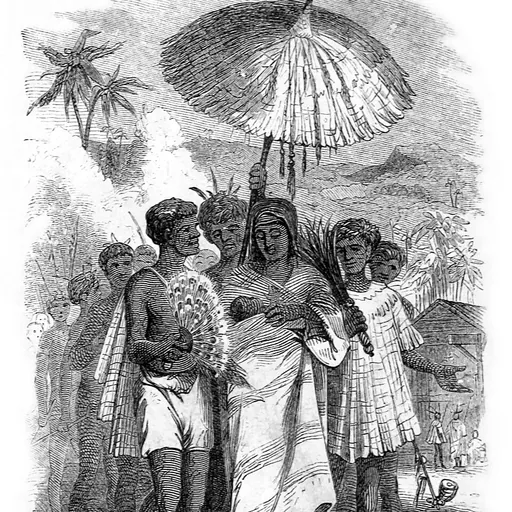
Keōpūolani
Queen consort of Hawaiʻi and the highest ranking wife of King Kamehameha I
About Keōpūolani
Lived 1778 – 1823 (aged 44–45). Keōpūolani was a consort.
Kalanikauikaalaneo Kai Keōpūolani-Ahu-i-Kekai-Makuahine-a-Kama-Kalani-Kau-i-Kealaneo (1778–1823) was a queen consort of Hawaii and the highest ranking wife of King Kamehameha I.
Early life Keōpūolani was born around 1778 at an area known as Pahoehoe of Pāpōhaku, near present-day Wailuku, on the island of Maui.
Battle of Kepaniwai In 1790, while Keōpūolani was 11, Kamehameha attacked the island of Maui at the Battle of Kepaniwai while her great-uncle King Kahekili II was away on the island Oahu. When Maui forces under Kalanikupule lost to Kamehameha, Kalola along with her two daughters, many Maui chiefesses and Keōpūolani tried to flee to Oahu. They stopped in Molokai as sickness overcame the elderly Kalola, and were caught by Kamehameha's forces. Kalola offered her granddaughter as a future bride and the recognition of Kamehameha as the ruler of Maui in exchange for peace. Other Maui chiefesses also joined Kamehameha's court.
She was given the name Wahinepio (captive women) around this time, but this name is usually associated with another chiefess. She was commonly known as Keōpūolani.
Ancestry and rank Keōpūolani was among the highest alii of all the islands of Hawaii in her days, a ranking called naha. This meant she was the product of a royal half-sister and brother marriage.
Her extended genealogy displays an extreme case of pedigree collapse; in the five preceding generations, the 64 possible positions for her ancestors are filled by only 30 individuals, largely due to multiple half-sibling marriages (by comparison, Charles II of Spain, an extreme case of European royal pedigree collapse, has 32 individuals in those positions, in his case largely due to multiple uncle-niece marriages).
This lineage gave her unquestionable social and political influence, which made her a coveted marriage partner for a chief to ensure heirs to inherit the combined ranks and birthrights of both parents. She married Kamehameha in 1795 and their marriage linked the House of Kamehameha to the ruling house of Maui and the old ruling house of Hawaii. Although Kamehameha had his own claims to these islands, Keōpūolani further cemented his legitimacy over his usurpation of his cousin, Keōpūolani's father.
She possessed the kapu moe (prostrating taboo) which required commoners to fall to their face on the ground at her presence. When chanters mentioned her name, listeners removed their kapa (bark cloth) garments above the waist in deference. Even the touching of her shadow by commoners was punishable by death. She was kindhearted and never enforced those punishments. Even Kamehameha had to remove his malo (loincloth) in her presence. She was amiable and affectionate, while her husband was not. Keōpūolani was strict in the observance of the kapu, but mild in her treatment of those who had broken it, so they often fled to her protection.
Children She mothered at least three of Kamehameha's children: Prince Liholiho in 1797 (later King Kamehameha II), Prince Kauikeaouli in 1814 (later King Kamehameha III), and Princess Nāhiʻenaʻena in 1815.
Perhaps up to eleven or twelve children were born but all except the three mentioned died young.
Illness Keōpūolani became ill, and worsened the last week of August, 1823. Many chiefs began to assemble to pay their respects to the Queen. Vessels were dispatched for them to different parts of the Islands, and one was sent by the king to Honolulu for Dr. Blatchley. In the evening of September 8, sensing that she was dying, a messenger summoned the mission families to her house.
She extended her hand to them with a smile, and said "Maikai! — "Good", — and added, "Great is my love to God". In the morning she was a little better, and conversed with her husband Hoapili.
To the prime minister, Kalanimoku, on his arrival, she is quoted by the missionaries:
Jehovah is a good God. I love him and I love Jesus Christ. I have given myself to him to be his. When I die, let none of the evil customs of this country be practiced. Let not my body be disturbed. Let it be put in a coffin. Let the teachers attend, and speak to the people at my interment. Let me be buried, and let my burial be after the manner of Christ's people. I think very much of my grandfather, Kalaniopuu, and my father Kiwalao, and my husband Kamehameha, and all my deceased relatives. They lived not to see these good times, and to hear of Jesus Christ. They died depending on false gods. I exceedingly mourn and lament on account of them, for they saw not these good times."
Baptism and death Keōpūolani wanted to receive Christian baptism. The missionaries in Lahaina, Charles Stewart and William Richards, agreed it would be appropriate. However, they wanted a spokesman fluent in the Hawaiian language so the implications of the public ceremony would be clearly understood.
English missionary William Ellis arrived at this time, and the dying woman was acknowledged as a member of the church. The king and all the assembled leaders listened to Ellis's statement of the grounds on which baptism was administered to the queen; and when they saw that water was sprinkled on her in the name of God, they said, "Surely she is no longer ours. She has given herself to Jesus Christ. We believe she is his, and will go to dwell with him." She wanted her daughter Nāhienaena to be raised as a Christian. Keōpūolani took her Christian name from Charles Stewart's wife Harriet Stewart, and her daughter would take the same name. An hour afterwards, in the early evening of September 16, 1823, she died.
The next day, the ships in port fired their guns in salute, and a large public funeral was held on September 18, 1823. She was buried at a new tomb at Hale Kamani in Lahaina. In 1837, King Kamehameha III transferred her body to the sacred island of Mokuula in Lahaina, Maui. Later her remains were perhaps reburied at the Christian cemetery at Waiola Church, along with her daughter and many others in the royal family. Keōpūolani Park at 700 Halia Nakoa Street in Wailuku and Keōpūolani Dormitory on the Kapalama Campus of Kamehameha Schools were named after her.
Family
Family tree
Ancestry
Don’t just read it —
keep it.
Full-length biographies made to live with: read them, listen on the way to work, watch them tonight.
- E-book
- Audio
- Video
Instant download · yours to keep · every purchase keeps this site free
Important facts
Family & relationships
People in Keōpūolani's life
Named in this biography and alive at the same time


Related people
Same field, nearest in time

Contemporaries
People whose lives overlapped Keōpūolani's




Frequently asked questions
Who was Keōpūolani?
Queen consort of Hawaiʻi and the highest ranking wife of King Kamehameha I
When was Keōpūolani born?
Keōpūolani was born in 1778 in Wailuku.
When did Keōpūolani die?
Keōpūolani died on 16 September 1823 in Lahaina.
What was Keōpūolani's occupation?
Keōpūolani was a consort.
What nationality was Keōpūolani?
Keōpūolani's recorded nationality: Kingdom of Hawaiʻi.
Sources & further reading
Cite this page
APA: Biography.guide. (2026). Keōpūolani. https://biography.guide/keopuolani/
MLA: "Keōpūolani." Biography.guide, https://biography.guide/keopuolani/.
Chicago: "Keōpūolani." Biography.guide. https://biography.guide/keopuolani/.
Data last updated: 2026-09-20 · Spot an error? Report a correction.
Portrait: Wikimedia Commons · author & licence
Page generated 2026-09-27 04:57 UTC