
About Kenneth Leask
Lived 1896 – 1974 (aged 77). Kenneth Leask was a British flying ace.
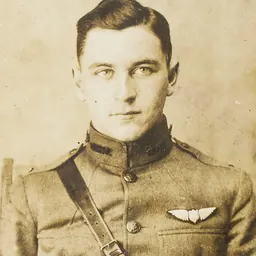
Air Vice Marshal Kenneth Malise St. Clair Graeme Leask, (30 October 1896 – 24 April 1974) was a senior officer of the Royal Air Force (RAF). He began his career in the British Army and served with the Royal Flying Corps in the First World War, being credited with eight aerial victories to become a flying ace. He flew over 100 sorties, and survived three forced landings. He attained the rank of captain, and position as flight commander, in No. 84 Squadron. He remained in the RAF after the war, being appointed Director-General of Engineering in the Air Ministry with the rank of air vice marshal after the Second World War.
Early life Leask was born in Southsea on 30 October 1896, the son of a doctor.
Military career First World War Leask joined the British Army soon after the outbreak of the First World War, being commissioned as a temporary second lieutenant in the 11th Battalion, Devonshire Regiment on 19 November 1914, just after his 18th birthday. The 11th Devonshire was a reserve training battalion, based in Wareham, Dorset, which provided the 8th and 9th Battalions, serving in France, with reinforcements and replacements. Leask was later transferred to the Machine Gun Corps, serving as an instructor. He was assigned to duty with the RFC on 1 October, and was posted to No. 42 Squadron, flying B.E.s until December, when he transferred to No. 41 Squadron flying F.E.8s. and in May he returned to England to serve as an instructor. His citation, published on 23 August, read:
On 1 April 1918, the Army's RFC and the Royal Naval Air Service were merged to form the Royal Air Force (RAF). That day Leask flew his final sorties with No. 84 Squadron, making three forced landings.
Inter-war career On 1 August 1919 Leask was granted a permanent commission in the RAF with the rank of flight lieutenant, resigning his army commission the same day. On 3 July 1920, during the Royal Air Force Aerial Pageant at Hendon Aerodrome, Leask took part in a mock aerial combat in which his Bristol F.2 Fighter was pitted against two Sopwith Snipes flown by Flight Lieutenant Arthur Coningham and Flying Officer C. E. Gibbs.
From 8 February 1921 Leask served as a flight commander in No. 208 Squadron, based at RAF Ismailia, Egypt. In late 1922, during the Chanak Crisis, his squadron was moved in Bakırköy district, Turkey. On 31 August 1923 at the British Consulate in Constantinople, Leask married Lydia Alexandrovna, the widow of Y. Genot, and daughter of General Modestoff, of Tver, Russia. Leask commanded No. 24 Squadron at RAF Kenley from 25 March to 25 May 1926, then attended the 21st Course at the Senior Officers' School at Sheerness until 20 August. After taking the Officers Engineering Course at the Home Aircraft Depot from 16 September 1926, he was appointed Engineering Officer and second in command of No. 4 Apprentices Wing at No. 1 School of Technical Training at RAF Halton on 20 August 1928. before serving as Officer Commanding No. 60 (Bomber) Squadron, based at RAF Kohat, from 20 February 1932.
On 1 January 1933 Leask was promoted to wing commander, and then served as Senior Equipment Staff Officer at the Headquarters of RAF India from 3 February On 3 February 1935 he was appointed Senior Engineering Staff Officer at the Headquarters of Air Defence of Great Britain, then as an Engineering Staff Officer, and then Senior Engineering Officer at the Headquarters of RAF Bomber Command from 14 July 1936.
Second World War Leask was transferred to the RAF's Technical Branch on 24 April 1940, and was appointed an acting air commodore to serve as Air Officer Commanding (AOC) No. 43 (Maintenance) Group (part of RAF Maintenance Command) from 20 November. On 1 June 1941 he was promoted to the temporary rank of air commodore, and on 21 August 1942 he was appointed an acting air vice marshal. A year later, on 21 August 1943, his temporary appointment as an air commodore was made war substantive. He became AOC, No 24 (Technical Training) Group (part of RAF Technical Training Command) on 10 January 1944. and this promotion was made permanent on 1 October. In March 1947 he was appointed Director-General of Servicing and Maintenance at the Air Ministry, and on 5 January 1948 he became Director-General of Engineering.
In February 1950 Leask was appointed the manager of de Jersey & Co. (Finland) Ltd., based in Helsinki, dealing with the company's exports of engineering products from the UK.
Leask and his wife Lydia were killed in a car crash at Chalfont St Peter on 24 April 1974, near to their home at Chalfont St Giles.
Don’t just read it —
keep it.
Full-length biographies made to live with: read them, listen on the way to work, watch them tonight.
- E-book
- Audio
- Video
Instant download · yours to keep · every purchase keeps this site free
Important facts
People in Kenneth Leask's life
Named in this biography and alive at the same time

Related people
Same field, nearest in time


Contemporaries
People whose lives overlapped Kenneth Leask's



Frequently asked questions
Who was Kenneth Leask?
Royal Air Force air marshals
When was Kenneth Leask born?
Kenneth Leask was born on 30 October 1896 in Southsea.
When did Kenneth Leask die?
Kenneth Leask died on 24 April 1974 in Chalfont St Peter.
What was Kenneth Leask's occupation?
Kenneth Leask was a flying ace.
What nationality was Kenneth Leask?
Kenneth Leask was British.
Sources & further reading
Cite this page
APA: Biography.guide. (2026). Kenneth Leask. https://biography.guide/kenneth-leask/
MLA: "Kenneth Leask." Biography.guide, https://biography.guide/kenneth-leask/.
Chicago: "Kenneth Leask." Biography.guide. https://biography.guide/kenneth-leask/.
Data last updated: 2026-09-20 · Spot an error? Report a correction.
Page generated 2026-09-27 05:10 UTC