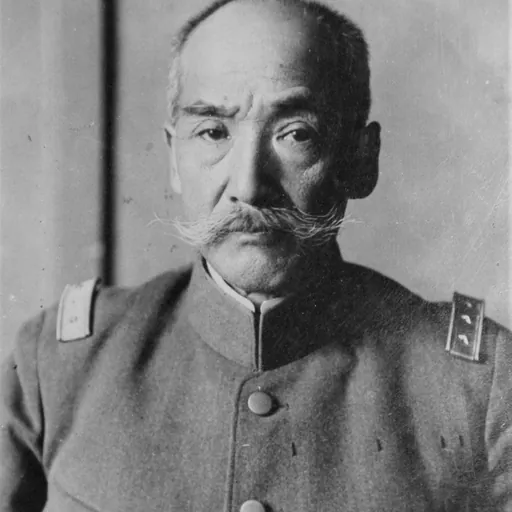
About Kenkichi Ueda
Lived 1875 – 1962 (aged 87). Kenkichi Ueda was a Japanese military personnel.
was a general in the Imperial Japanese Army during the Second Sino-Japanese War. He played an active role in the Soviet-Japanese Border Wars of the late 1930s.
Biography Born in Osaka prefecture, Ueda attended the predecessor of Hitotsubashi University and subsequently graduated from the 10th class Imperial Japanese Army Academy in 1898, and the 21st class of the Army Staff College in 1908. Although his specialization was infantry, he was assigned to the 9th Cavalry Brigade under the IJA 18th Division, and was later transferred to the IJA 16th Division. He remained in cavalry for the remainder of his career. Serving as a staff officer in the Siberian Expeditionary Army from 1918 to 1919, Ueda was promoted to colonel in July 1919.
Assigned command of the IJA 1st Cavalry Regiment in 1923, Ueda was promoted to major general in 1924 and was assigned as commanding officer of the IJA 3rd Cavalry Brigade.
Promoted to lieutenant general in 1928, Ueda became commander-in-chief of the Japanese China Garrison Army from March 1929 to the end of December 1930. As commander of the IJA 9th Division from 1930 to 1932, his division was sent into combat during the First Shanghai incident; however, it failed to break the Chinese defenses and Ueda was withdrawn in disgrace and replaced by General Yoshinori Shirakawa's IJA 11th Division. Ueda was subsequently involved in much of the fighting against Chinese forces during the Japanese occupation of Manchuria. He was promoted to the honorific title of Junior Fourth Court Rank.
Ueda lost a leg in the 29 April 1932 attack by Korean independence activist Yoon Bong-Gil which killed his superior, General Yoshinori Shirakawa in Shanghai's Hongkou Park.
Despite his injury, Ueda remained on active service and returned to Japan to staff postings with the Imperial Japanese Army General Staff, rising to the post of Vice Chief from 1933 to 1934. In 1934, Ueda became the commander-in-chief of the Chosen Army in Korea. Promoted to full general on November 28, 1934, Ueda returned to Manchukuo as commander-in-chief of the Kwantung Army from 1936 to 1939. As commander, Ueda supported measures to suppress the illicit narcotics trade in Manchukuo and northern China.
In 1939, he also held the post of ambassador of Japan to Manchukuo and was a member of the Supreme War Council.
A strong believer in the “Strike North” or Hokushin-ron policy that Japan's main enemy was communism and that Japan's destiny laid in conquest of the natural resources of the sparsely populated north Asian mainland, Ueda supported the unauthorized aggressive actions initiated by staff and field officers on the Soviet border with Manchukuo and Mongolia which led to the Soviet–Japanese border conflicts with heavy fighting and high casualties against Soviet forces around Nomonhan between May and August 1939. Despite the disastrous results of the battles against Soviet forces, Ueda remained adamant in his support of the hokushin-ron policy and refused to discourage his officers from taking similar actions. He was recalled back to Japan in late-1939 and forced into retirement.
Retiring from public life, Ueda lived quietly through World War II. In the postwar era, he served as honorary chairman of various veterans associations and died in 1962.
Decorations
Don’t just read it —
keep it.
Full-length biographies made to live with: read them, listen on the way to work, watch them tonight.
- E-book
- Audio
- Video
Instant download · yours to keep · every purchase keeps this site free
Important facts
People in Kenkichi Ueda's life
Named in this biography and alive at the same time

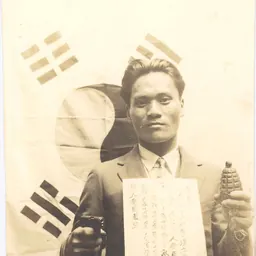
Related people
Same field, nearest in time





Contemporaries
People whose lives overlapped Kenkichi Ueda's



Frequently asked questions
Who was Kenkichi Ueda?
Japanese general (1875–1962)
When was Kenkichi Ueda born?
Kenkichi Ueda was born on 8 March 1875 in Osakasayama.
When did Kenkichi Ueda die?
Kenkichi Ueda died on 11 September 1962 in Ōiso-machi.
What was Kenkichi Ueda's occupation?
Kenkichi Ueda was a military personnel.
What nationality was Kenkichi Ueda?
Kenkichi Ueda was Japanese.
Sources & further reading
Cite this page
APA: Biography.guide. (2026). Kenkichi Ueda. https://biography.guide/kenkichi-ueda/
MLA: "Kenkichi Ueda." Biography.guide, https://biography.guide/kenkichi-ueda/.
Chicago: "Kenkichi Ueda." Biography.guide. https://biography.guide/kenkichi-ueda/.
Data last updated: 2026-09-24 · Spot an error? Report a correction.
Portrait: Wikimedia Commons · author & licence
Page generated 2026-09-27 05:08 UTC