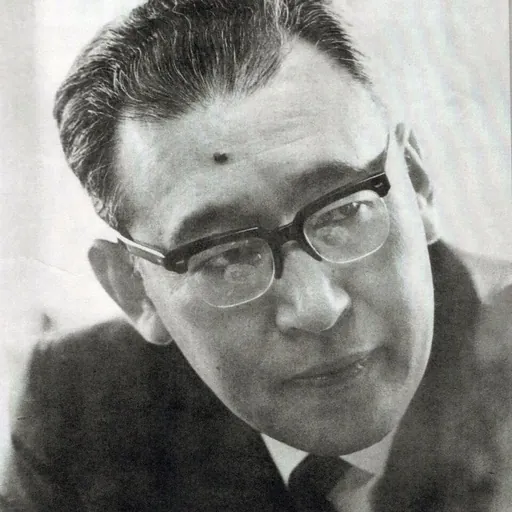
About Keizo Saji
Lived 1919 – 1999 (aged 79–80). Keizo Saji was a Japanese businessperson.
(November 1, 1919 – November 3, 1999) was a Japanese businessman and art patron.
Saji founded the Suntory Museum of Art and Suntory Hall in Tokyo. He held the court rank of Senior Third Rank (正三位).
He was ranked by Forbes in 1987 as the tenth richest person in the world, with an estimated net worth of US$4.0 billion.
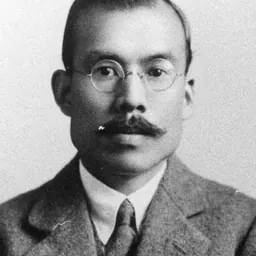
Saji married the third daughter of the engineer Yuzuru Hiraga. She died at the age of 21 shortly after giving birth to their eldest son, Saji Nobutada. He later remarried, taking as his second wife a daughter of Kensaku Ōhira, former president of Sumitomo Bank.
Nobutada, born to his first wife, served as President and Representative Director of Suntory and later served as chairman.
Harue, Saji’s daughter by his second wife, is married to the cellist Tsuyoshi Tsutsumi. She received the 44th Yomiuri Prize for Literature for her play Kana-dehon Hamlet.
Cultural patronage
Beyond business leadership, Saji played a central role in establishing Suntory as a major corporate patron of the arts in postwar Japan. He founded the Suntory Museum of Art and later supported the establishment of Suntory Hall, which became one of Tokyo’s leading concert venues. Through the Suntory Music Award, he promoted contemporary music and international cultural exchange.
Saji’s approach reflected a broader postwar pattern in which large Japanese corporations invested in cultural institutions as part of corporate identity formation. Under his leadership, Suntory cultivated an image associated with aesthetic refinement and intellectual engagement, linking its brand to both Western classical traditions and Japanese artistic heritage.
Relationship with Kaikō Takeshi
Saji maintained a notable professional and intellectual relationship with the writer Kaikō Takeshi. The two figures collaborated in advertising and public-facing cultural initiatives associated with Suntory. Their relationship has been described as an example of the intersection between corporate leadership and literary culture in late twentieth-century Japan.
Biographical accounts have highlighted the dynamic between Saji’s corporate authority and Kaikō’s literary sensibility, suggesting that their collaboration contributed to the development of a distinctive advertising style that combined narrative sophistication with commercial appeal.
Leadership at Suntory
Saji assumed leadership of Suntory during Japan’s period of rapid postwar economic growth. Succeeding his father, Shinjirō Torii, he expanded the company from a domestic wine and spirits producer into one of Japan’s leading beverage conglomerates. Under his presidency, Suntory strengthened its position in whisky production while diversifying into beer, soft drinks, and international markets.
During the high-growth decades of the 1960s and 1970s, Saji emphasized brand identity and marketing innovation. Suntory cultivated an image that linked its products to sophistication, Western modernity, and cultural refinement. The company invested heavily in advertising and celebrity endorsements, contributing to the popularization of whisky and other Western-style beverages among middle-class consumers in postwar Japan.
In the 1980s, during Japan’s asset bubble era, Suntory expanded its corporate profile internationally. In 1987, Saji was ranked by Forbes as the tenth richest person in the world, with an estimated net worth of US$4.0 billion.
Saji also integrated corporate leadership with cultural patronage, reinforcing Suntory’s identity as a company associated not only with beverages but also with the arts and scientific research.
Although Suntory remained a privately held and family-controlled company, Saji emerged as one of the most visible representatives of Japan’s corporate elite during the late twentieth century. His leadership coincided with a period in which Japanese consumer brands gained increasing international recognition.
Don’t just read it —
keep it.
Full-length biographies made to live with: read them, listen on the way to work, watch them tonight.
- E-book
- Audio
- Video
Instant download · yours to keep · every purchase keeps this site free
Important facts
People in Keizo Saji's life
Named in this biography and alive at the same time


Related people
Same field, nearest in time



Contemporaries
People whose lives overlapped Keizo Saji's


Frequently asked questions
Who was Keizo Saji?
Japanese businessman
When was Keizo Saji born?
Keizo Saji was born in 1919 in Osaka Prefecture.
When did Keizo Saji die?
Keizo Saji died on 3 November 1999.
What was Keizo Saji's occupation?
Keizo Saji was a businessperson.
What nationality was Keizo Saji?
Keizo Saji was Japanese.
Sources & further reading
Cite this page
APA: Biography.guide. (2026). Keizo Saji. https://biography.guide/keizo-saji/
MLA: "Keizo Saji." Biography.guide, https://biography.guide/keizo-saji/.
Chicago: "Keizo Saji." Biography.guide. https://biography.guide/keizo-saji/.
Data last updated: 2026-09-23 · Spot an error? Report a correction.
Portrait: Wikimedia Commons · author & licence
Page generated 2026-09-27 05:07 UTC