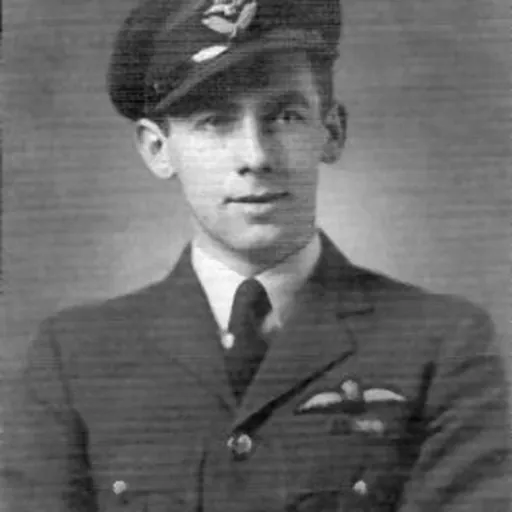
About Keith Thiele
Lived 1921 – 2016 (aged 94). Keith Thiele was a New Zealand aircraft pilot.
Keith Frederick (Jimmy) Thiele, (25 February 1921 – 5 January 2016) was an officer of the Royal New Zealand Air Force (RNZAF) during the Second World War. He was one of only four New Zealand-born airmen to receive two medal Bars to his Distinguished Flying Cross.
Early life Thiele was born in Christchurch, New Zealand on 25 February 1921. He was educated at Waltham Primary and Christchurch Boys' High Schools. Thiele was working as a junior reporter at the Christchurch Star-Sun newspaper when war was declared in September 1939. He was 19 when he joined the Royal New Zealand Air Force (RNZAF) in December 1940. On a train from Liverpool, Thiele spotted his first Supermarine Spitfire fighters and was convinced they were for him. At the reception centre later that evening he was asked to declare his flying preference and he wrote "fighters", but was posted to RAF Bomber Command. His citation in part read: "he has shown great skill and has pressed home his attacks regardless of opposition. A fine leader and a courageous flight commander, this officer has set a most praiseworthy example". He completed a tour of operations in September, having completed 32 sorties. He was rested and sent to an Operational Training Unit to serve as an instructor but quickly found this duty unsatisfactory. He dropped a rank, back to flight lieutenant, in order to return to operations. After converting to the Avro Lancaster heavy bomber, Thiele was posted to the Australian No. 467 Squadron. He took severe risks and displayed leadership, tending to a sick comrade on one flight, and on another mission to Berlin flying low enough to knock out Nazi searchlights and anti-aircraft. In March 1943, Bomber Command ordered an attack on Nuremberg into the heart of the Third Reich. Thiele, on the right, with Squadron Leader Sinclair of No. 467 Squadron, June 1943 It was flying a Lancaster that Thiele completed 20 more missions and, in May 1943, he was awarded the Distinguished Service Order for displaying outstanding courage, keenness and determination during operations.
In mid 1943, Thiele declined a posting to No. 617 Squadron under the command of Guy Gibson, the man who had led that squadron on the May 1943 Dambusters raid that blew up the Ruhr dams. A few weeks after the raid, Thiele received a message that Gibson wanted to see him at RAF Scampton, in Lincolnshire. Thiele, with 50 operations behind him, told Gibson that he had had his fill of bombers and was desperate to fulfil his ambition to fly Spitfires. He informed Gibson that he did not want to appear ungrateful but disclosed he already had the wheels rolling to go to a unit flying experimental Spitfires as a step out of Bomber Command. Thiele believed that he had been picked out by Ralph Cochrane of Group Headquarters as a likely successor to Gibson, a position that would eventually go to Squadron Leader George Holden. Thiele's decision not to join No. 617 Squadron proved the right decision. On the night of 15–16 September 1943, 5 of the 12 Lancasters were lost during a mission to bomb on the Dortmund-Ems Canal, including Holden's, which was shot down by flak with no survivors. He flew Spitfires XIIs from Tangmere with No. 41 Squadron, flying cross-channel support missions in support of the June D-Day landings on the Normandy coast. He was one of the experienced pilots sent to destroy V1-flying bombs destined for London. As the campaign opened he had been delegated to shore patrols along the Kent coast and the Narrow Seas in defence of coastal shipping, victims of sabotage attacks from occupied France. Thiele stands second left with fellow squadron commanders of No. 122 Wing, Evan Mackie (first left), of No. 80 Squadron, and Arthur Umbers (first right), of No. 486 Squadron; Patrick Jameson, commander of the wing, stands third left Later promoted to flight command, Thiele joined No. 486 (NZ) Squadron in October 1944 to pilot Hawker Typhoon fighters from Volkel, the Netherlands, on which he completed 50 operations.
Prisoner of war On 10 February 1945, Thiele led a formation of eight Tempests to attack locomotives in the Paderborn-Rheine area. Thiele and another pilot were shot down by enemy anti-aircraft fire, Thiele being seen to bail out of his burning aircraft near Doorsten. He was officially reported as missing in action. Slightly wounded, Thiele was taken captive by the flak crew that had shot him down and, following interrogation, he was sent to a prisoner of war (POW) camp at Dulag Luft near Wetzlar.
On 31 March 1945, after the POW camp was liberated but before any transport or Allied forces arrived, Thiele and a Canadian airman stole bicycles and then a motorcycle, and he got back to his base five weeks before the end of the war in Europe. He was one of four New Zealanders to have been awarded the DFC three times. Thiele relinquished his commission on 5 December 1946. Thiele was a member of the Caterpillar Club, an informal association of people who had successfully used a parachute to bail out of a disabled aircraft. He was the captain of the inaugural jet service from Brisbane to London in October 1959, flying the Sydney to Singapore leg of the trip in the Boeing 707. An avid adventurer, twice during sailing excursions on the notorious Tasman Sea, Thiele had his tiny yacht (named Spitfire) smashed by mountainous waves, yet he managed to sail home. Thiele later built and operated a marina in Sydney and sailed his own yacht across the Tasman Sea to see New Zealand's first America's Cup defence when he was 80. In later life, Thiele retired to the Queensland town of Bundaberg.
Don’t just read it —
keep it.
Full-length biographies made to live with: read them, listen on the way to work, watch them tonight.
- E-book
- Audio
- Video
Instant download · yours to keep · every purchase keeps this site free
Important facts
People in Keith Thiele's life
Named in this biography and alive at the same time


Related people
Same field, nearest in time


Contemporaries
People whose lives overlapped Keith Thiele's




Frequently asked questions
Who was Keith Thiele?
New Zealand World War II pilot (1921-2016)
When was Keith Thiele born?
Keith Thiele was born on 25 February 1921 in Christchurch.
When did Keith Thiele die?
Keith Thiele died on 5 January 2016 in Sydney.
What was Keith Thiele's occupation?
Keith Thiele was an aircraft pilot.
What nationality was Keith Thiele?
Keith Thiele was New Zealand.
Sources & further reading
Cite this page
APA: Biography.guide. (2026). Keith Thiele. https://biography.guide/keith-thiele/
MLA: "Keith Thiele." Biography.guide, https://biography.guide/keith-thiele/.
Chicago: "Keith Thiele." Biography.guide. https://biography.guide/keith-thiele/.
Data last updated: 2026-09-20 · Spot an error? Report a correction.
Page generated 2026-09-27 05:10 UTC