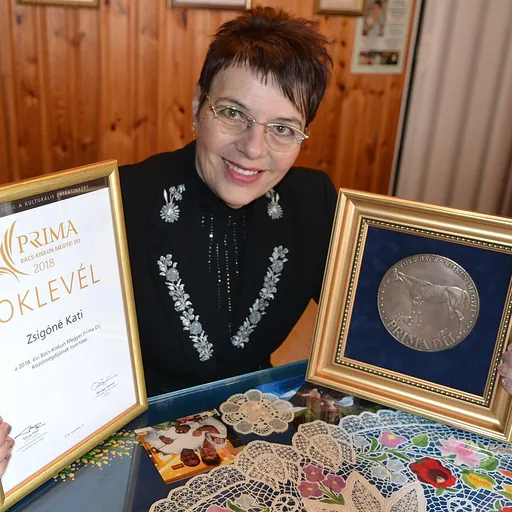
Kati Zsigóné
Hungarian fine artist
About Kati Zsigóné
Born 1953. Kati Zsigóné is a Hungarian folk artist.
Kati Zsigóné (Józsefné Zsigó, born Julianna) (born 16 June 1953 in Kecskemét) is a Hungarian fine artist, egg painting artist. In 2009 in Dubai, she was chosen among the top five egg painting artists in the world, and the best one on the European continent.
Life Her father was a farmer and basket weaver. Julianna (who got her nickname ’Kati’ from her father)
She married József Zsigó on 7 May 1977, their daughter, Katalin was born 9 July 1978, while their granddaughter, Panna was born 3 January 2013.
Artistry Her artistry unfolded because of the support of her husband, until today he is her most important supporter and inspiration. The start of her career was the birth of their daughter, when she wanted to hire painter ladies to decorate the room of her daughter; her husband persuaded her to paint the room herself. Because of this, she started to practice drawing and painting on a higher level. Among the eight forms of artistry she practices today, the first one was wall-painting.
The final form of art she learned was glass painting (including icons) - her first major work in this field was the decoration of the cabinets at her own exhibition. But the branch of art she is fond of the most is egg painting. She decided to involve herself in this art after she got to enjoy the motives (including flowers) and colors of wall painting. Since then, she is spreader and teacher of Hungarian folk art.
She makes nearly 300 types of egg decorations using over 20 different techniques.
She has painted, scratched, engraved, waxed, lacy, applique, washed, carved, etched, tapestry eggs, eggs with horseshoes etc. She often uses combined techniques on her eggs as well.
She mainly uses eggs of hens, geese, ducks, ostriches, emus, greater rheas and parrots.
Among her most notable creations, we find eggs that are a meter or even 2 meters tall, eggs decorated with silver and gold, and she also captured Leonardo’s famous painting The Last Supper. Her own, self-drawn collection of motifs include nearly 3500 different egg- and other motifs of folk art.
The Egg of the Hungarian Nation
The Egg of the Hungarian Nation (Hungarian: ’’A Magyar nemzet Tojása’’) is a special egg Zsigóné made in 2018, for the 980th anniversary of the death of Stephen I. The base was the egg of an ostrich. She utilized 11 different techniques on it (including painting, waxing, scratching, carving, batik, dotting, horseshoeing etc.) creating 79 patterns, including Hungarian motifs (halas lace, Matyó- and Kalocsai lace etc.). The motifs, images and signals depicted on the egg commemorate different important moments and symbols of Hungarian history, including the Hungarian crown jewels, the turul, the Conquest of the Carpathian Basin, the Blood oath, or the Treaty of Trianon, as well as the Assumption of Mary and 16 golden horseshoes.
The work on this egg lasted for over a year, including four months for placing the motifs.
The Talking Egg
Another special egg created by zsigóné is the Talking Egg (Hungarian: A Beszélő Tojás). This egg uses traditional waxed technique, and depicts 348 classic, traditional Hungarian motifs, which are separated by 13000 dots, symbolizing seeds.
The base of this piece of art was a 49x44 cm ostrich egg, the process took seven months and was finished in 2019. The egg depicts 40 notable historical figures, including Albert Einstein, Thomas Alva Edison, Marie Curie, Ignác Semmelweis, Ede Teller, Isaac Newton, Stephen Hawking, Leonardo da Vinci, Nikola Tesla, Wolfgang Amadeus Mozart, Mahatma Gandhi, Mother Teresa, Yuri Gagarin, Jesus Christ, and Pelé, among others, as well as 4 contemporary figures like Bill Gates and Oprah Winfrey. 4 Hungarian people are also present, just like the initials of the artist herself. Furthermore, the egg depicts 14 well-known buildings and structures like the Giza pyramid complex, the Great Wall of China, the Christ the Redeemer statue of Rio, Taj Mahal, the Moai statues, or Petra of Jordan, as well as 30 objects and expressions which bear importance in the human life, like peace, the DNA, time, writing, family, numbers, movie, flight, healing, time etc. The 14 most notable religions and 16 diamonds in golden socket are also present on the surface of the egg.
She spent no less than 3 years decorating the egg, the craftsmanship itself took 6 months, the rest was collection and processing of the materials. Her goal was to find motives which best represent mankind, in order to offer at least one familiar motif to everyone around the world. The creation aims to be a message for every human being, stressing the importance of loving each other and the protection of our planet.
The artwork was unveiled on 7 March 2023.
Awards
1995: Népi Iparművész-díj (circa Traditional Fine Artist of the Year) 2004: A nap embere (People of the Day award) 2009: Dubai: she was chosen among the top five egg painting artists in the world, and the best one in Europe. 2011: she released a portrait film in five languages, titled A tojásdíszítés királynője (The Queen of Egg Painting), on a disc decorated with 24 carat gold. 2017: she was chosen member of the British Encyclopaedia 2018: Kecskemét Mestere díj (Master of Kecskemét Award) 2018: Prima-award 2018: her work was declared National Value 2021: Vitézi Rend Lovagkeresztje 2021: Kárpát-medencei Vitézi Rend vitézi kardos nagy jelvénye 2021: Nemzeti Önazonosságunk Védelmezője cím 2023: Magyar Bronz Érdemkereszt polgári tagozat kitüntetés 2024: A Magyar Művészeti Akadémia tagjává választotta, mint a "A magyar művészeti és kulturális élet jeles képviselőjét." 2025 Elismerő oklevél a kazahsztáni mesterkurzus magasszintű megtartásáért. 2026 Munkássága értékként bekerült a Bács-Kiskun Vármegyei Értéktárba és kulturális örökségnek nyilvánították – released in German translation as well Tojásdíszítés mesterfokon (2002)
Exhibitions Zsigóné had her creations exhibited in Hungary, in the Danish Cultural Institute and in Herend (together with the famous Herend porcelains), as well as in Dubai and in Brussels.
In 2014, she created her own exhibition in her own home, which is visited by Hungarians and foreigners alike.
Don’t just read it —
keep it.
Full-length biographies made to live with: read them, listen on the way to work, watch them tonight.
- E-book
- Audio
- Video
Instant download · yours to keep · every purchase keeps this site free
Important facts
People in Kati Zsigóné's life
Named in this biography and alive at the same time




Related people
Same field, nearest in time


Contemporaries
People whose lives overlapped Kati Zsigóné's



Frequently asked questions
Who is Kati Zsigóné?
Hungarian fine artist
When was Kati Zsigóné born?
Kati Zsigóné was born on 16 June 1953 in Kecskemét.
What is Kati Zsigóné's occupation?
Kati Zsigóné is a folk artist.
What nationality is Kati Zsigóné?
Kati Zsigóné is Hungarian.
Sources & further reading
Cite this page
APA: Biography.guide. (2026). Kati Zsigóné. https://biography.guide/kati-zsigone/
MLA: "Kati Zsigóné." Biography.guide, https://biography.guide/kati-zsigone/.
Chicago: "Kati Zsigóné." Biography.guide. https://biography.guide/kati-zsigone/.
Data last updated: 2026-09-22 · Spot an error? Report a correction.
Portrait: Wikimedia Commons · author & licence
Page generated 2026-09-27 05:02 UTC