
About Käthe Reinhardt
Lived 1896 – 1987 (aged 90). Käthe Reinhardt was an event producer and lGBTQ rights activist.
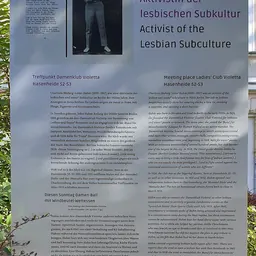
Käthe "Kati" Reinhardt, born Katharina Erika Selma Reinhardt (23 September 1896 – 28 June 1987), was a German activist in the lesbian movement. She was a formative figure in Berlin's lesbian subculture from the time of the Weimar Republic to the early 1980s as an organizer of clubs, balls, and meetings, and as a bar operator. In the 1920s she ran the largest clubs for the lesbian movement, which served up to 2,000 people, and worked, among others, with Charlotte “Lotte” Hahm.
Early life Käthe Reinhardt was born on 23 September 1896 at her parents' apartment at Claudiusstrasse 4 in the Hansa Quarter. Her parents were Max Reinhardt, a bank clerk, and Marie née Gassel. She grew up as part of the upper middle class. She had a brother, Walter, who was born in 1890. No further details about her childhood and youth are known.
1927 - 1932 Reinhardt first came to public prominence at the beginning of 1927, after she published two poems in the lesbian magazine The Girlfriend. The following was reported about the Christmas and New Year's Eve balls in 1928: "The events of the club were rarely of great success Women's Club 'Monbijou', in the 'Zauberflöte', Commandant Street 72, on Christmas holidays and New Year's Eve. Around 300 women showed up on Christmas Day to hand out Christmas presents […]. The New Year’s Eve celebration at the ‘Monbijou’ club was surprisingly well attended. Well over 400 women wanted to celebrate the New Year with like-minded people. Many left because there was no chance of getting a chair. [...] It was full of activity until 6 a.m".
Ruth Margarete Roellig dedicated a separate chapter to the club in her 1928 book, in which she wrote: "a lavishly colorful flood of light floods over the mostly youthful, slim female figures who are here harmless happiness at the "mirror dance", waltz or at the social tyrolienne. A special feature of the club is the very official distinction between "Bubis" - the masculine - and "Mädis" - the feminine women. This is the case with the popular bell dance, where the "Bubis" are alone Receive bells and use them to ring the bells for their girls. [...] Other male visitors are very unwelcome, people prefer to be among themselves. Despite its relative youth, the Monbijou club already enjoys a large following in the better circles of young girls [ ...] The highlight of these evenings is the wonderful play of lights, which is worth seeing - soon the large, beautiful hall is ablaze with purple, then green again, or it suddenly turns into a deep, rich red, in whose soft light the couples follow the sounds of the music."
The club's first foundation festival was scheduled for 31 August 1929. Two days earlier, the announcement came that Kati Reinhardt and the club were leaving the German Friendship Association, merging with the Violetta club under Lotte Hahm, which also belonged to the DFV, and joining together to form the DFV's larger competitor organization, the Bund für Menschrecht under Friedrich Radszuweit. According to Lotte Hahm, Carl Bergmann, the president of the DFV and the head of the women's group, was a heterosexual man who founded the women's club "only to exploit it for his personal purposes". Selli Engler, who was still part of the DFV at the time but also switched to the BfM shortly afterwards, reported on an encounter between her and Reinhardt on the evening of the foundation party, at which Reinhardt insulted and verbally abused her, which was probably related to Engler's previous publications in which she had accused Reinhardt and Hahm of betrayal of the DFV and base motives.
The Association 1929 of the ladies' clubs Violetta and Monbijou organized three evenings a week in the Magic Flute. Around 500 women could be present at New Year's Eve balls; men were not allowed to enter. Outside of the Magic Flute evenings, the two clubs operated independently of each other. The bar existed from 1945 to 1947 for around one and a half years and was therefore the first lesbian bar in East Berlin. Since the restaurant was not well-liked in the Soviet sector, they moved to Oranienstrasse 162
"Elite dance evenings" In 1945, immediately after the end of the war, Reinhardt and Lotte Hahm began to organize larger events. They tried to organize balls together at the Magic Flute, but Reinhardt soon began organizing balls on her own. These balls were called “elite dance evenings” and took place once a month from the 1950s to the early 1980s. The locations changed, around 1950 in the “cabin” behind the Schöneberg town hall, in the winter in the 1950s and in the 1980s in the Hotel Intercontinental, In monographic works on the history of the Berlin homosexual movement, Heike Schader in 1994 and Jens Dobler in the early 2000s systematized and supplemented the knowledge about Reinhardt. In 2020, Claudia Schoppmann published a first biographical account of Käthe Reinhardt's life.
Don’t just read it —
keep it.
Full-length biographies made to live with: read them, listen on the way to work, watch them tonight.
- E-book
- Audio
- Video
Instant download · yours to keep · every purchase keeps this site free
Important facts
People in Käthe Reinhardt's life
Named in this biography and alive at the same time





Related people
Same field, nearest in time




Contemporaries
People whose lives overlapped Käthe Reinhardt's
Frequently asked questions
Who was Käthe Reinhardt?
lesbian activist of Weimar Germany
When was Käthe Reinhardt born?
Käthe Reinhardt was born on 23 September 1896 in Berlin.
When did Käthe Reinhardt die?
Käthe Reinhardt died on 28 June 1987 in West Berlin.
What was Käthe Reinhardt's occupation?
Käthe Reinhardt was an event producer and lGBTQ rights activist.
What nationality was Käthe Reinhardt?
Käthe Reinhardt's recorded nationality: Weimar Republic.
Sources & further reading
Cite this page
APA: Biography.guide. (2026). Käthe Reinhardt. https://biography.guide/kathe-reinhardt/
MLA: "Käthe Reinhardt." Biography.guide, https://biography.guide/kathe-reinhardt/.
Chicago: "Käthe Reinhardt." Biography.guide. https://biography.guide/kathe-reinhardt/.
Data last updated: 2026-09-20 · Spot an error? Report a correction.
Page generated 2026-09-27 04:59 UTC