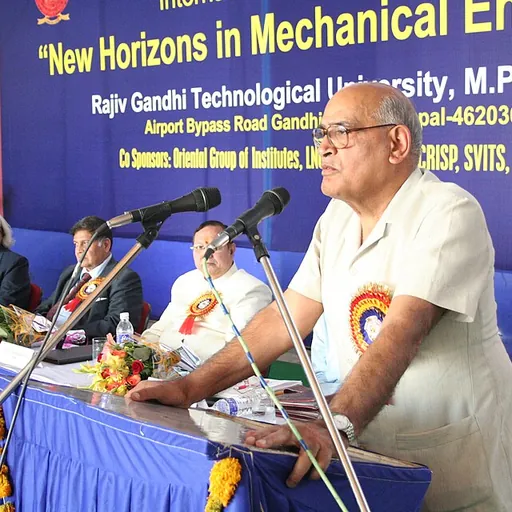
About Kasturi Lal Chopra
Lived 1933 – 2021 (aged 87). Kasturi Lal Chopra was an Indian physicist.
Kasturi Lal Chopra (31 July 1933 – 18 May 2021) was an Indian materials physicist and a director of the Indian Institute of Technology, Kharagpur. He was the founder of the Thin Film Laboratory at Indian Institute of Technology, Delhi and the Microscience Laboratory at IIT, Kharagpur and held several US and Indian patents for his research findings. Author of a number of books on thin film technology, he was a recipient of Shanti Swarup Bhatnagar Prize, the highest Indian award in the science and technology categories. The Government of India awarded him the fourth highest civilian honour of the Padma Shri, in 2008, for his contributions to science and engineering.
Biography
K. L. Chopra was born on 31 July 1933 at Chahal Kalan in the Gujranwala District of British Punjab Province to Jagat Ram and Chanan Devi Chopra. He studied science at the University of Delhi from which he graduated with honors in physics in 1952, and followed it up with a master's degree from the same university in 1954. He pursued his doctoral studies at the University of British Columbia on a fellowship and secured his PhD in low temperature physics in 1957. He served as the vice president of the Materials Research Society of India and was a life member of the society. He was also a former member of the council of the Indian National Science Academy (1988–90) and served as an honorary professor at King Fahd University of Petroleum and Minerals, Saudi Arabia, IIT Delhi, IIEST Shibpur and Indian Institute of Technology Bhubaneswar.
Legacy Working on thin films and nanomatter, Chopra did pioneering studies through which he established specular scattering of electrons in epitaxial metal films, discovered field induced nucleation and growth process as well as giant photocontraction effect in amorphous chalcogenide films, developed semiconducting metallopolymer films and proposed new process protocols for low dimensional nanomaterials and high temperature superconductors. Thin Film Solar Cells, Thin Film Device Applications and Vacuum Science and Technology. He also edited two books, Thin Film Technology and Applications: International Workshop, New Delhi, Nov. 1984, Proceedings and Thin Films 7: Proceedings of the 7th International Conference on Thin Films, New Delhi, India, December 7–11, 1987. He held six US patents and eight of his know-hows are in use with Indian industries. Besides, he mentored 100 MTech and 60 PhD students in their researches and served as a member of the editorial boards of many journals. It was during his tenure as the head of the institution, the Thin Film Laboratory of IIT Delhi and Microscience Laboratory of IIT Kharagpur were established. The Indian Vacuum Society awarded him Distinguished Vacuum Scientist Award in 1994, and the next year, he received the Distinguished Material Scientist Award of the Materials Research Society of India, the highest award of the society. The Indian National Science Academy awarded him the Prasanta Chandra Mahalanobis Medal in 1996 and the Aryabhata Medal in 2004. In between, he received two awards, the Lifetime Achievement Award of the Solar Energy Society of India and ISI Citation Laureate Award. and the National Academy of Sciences, India followed suit in 1980 and 1988 respectively. He was also an elected fellow of the Indian National Academy of Engineering, Asian Pacific Society for Materials Research and the American Physical Society and an honorary fellow of Punjab Academy of Sciences. Uttar Pradesh Technical University conferred the degree of Doctor of Science (honoris causa) on him in 2006, followed by the Indian Institute of Technology, Kharagpur in 2010. He delivered several award orations and keynote addresses including K. S. Krishnan Memorial Award Lecture of the Indian National Science Academy (1992), Biren Roy Memorial Lecture Award (1997), Institute Lecture on Ethical Values in Science and Technology of the Indian Institute of Technology, Kanpur (2008) and D. S. Kothari Memorial Oration Award of the Defence Laboratory, Jodhpur (2009).
Selected bibliography
Don’t just read it —
keep it.
Full-length biographies made to live with: read them, listen on the way to work, watch them tonight.
- E-book
- Audio
- Video
Instant download · yours to keep · every purchase keeps this site free
Important facts
People in Kasturi Lal Chopra's life
Named in this biography and alive at the same time
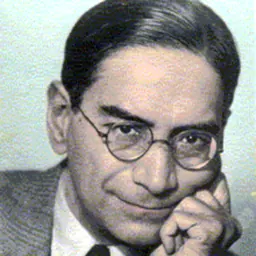

Related people
Same field, nearest in time

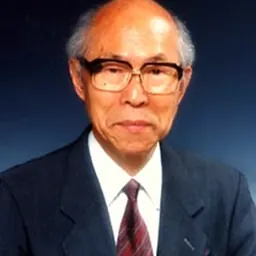
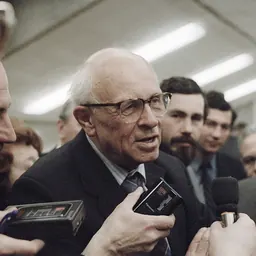
Contemporaries
People whose lives overlapped Kasturi Lal Chopra's




Frequently asked questions
Who was Kasturi Lal Chopra?
Indian material physicist
When was Kasturi Lal Chopra born?
Kasturi Lal Chopra was born on 31 July 1933 in Gujranwala District, India, Punjab Province (British India).
When did Kasturi Lal Chopra die?
Kasturi Lal Chopra died on 18 May 2021.
What was Kasturi Lal Chopra's occupation?
Kasturi Lal Chopra was a physicist.
What nationality was Kasturi Lal Chopra?
Kasturi Lal Chopra was Indian.
Sources & further reading
· Wikipedia: Kasturi Lal Chopra
Cite this page
APA: Biography.guide. (2026). Kasturi Lal Chopra. https://biography.guide/kasturi-lal-chopra/
MLA: "Kasturi Lal Chopra." Biography.guide, https://biography.guide/kasturi-lal-chopra/.
Chicago: "Kasturi Lal Chopra." Biography.guide. https://biography.guide/kasturi-lal-chopra/.
Data last updated: 2026-09-22 · Spot an error? Report a correction.
Portrait: Wikimedia Commons · author & licence
Page generated 2026-09-27 05:01 UTC