
About Kassian Cephas
Lived 1845 – 1912 (aged 67). Kassian Cephas was an Indonesian photographer.
Kassian Cephas or Kassian Céphas (15 January 1845 – 16 November 1912) was a Javanese photographer of the court of the Yogyakarta Sultanate. He was the first indigenous person from Indonesia to become a professional photographer and was trained at the request of Sultan Hamengkubuwana VI (r. 1855–1877). After becoming a court photographer in as early 1871, he began working on portrait photography for members of the royal family, as well as documentary work for the Dutch Archaeological Union . Cephas was recognized for his contributions to preserving Java's cultural heritage through membership in the Royal Netherlands Institute of Southeast Asian and Caribbean Studies and an honorary gold medal of the Order of Orange-Nassau. Cephas and his wife Dina Rakijah raised four children. Their eldest son Sem Cephas continued the family's photography business until his own death in 1918.
Early life Kassian Cephas was born in Yogyakarta to the Javanese couple of Kartodrono and Minah. As a youth, Cephas became a pupil of Protestant Christian missionary Christina Petronella Philips-Steven and followed her to nearby Bagelen, Purworejo. He was baptized there on 27 December 1860 at the age of fifteen and took the name of Cephas, the Aramaic equivalent of Saint Peter's name, as his baptismal name. He began using Cephas as a family name following the baptism.
Photography career Taman Sari complex, part of the kraton at Yogyakarta, around 1890. Upon Cephas' return to Yogyakarta in the early 1860s, he began training under Simon Willem Camerik, a member of the civil militia and court photographer of the Yogyakarta Sultanate. Cephas' training was conducted at the request of Sultan Hamengkubuwana VI, who noted his talent for photography. He became the appointed court painter and photographer as early as 1871.
Cephas' studio was located on the second floor of the building where he and his wife lived in Yogyakarta's Lodji Ketjil Wetan area, now known as Major Suryotomo Street. His photography business was not the only one established in the area during this time period. Aside from portrait photography, Cephas also produced many works on buildings and ancient monuments. This included photographs of the Taman Sari Water Castle (1884) for the Royal Batavian Society of Arts and Sciences.
Professional works
His work first appeared for a wider public in 1888 in the publication In den Kedaton te Jogjåkartå by Isaäc Groneman. The book included 16 collotype prints of the art of Hindu Javanese dances. Groneman wished to generate interest in this culture in the Netherlands and requested permission from Sultan Hamengkubuwana VII for Cephas to photograph the dance scenes. The publication was originally prepared by the Royal Netherlands Institute of Southeast Asian and Caribbean Studies, but the high cost of collotype prints forced the institute to abandon it. In keeping with the technological advances of photography, Cephas bought a new camera in 1886 which enabled him to capture pictures in 1/400th of a second. This allowed the subjects to be photographed more quickly rather than having to remain still for several moments. These pictures were often presented as farewell presents to European elites when they left Yogyakarta to return to Europe and to Dutch civil servants.
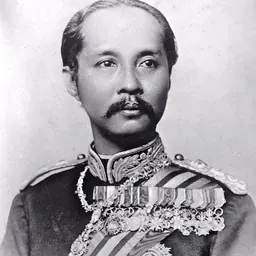
In 1889, the Archaeological Union began efforts to study and preserve monuments of the Hindu Javanese civilization in Central Java. One of the locations having high priority in the union's efforts was the temple of Prambanan, part of the larger complex attributed to the legend of Loro Jonggrang. Cephas was assigned to photograph the site, while his eldest son Sem drew the buildings' profiles and ground plans. Groneman submitted the photographs and descriptions made by Cephas to the Royal Institute in 1891, but it would not be published until 1893 because of the high reproduction costs. The final publication included 62 collotypes depicting Prambanan and the surrounding temples. Several years later, he was nominated for membership in the Royal Institute in recognition of his work with the Archaeological Union. Cephas accepted the nomination in a letter dated 15 June 1896. Later that year, he photographed a visit by Thailand's King Chulalongkorn to Yogyakarta. As a token of gratitude, the king presented him with a case of three jeweled buttons.
Groneman and Cephas worked together for the final time in 1899 to document the four-year commemoration of Hamengkunegara III's accession to the throne as Crown Prince of the Yogyakarta Sultanate. The event's preparation took one and a half years, and a theatrical performance lasting four days was attended by 23,000 to 36,000 spectators daily. A blue velvet book covered with gold and diamonds covering the performance was presented as a gift on the occasion of the wedding of Queen Wilhelmina and Prince Henry of the Netherlands in 1901. On the occasion of Wilhelmina's 21st birthday later that year, Cephas was awarded with an honorary gold medal of the Order of Orange-Nassau for his work to portray and preserve Java's cultural heritage. Their graves were moved to Sasanalaya Cemetery, east of Brigadier General Katamso Street, in 1964, to make way for new buildings. Although both Cephas and his son were accomplished court photographers, Cephas was the most important of the two and was the first Javanese person (and therefore first indigenous Indonesian) to become a professional photographer.
Personal life Cephas married Dina Rakijah (b. 1846), a Christian Javanese woman and daughter of Soerobangso and Rad Rakemah, at a church in Yogyakarta on 22 January 1866. The couple raised one daughter and three sons: Naomi (b. 28 June 1866), Sem (b. 15 March 1870), Fares (b. 30 January 1872), and Jozef (b. 4 July 1881). They also had a son named Jacob who was born in 1868, but died the same year. Naomi married Dutch engineer Christiaan Beem in 1882, and the couple had thirteen children, eight of whom reached adulthood. Cephas' eldest son Sem became a photographer and painter in his father's studio.
Gallery
Don’t just read it —
keep it.
Full-length biographies made to live with: read them, listen on the way to work, watch them tonight.
- E-book
- Audio
- Video
Instant download · yours to keep · every purchase keeps this site free
Important facts
People in Kassian Cephas's life
Named in this biography and alive at the same time
Related people
Same field, nearest in time



Contemporaries
People whose lives overlapped Kassian Cephas's


Frequently asked questions
Who was Kassian Cephas?
Indonesian photographer (1845–1912)
When was Kassian Cephas born?
Kassian Cephas was born on 15 January 1845 in Yogyakarta.
When did Kassian Cephas die?
Kassian Cephas died on 16 November 1912 in Yogyakarta.
What was Kassian Cephas's occupation?
Kassian Cephas was a photographer.
What nationality was Kassian Cephas?
Kassian Cephas was Indonesian.
Sources & further reading
Cite this page
APA: Biography.guide. (2026). Kassian Cephas. https://biography.guide/kassian-cephas/
MLA: "Kassian Cephas." Biography.guide, https://biography.guide/kassian-cephas/.
Chicago: "Kassian Cephas." Biography.guide. https://biography.guide/kassian-cephas/.
Data last updated: 2026-09-25 · Spot an error? Report a correction.
Page generated 2026-09-27 05:13 UTC