
About Kasëm Trebeshina
Lived 1926 – 2017 (aged 91). Kasëm Trebeshina was an Albanian poet and translator.
Kasëm Trebeshina (8 August 1926 – 6 November 2017) was an Albanian resistance fighter, actor, translator and writer. He was member of national resistance during World War II, part of the National Liberation Movement.
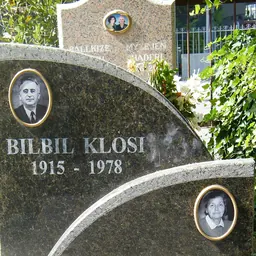
Biography Kasëm Trebeshina was born in Berat, originating from Vinokash in the region of Përmet, born to Hysen Vinokashi and Hatixhe Sanxhaktari. He was born in his mother's house in the "Murad Çelebi" neighbourhood in Berat, because Vinokash was burned by the Greek andarts during the First Balkan War and the family settled in the plain of Myzeqe. He finished elementary education in his birthplace and continued high-school in Elbasan, he left school in order to join the resistance movement, due to his brother being arrested by the fascist authorities. He fought in the region of Myzeqe and Mallakastër, after the injury he served in Vlora. At this time Trebeshina committed two controversial murders: one without trial and one behind the back. In the last days of the resistance Trebeshina was proposed to join the Department for People's Protection (Albanian name-sake of OZNA), but he did not accept. He continued in the serving as a military officer, being banished at 8 January 1948. During the years 1945-46 he served as assistant judge of Bilbil Klosi in some political cases.
In 1945, the communist dictator Enver Hoxha gave him the rank of First Captain, next to Kadri Hazbiu, Teme Sejko and Nesti Kerenxhi. After the war, he studied at the A. N. Ostrovsky Theatre Institute in Leningrad, but did not remain long. According to Edmond Cali and Nuri Dragoj he left the Ostrovsky Institute due to political quarrels However archival sources have shown he left it due to his desire to return to the Albanian People's Army. After he wrote a letter to Enver Hoxha, he left the Party and later the League of Writers and Artists. He was firstly arrested in 1953 and condemned with three years, yet served only 11 months of his sentence. From 1955 to 1962 he did not work, Although aware that Trebeshina was not working, the communist authorities who in other instances persecuted what they referred to as "parasites", took no measures against him, nor did they pressure him to work. Due to this behavior, in 1962 the authorities finally decided to send him to internment for 5 years, a sentence which he didn't serve in full. Some sources claim he was imprisoned for 17 years. Afterwards he was not released from prison until 1991. After the infamous 1997 riot in Albania Trebeshina fled from Albania and migrated to Istanbul, Turkey. He wrote the novel "Mekami", in the narrative "Kukudhi", the short novel "Kisha e Shën Kristoforit: Legjenda e Kostandinit dhe e Doruntinës", the novel "Rruga e Golgotës", short novel "Odin Mondvalsen" and the short novel "Hani i Begomires". It is clearly expressed in the memuaristic essays in the volume "Dafinat e thara", in the historical novel "Këngë shqiptare" and the novel "Tregtari i skeleteve", perfect example of intertextuality. When he was lastly arrested, in his investigation file the authorities labelled his literary work as "amoral".
After the fall of communism he was proclaimed a dissident based on a letter he supposedly sent to Enver Hoxha in 1953, where he supposedly criticized the method of socialist realism. However the veracity of this claim has been called into question and the letter has been called a fabrication. Albanian writer Ismail Kadare expressed indignation at the attempt of portraying a member of the secret police Sigurimi, as a dissident. According to the writer, part of the blame for spreading the myth of Trebeshina's dissidence is attributed to the albanologist Robert Elsie.
In the novel Mekami, Trebeshina portrays Albanian national hero Skanderbeg as a horse thief and ethnic Albanians as cowards who offer their wives and daughters to the Turkish warriors who are portrayed as heroic. The Turks have the author's sympathy. He glorifies their virtues and their victories. The Turk is presented as noble and peaceful in peace and brave in war against the "dirty" and "treacherous" Albanians. The book is filled with an insulting and derogatory tone towards Albanians and their history. The book has been compared to Hitler's Mein Kampf.
Translations His novel Odin Mondvalsen was translated into German by Hans-Joachim Lanksch, published in Klagenfurt in 1994. His memoirs-essays Dafinat e thara (The dry laurels) were translated in Italian by Edmond Çali, published in Rome in 2007. Furthermore his novel Pylli - Evandri dhe Nausika (; ) was translated in French by Anne-Marie Autissier and published by L’Espace d’un Instant editions in 2011.
Oeuvre He was one of the first writers to write an elegy about Stalin's death. In his poem about Stalin, Trebeshina reinforces the myth of Stalin as Prometheus and father of the world, the main myths of communist propaganda, and points out with admiration that both Albanian dictator Enver Hoxha and Mehmet Shehu are crying for Stalin. His first post-Communist work published came out in Pristina by the intervention of Martin Camaj. Most of his work was published after the fall of Communism, during the 1990s, which made him free to express his ideas in his works. His literary works include: Kruja e çliruar, 1953 Artani dhe Min'ja, 1961 Stina e Stinëve, 1991 Legjenda e asaj që iku, 1992 Qezari niset për luftë, 1993 Koha tani, vendi këtu, 1992 Rruga e Golgotës, 1993 Mekami, 1994 Lirika dhe satira, 1994 Historia e atyre që s'janë, 1994 Ëndrra dhe hije, 1996Hijet e shekujve, 1996 Nata para apokalipsit, 1998 Ku bie Iliria, 2000 Kënga Shqiptare, 1-5, 2001 Më përtej kohërave, 2004 Drama, 2006 Polimnia dhe Melpomena, 1-2, 2006 Tregtari i skeleteve, 2006 Këngë për Kosovën, 2007 Shtigjet e shekujve, 2007 Një ditë në natën pa fund (Dafinat e thara), 2016
Don’t just read it —
keep it.
Full-length biographies made to live with: read them, listen on the way to work, watch them tonight.
- E-book
- Audio
- Video
Instant download · yours to keep · every purchase keeps this site free
Important facts
People in Kasëm Trebeshina's life
Named in this biography and alive at the same time




Related people
Same field, nearest in time




Contemporaries
People whose lives overlapped Kasëm Trebeshina's


Frequently asked questions
Who was Kasëm Trebeshina?
Albanian writer
When was Kasëm Trebeshina born?
Kasëm Trebeshina was born on 5 August 1926 in Berat.
When did Kasëm Trebeshina die?
Kasëm Trebeshina died on 6 November 2017 in Ankara.
What was Kasëm Trebeshina's occupation?
Kasëm Trebeshina was a poet and translator.
What nationality was Kasëm Trebeshina?
Kasëm Trebeshina was Albanian.
Sources & further reading
Cite this page
APA: Biography.guide. (2026). Kasëm Trebeshina. https://biography.guide/kasem-trebeshina/
MLA: "Kasëm Trebeshina." Biography.guide, https://biography.guide/kasem-trebeshina/.
Chicago: "Kasëm Trebeshina." Biography.guide. https://biography.guide/kasem-trebeshina/.
Data last updated: 2026-09-20 · Spot an error? Report a correction.
Page generated 2026-09-27 05:19 UTC