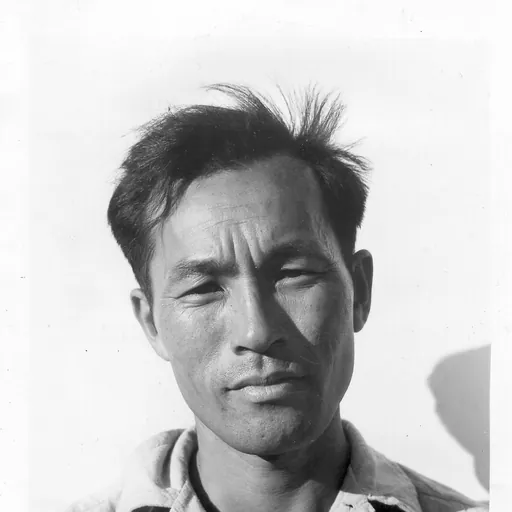
Karl Yoneda
Japanese American activist and trade unionist; interned at the beginning of WWII at Manzanar; served in World War II as a Japanese language specialist for the U.S. Army
About Karl Yoneda
Lived 1906 – 1999 (aged 92). Karl Yoneda was an American journalist, trade unionist, military personnel, activist and soldier, known for Communist Party USA and International Longshore and Warehouse Union.
was a Japanese American activist, union organizer, World War II veteran and author. He played a substantial role in the founding of the International Longshore and Warehouse Union.
Early life
Born in Glendale, California in 1906 to Japanese immigrants, Hideo and Kazu. In 1913, Yoneda's father, now diagnosed with tuberculosis, took the family to Japan to live in their native village just outside Hiroshima. His father died two years later, leaving his mother to raise him and his two sisters.
After World War I, Yoneda went to high school in Hiroshima. When he was 15, he organized a strike among the delivery boys of the powerful Chugoku Shimbun newspaper. The company had increased the delivery routes without increasing pay.
Such experiences led Yoneda to progressive ideas. He began reading the works of anarchists and socialists such as Karl Marx, Engels, Kropotkin, Bakunin, and the blind anarchist poet Vasili Eroshenko, whom he hitch-hiked to meet in Beijing when he was 16 years old. He stayed with Eroshenko two months and went back to Japan. There, he participated in workers strikes and began publishing a journal for poor farmers, Tsuchi. For that, he was beaten and thrown into jail.
Activist life in the U.S.
In 1926, Yoneda returned to the U.S. rather than be drafted into the imperial army. On entering the U.S., though he was an American citizen carrying his birth certificate, he was detained at the Immigration Detention House on Angel Island in San Francisco Bay for two months.
He changed his name to Karl to honor Karl Marx and worked as a dish washer and window washer in Los Angeles for $5 a day. He became involved with the Communist Party and the Los Angeles Japanese Workers Association. About that period, he wrote:
I was a young dreamer back then, you know, the utopian type. The Plaza was my very first experience with mass demonstrations. It was easy to go over there because you felt like you were with your own kind of people—no dressed-up people there, nobody was wearing neckties. The couple soon fell in love. They could not get married, however, because of California's Anti-miscegenation laws. They borrowed money for a ticket to Seattle, where they were married in 1935.
They participated in the largest demonstrations in the city's history. In 1933, after he spoke out against the tactics of the Red Squad before the L.A. City Council, the squad caught him in an elevator and gave him the worst beating of his life. During his three-month recovery, Elaine went to San Francisco to work for the International Labor Defense group. He was offered the job of editing the Japanese Communist publication Rodo Shimbun and moved to San Francisco to take it.
In May 1934, they helped organize and participate in a longshoremen's strike in San Francisco. The bosses and police, determined to stop the strike, opened fire on the strikers, killing two and wounding several others. Later that year, Yoneda was the Communist Party candidate for State Assembly in the 22nd district, coming in a distant third place with just over a thousand votes, or 3.6%. In 1938, Karl went to Washington State to help organize Alaska cannery workers.
World War II and after
In 1942, Karl, Elaine, and son Tom were incarcerated at Manzanar following the signing of Executive Order 9066. Karl registered for the draft and joined the army in November. He served in the United States Military Intelligence Service as a Japanese language specialist in China, Burma and India. He served valiantly and was decorated several times.
After the war, Elaine and Karl continued to work throughout their lives for the unions and anti-war efforts. His mother had survived the atom bomb. In 1960, they visited her on the occasion of attending a peace conference in Tokyo.
After he retired in 1972, he continued to organize and work for human rights. He lectured, wrote articles and an autobiography, and kept his membership in the Communist Party. His wife died in 1988, and he died on May 8, 1999.
Works Ganbatte: Sixty-Year Struggle of a Kibei Worker. (1983). Los Angeles: Asian American Studies Center, University of California.
Don’t just read it —
keep it.
Full-length biographies made to live with: read them, listen on the way to work, watch them tonight.
- E-book
- Audio
- Video
Instant download · yours to keep · every purchase keeps this site free
Important facts
Family & relationships
People in Karl Yoneda's life
Named in this biography and alive at the same time

Related people
Same field, nearest in time



Contemporaries
People whose lives overlapped Karl Yoneda's


Frequently asked questions
Who was Karl Yoneda?
Japanese American activist and trade unionist; interned at the beginning of WWII at Manzanar; served in World War II as a Japanese language specialist for the U.S. Army (1906–1999)
When was Karl Yoneda born?
Karl Yoneda was born on 15 July 1906 in Glendale.
When did Karl Yoneda die?
Karl Yoneda died on 9 May 1999.
What was Karl Yoneda's occupation?
Karl Yoneda was a journalist, trade unionist, military personnel, activist and soldier.
What was Karl Yoneda known for?
Karl Yoneda was known for Communist Party USA and International Longshore and Warehouse Union.
What nationality was Karl Yoneda?
Karl Yoneda was American.
Sources & further reading
Cite this page
APA: Biography.guide. (2026). Karl Yoneda. https://biography.guide/karl-yoneda/
MLA: "Karl Yoneda." Biography.guide, https://biography.guide/karl-yoneda/.
Chicago: "Karl Yoneda." Biography.guide. https://biography.guide/karl-yoneda/.
Data last updated: 2026-09-21 · Spot an error? Report a correction.
Portrait: Wikimedia Commons · author & licence
Page generated 2026-09-27 05:00 UTC