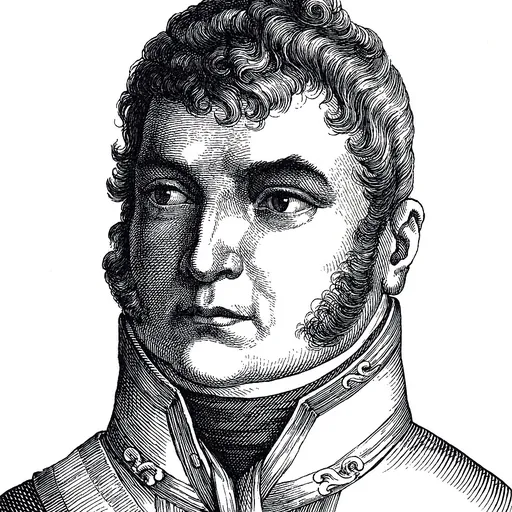
Karl Philipp, Prince of Schwarzenberg
Austrian field marshal
About Karl Philipp, Prince of Schwarzenberg
Lived 1771 – 1820 (aged 49). Karl Philipp, Prince of Schwarzenberg was a military officer, ambassador, diplomat, military leader and soldier.
Karl Philipp, Fürst zu Schwarzenberg (or Charles Philip, Prince of Schwarzenberg; 18/19 April 1771 – 15 October 1820) was an Austrian Generalissimo and former Field Marshal. He first entered military service in 1788 and fought against the Turks. During the French Revolutionary War, he fought on the allied side against France and in that period rose through the ranks of the Imperial Army. During the Napoleonic Wars, he fought in the Battle of Wagram, which the Austrians lost decisively against Napoleon. He had to fight for Napoleon in the battles of Gorodechno and Wolkowisk (1812) against the Russians and won. During the War of the Sixth Coalition, he was in command of the allied army that decisively defeated Napoleon in the Battle of Leipzig (1813). He participated in the Battle of Paris (1814), which forced Napoleon to abdicate.
Schwarzenberg is well-remembered for his participation in the wars against Napoleon from 1803 to 1815. During the War of the Sixth Coalition to defeat Napoleon, Schwarzenberg was a pioneer of the Trachenberg Plan which led to the success at the Battle of Leipzig and later the campaigns against Napoleon on French soil. During the latter stage of the war he won many victories that garnered him fame and reputation as a military commander, particularly during his campaigns in Germany, Switzerland, and France during the war in 1814. The Trachenberg Plan called for avoiding direct battle with Napoleon himself; however, by a twist of fate, Schwarzenberg still ended up facing him. One encounterthe Battle of Dresden (1813)resulted in a catastrophic tactical defeat for Schwarzenberg, but he also managed to beat Napoleon at Peterswalde (1813) and Arcis-sur-Aube (1814). In the years following the war, Schwarzenberg served as a diplomat for the Austrian Empire and later went on to serve as Austrian ambassador to Russia and also represented Austria at the Congress of Vienna.
Background Family Karl Philipp was born 18/19 April 1771 in Vienna, the son of Johann Nepomuk Anton of Schwarzenberg, who was a member of the cadet branch of the Schwarzenberg princedom and Marie Eleonore Countess of Öttingen-Wallerstein, whose family ruled the region known as the County of Öttingen since the 11th century. Their ancestor Ludovicus de Otingen who was a member of a family that is a relative of the imperial House of Hohenstaufen, who ruled the Holy Roman Empire during the Medieval Age. He was one of thirteen siblings, seven of whom did not reach adulthood. His family descends from the line of the Princes of the Schwarzenberg of the illustrious and noble House of Schwarzenberg, whose lineage could be traced back to at least the 16th century. Their roots began with the Lords (Princes) of Seinsheim in the Middle Ages and they held land and fiefdoms in Franconia and Bohemia. When the founder of the Schwarzenberg line, Erkinger of Seisheim acquired the lands and the castle of Schwarzenberg in the Holy Roman Empire, Erkinger was later made Freiherr (Baron) of the region in 1429. They were at first were made imperial counts by the Holy Roman Emperor and later became counted among the German and Austrian nobility during the 18th century. Later Emperor Francis I of Austria granted a Prince of Schwarzenberg title specifically for Karl Phillip, for his active military service and contributions during Napoleonic Wars. His branch of the Schwarzenberg princedom still continues to this very day. During the early years of his life, Schwarzenberg underwent extensive military training from an early age. Due to his high birth, rank and his family's relationship with the House of Habsburg, he was enlisted in the Austrian army as a lieutenant in 1788 and that same year, he went on to experience war for the first time in his life.
Early military career 1788–1792
Karl Philipp entered the imperial cavalry in 1788, fought in 1789 under Austrian generals Franz Moritz Graf von Lacy and Ernst Gideon Freiherr von Laudon against the Ottoman Empire, during the Austro-Turkish War. That war was a result of Russian Empress Catherine the Great and the Russian Empire's aggression against the Ottoman Empire, and as Austria was an ally of Russia, it triggered Austria's open involvement in the conflict. In the war, he distinguished himself by his bravery, and became a major in 1792 and campaigned extensively in the Balkans.
French Revolutionary War
1792–1801 The Battle of Hohenlinden, in which Schwarzenberg participated under the Archduke John of Austria. Though the battle was a disastrous defeat, Schwarzenberg, who commanded the right wing of the Austrian army, where able to retreat in relative safety in good order, thus saving the entire Austrian army. During the outbreak of the French Revolution, Europe experienced one of the most remarkable political incidents in history, during which the House of Bourbon, the French royal family and its members were executed or fled, which also led to dissolution of the French hierarchical system and also decentralization of power invested in the Church and the Nobility. This resulted in the establishment of a France that came under a republican government led by the revolutionaries. The major powers of Europe opposed the French Republic, fearing that such revolutions might happen in their respective countries, declaring war on France and subsequently invaded the country, thus beginning a conflict that lasted from 1792 to 1801.
The Rhine and Low Countries In the French campaign of 1793, Schwarzenberg served in the advanced guard of the army commanded by Prince Josias of Coburg. At the battle of Le Cateau-Cambrésis in 1794, his impetuous charge at the head of his regiment, vigorously supported by twelve British squadrons, broke a whole corps of the French (of around 25,000 men), killed and wounded 3,000 men, and captured 32 of the enemy's guns. He was immediately decorated with the Knight's Cross of the Military Order of Maria Theresa for his conduct.
During the mid-stages of the war, after taking part in the Austrian victories at the battles of Amberg and Würzburg in 1796, he was raised to the rank of general-major, and, in 1799, he was subsequently promoted to Generalleutnant. At the Battle of Hohenlinden (3 December 1800), the Austrian forces under Archduke John of Austria engaged in a decisive battle with the French army under General Jean Moreau, whom the Austrians believed were "beaten". However, the French were not beaten but had laid an ambush for the Austrians and attacked as the Austrians were emerging from the Ebersberg forest. The Austrian left flank was attacked by General Antoine Richepanse's division, leading to a disastrous defeat. During the battle, Schwarzenberg led a division in the right wing. During the retreat, his promptitude and courage saved the right wing of the Austrian army from destruction, and the Archduke Charles of Austria afterwards entrusted him with the command of the rearguard.
After the battle, the Austrians suffered a major setback as well as another defeat at the Battle of Marengo (14 June 1800), which led to the conclusion of the War of the Second Coalition and also led to the Treaty of Lunéville in 1801. As a result of the treaty, the Austrians accepted French dominance up to the Rhine and recognized the French puppet republics in Italy. Two years prior, the French republican government, the Directory, was overthrown in the Coup of 18 Brumaire in 1799, under a certain brilliant and famous French general, Napoleon Bonaparte, who declared himself First Consul and later Emperor of the newly formed French Empire in 1803. In 1804 Prince Karl Philipp was created Fürst zu Schwarzenberg in a title identical to, but separate from, that of his brother, Joseph II, Prince of Schwarzenberg. This eventually led to Napoleon's brief exile in the island of Elba in 1814. The capture of Paris successfully ended Napoleon's rule and domination of Europe, and after, the Great Powers began the rebuilding of Europe's political and geographic structure at the Congress of Vienna.
The next year, during the Hundred Days, when Napoleon escaped from Elba and regained the French throne, Schwarzenberg commanded the Army of the Upper Rhine (an Austrian-allied army of about a quarter of a million men) in the hostilities that followed. However, as the allies amassed their forces, the Austrians did not have to fight a single battle, because the Anglo-Allied Army, under the Duke of Wellington and the Prussians under Field Marshal Blücher, jointly defeated Napoleon at the Battle of Waterloo in June 1815. Thus the twenty year period of instability and conflict in Europe came to an end and the Congress of Vienna was able to complete its work. The agreements and conditions of the congress led to the redrawing of the map of Europe and creating a new balance power between the Great Powers of the continent, aiming to prevent further major conflicts in Europe. This turned out to be successful and led to a period of relative calm and peace between the European nations for half a century.
Diplomatic career During 1806–1809 Schwarzenberg served as the Austrian ambassador to Russia. He had previously served as the ambassador to France from 1809 to 1814.
In the aftermath of the War of the Fifth Coalition (1809), in which Austria suffered a crushing defeat and was forced give up lands in Illyria, Salzburg, and Galicia as recompense, Schwarzenberg participated in the signing of Treaty of Schönbrunn (14 October 1809). In 1810, he was sent to Paris as ambassador to negotiate the 1810 marriage between Napoleon and the Archduchess Marie Louise of Austria. The prince gave a ball in honour of the bride on 1 July 1810, which ended in a fire that killed many of the guests, including his own sister-in-law, wife of his older brother, Joseph.
Illness After the French Revolutionary and Napoleonic wars ended, Schwarzenberg's health steadily declined. Shortly afterwards, in 1816, having lost his sister Caroline, to whom he was deeply attached, he fell ill. A stroke disabled him in 1817 and in 1820, when revisiting Leipzig (the scene of the "Battle of the Nations" that he had directed seven years before) he suffered a second stroke. He died there on 15 October. At the news of his death, the Austrian Empire held three days of mourning for the great general and Victor of Leipzig. Even Emperor Alexander I of Russia said that: "Europe has lost a hero and I a friend, one that I would miss as long as I live."
Marriage and descendants
The Prince married the Countess Maria Anna von Hohenfeld (20 May 1767–1848), who was the widow of Prince Anton Esterhazy von Galantha. They had three sons: Commander, 1806; Grand Cross, 1813 Knight of the Golden Fleece, 1809 Army Cross 1813/14 in gold, 1814 France: French Empire: Grand Eagle of the Legion of Honour, 1811 Kingdom of France: Knight of the Holy Spirit, 1816 Knight of St. George, 1st Class, 8 October 1813 Knight of St. Andrew, 11 October 1813 Grand Cross of the Military Order of Max Joseph, 27 February 1814 Knight of St. Hubert, 1814 Knight of the Annunciation, 4 January 1815 Knight of the Elephant, 30 April 1815 Honorary Grand Cross of the Bath (military), 18 August 1815 Grand Cross of the Military William Order, 27 August 1815 Grand Cross of the Royal Guelphic Order, 1816
Gallery Coat of Arms and portraits
Ancestry
Don’t just read it —
keep it.
Full-length biographies made to live with: read them, listen on the way to work, watch them tonight.
- E-book
- Audio
- Video
Instant download · yours to keep · every purchase keeps this site free
Important facts
People in Karl Philipp, Prince of Schwarzenberg's life
Named in this biography and alive at the same time
Related people
Same field, nearest in time
Contemporaries
People whose lives overlapped Karl Philipp, Prince of Schwarzenberg's



Frequently asked questions
Who was Karl Philipp, Prince of Schwarzenberg?
Austrian field marshal (1771–1820)
When was Karl Philipp, Prince of Schwarzenberg born?
Karl Philipp, Prince of Schwarzenberg was born on 15 April 1771 in Vienna.
When did Karl Philipp, Prince of Schwarzenberg die?
Karl Philipp, Prince of Schwarzenberg died on 15 October 1820 in Leipzig.
What was Karl Philipp, Prince of Schwarzenberg's occupation?
Karl Philipp, Prince of Schwarzenberg was a military officer, ambassador, diplomat, military leader and soldier.
Sources & further reading
· Wikipedia: Karl Philipp, Prince of Schwarzenberg
· DBpedia: Karl Philipp, Prince of Schwarzenberg
Cite this page
APA: Biography.guide. (2026). Karl Philipp, Prince of Schwarzenberg. https://biography.guide/karl-philipp-prince-of-schwarzenberg/
MLA: "Karl Philipp, Prince of Schwarzenberg." Biography.guide, https://biography.guide/karl-philipp-prince-of-schwarzenberg/.
Chicago: "Karl Philipp, Prince of Schwarzenberg." Biography.guide. https://biography.guide/karl-philipp-prince-of-schwarzenberg/.
Data last updated: 2026-09-29 · Spot an error? Report a correction.
Portrait: Wikimedia Commons · author & licence
Page generated 2026-10-04 13:55 UTC