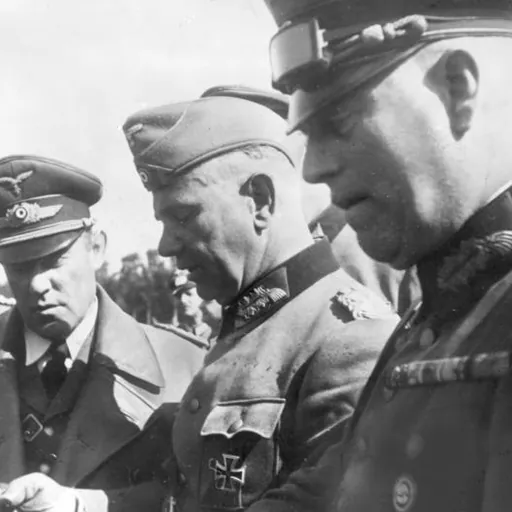
About Karl Bodenschatz
Lived 1890 – 1979 (aged 88). Karl Bodenschatz was a German military personnel, judge, military commander, military officer and soldier.
Karl Georg Bodenschatz (sometimes wrongly Karl-Heinrich; 10 December 1890 – 25 August 1979) was a German general who was the adjutant to Manfred von Richthofen in World War I and the liaison officer between Hermann Göring and Adolf Hitler in World War II.
Biography
Early life and First World War Bodenschatz was born in Rehau, Kingdom of Bavaria in 1890. He enlisted in the Royal Bavarian 8th Infantry Regiment (Königlich Bayerisches 8. Infanterie-Regiment „Großherzog Friedrich II. von Baden“) in Metz on 23 July 1910 and was commanded to War School in Munich. He was commissioned a Leutnant (2nd Lieutenant) on 28 October 1912. Following the German entry into World War I, he saw active infantry service on the Western Front and participated in the Battle of Verdun. After being wounded four times, on 15 July 1916, now a 1st Lieutenant (since 16 March 1916), he transferred to the Deutsche Luftstreitkräfte. He served as an adjutant in Jagdstaffel 2 ("Jasta Boelcke") and then in Jagdgeschwader 1 based at Avesnes-le-sac. He was adjutant to Manfred von Richthofen and later, after the deaths of Manfred von Richthofen and his successor Wilhelm Reinhard, to Hermann Göring, who took over command of the fighter wing in June 1918.
Between the wars After the war, Bodenschatz was carried over into the Reichswehr as a regular officer and served in the 21st (Bavarian) Infantry Regiment from 1919 until April 1933. In 1939, he warned the Polish military attaché in Berlin that Nazi Germany was planning to invade Poland by the end of the year.
Second World War During World War II he was the liaison officer between Hitler's headquarters and the Commander-in-Chief of the Luftwaffe until he was seriously injured in 1944 by the 20 July plot bomb at the Wolf's Lair headquarters in Rastenburg, East Prussia. He was fortunate to survive the explosion as two officers immediately to his left and one to his right were killed.
Post-war He was captured at Reichenhall on 5 May 1945 and served two years in prison. In 1946 he was called as a witness at the Nuremberg Trials of major Nazi war criminals. He died in Erlangen, West Germany, in 1979, aged 88.
Awards and decorations (excerpt) Kingdom of Bavaria: Military Merit Order, 4th Class with Swords (18 October 1914) Wound Badge of 20 July 1944 in Gold Finland: Order of the Cross of Liberty, 1st Class with Oakleaves and Swords
Don’t just read it —
keep it.
Full-length biographies made to live with: read them, listen on the way to work, watch them tonight.
- E-book
- Audio
- Video
Instant download · yours to keep · every purchase keeps this site free
Important facts
People in Karl Bodenschatz's life
Named in this biography and alive at the same time


Related people
Same field, nearest in time




Contemporaries
People whose lives overlapped Karl Bodenschatz's

Frequently asked questions
Who was Karl Bodenschatz?
German general (1890–1979)
When was Karl Bodenschatz born?
Karl Bodenschatz was born on 10 December 1890 in Rehau.
When did Karl Bodenschatz die?
Karl Bodenschatz died on 25 August 1979 in Erlangen.
What was Karl Bodenschatz's occupation?
Karl Bodenschatz was a military personnel, judge, military commander, military officer and soldier.
What nationality was Karl Bodenschatz?
Karl Bodenschatz was German.
Sources & further reading
Cite this page
APA: Biography.guide. (2026). Karl Bodenschatz. https://biography.guide/karl-bodenschatz/
MLA: "Karl Bodenschatz." Biography.guide, https://biography.guide/karl-bodenschatz/.
Chicago: "Karl Bodenschatz." Biography.guide. https://biography.guide/karl-bodenschatz/.
Data last updated: 2026-09-23 · Spot an error? Report a correction.
Portrait: Wikimedia Commons · author & licence
Page generated 2026-09-27 05:07 UTC