
About Karl Bechert
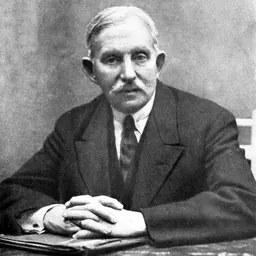
Lived 1901 – 1981 (aged 79). Karl Bechert was a German physicist, politician, university teacher and writer.
Karl Richard Bechert (23 August 1901, Nuremberg, Middle Franconia – 1 April 1981, Weilmünster-Möttau, Hesse) was a German theoretical physicist and political leader. As a scientist, he made contributions in atomic physics.
Scientific career From 1920 to 1925, Bechert studied physics and mathematics at the Ludwig-Maximilians-Universität München, at the Institute of Theoretical Physics. He received his doctor of philosophy under Arnold Sommerfeld, in 1925. Under a fellowship of the Rockefeller Foundation, from 1925 to 1926, he accomplished postdoctoral studies and research at the Physics Institute of the Complutense University of Madrid. From 1926 to 1933, he was an assistant to Sommerfeld, completing his Habilitation in 1930 and becoming a Privatdozent.
While working for his Ph.D., Bechert helped Sommerfeld extend the Bohr model of the atom and determine the atomic cobalt and vanadium energy terms from their respective spectra. He worked in collaboration with Miguel A. Catalán and Ludwig August Sommer. His thesis was on the structure of atomic nickel spectra.
In 1933, he was called as an ordinarius professor and director of the Institute for Theoretical Physics at the University of Giessen. From 1945 to 1946, he was rector at the university. He remained at Giessen until 1946, whereupon he was called as ordinarius professor and director of the Institute for Theoretical Physics at the University of Mainz, where he remained until his retirement in 1969. He was also a member of the State Commission for School Questions on Lecture Courses at Mainz.
In 1945, the Allied Military Government for Occupied Territories appointed Bechert mayor of Donsbach, Westerwald and the Oberschulrat in Dillingen, where, on behalf of the Allied Military Government, he built a secondary school/high school.
While at the University of Mainz, he was a member of the Senate Commission for Atomic Questions. Since the 1950s, he was a member of the Kuratorium of the Deutsche Friedensgesellschaft (DFG) - the German Peace Society. In 1951, Bechert joined Victor Paschkis in founding the Society for Social Responsibility in Science. In 1955, he became a member the Church and Politics working group of the Evangelist Church in Hesse-Nassau. The next year, he joined the Social Democratic Party of Germany – the SPD. From 1957 to 1972, he was an SPD delegate in the German Bundestag. From 1962 to 1965, he was also chairman of the Committee for Atomic Energy and Water Management. In the beginning of his political career, he fought against nuclear armament. Later he opposed also the so-called "peaceful use of nuclear energy" ("friedliche Nutzung der Kernenergie") which was the official political aim of the SPD (and the other political parties at that time). He argued that the development and use of nuclear plants never could be safe and the problems with nuclear waste were impossible to solve. He became the "father of the german anti-nuclear movement" as the Manchester Guardian called him in 1981 and one of the precursors of the German Green Party. Bechert was also part of the Pugwash movement and member of the World Union for Protection of Life.
Books Karl Bechert and Christian Gerthsen Atomphysik Bd. I Allgemeine Grundlagen (De Gruyter, 1944) Karl Bechert and Christian Gerthsen Atomphysik Bd. II Allgemeine Grundlagen (De Gruyter, 1944) Karl Bechert Der Wahnsinn des Atomkrieges (Diederichs, 1956) Karl Bechert Deutsche Politik im Schatten der Atomdrohung (1958) Karl Bechert and Christian Gerthsen Atomphysik Bd. III, Theorie des Atombaus (De Gruyter, 1963) Karl Bechert, Christian Gerthsen, and Arnold Flammersfeld Atomphysik. Bd. IV. Theorie des Atombaus 2. Teil (De Gruyter, Berlin, 1963)
Selected Literature Karl Bechert and Ludwig August Sommer, "Zur Struktur des Vanadiumspektrums", Z. Phys. 31 145-162 (1925)
Don’t just read it —
keep it.
Full-length biographies made to live with: read them, listen on the way to work, watch them tonight.
- E-book
- Audio
- Video
Instant download · yours to keep · every purchase keeps this site free
Important facts
People in Karl Bechert's life
Named in this biography and alive at the same time


Related people
Same field, nearest in time
Contemporaries
People whose lives overlapped Karl Bechert's



Frequently asked questions
Who was Karl Bechert?
German physicist (1901-1981)
When was Karl Bechert born?
Karl Bechert was born on 23 August 1901 in Nuremberg.
When did Karl Bechert die?
Karl Bechert died on 1 April 1981 in Weilmünster.
What was Karl Bechert's occupation?
Karl Bechert was a physicist, politician, university teacher and writer.
What nationality was Karl Bechert?
Karl Bechert was German.
Sources & further reading
Cite this page
APA: Biography.guide. (2026). Karl Bechert. https://biography.guide/karl-bechert/
MLA: "Karl Bechert." Biography.guide, https://biography.guide/karl-bechert/.
Chicago: "Karl Bechert." Biography.guide. https://biography.guide/karl-bechert/.
Data last updated: 2026-09-20 · Spot an error? Report a correction.
Page generated 2026-09-27 05:25 UTC