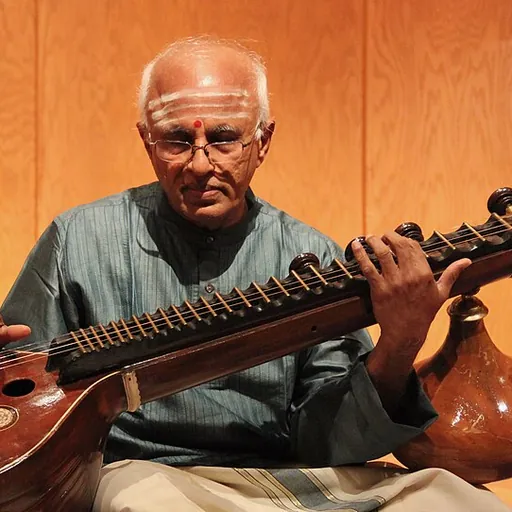
About Karaikudi S. Subramanian
Born 1944. Karaikudi S. Subramanian is an Indian musician.
Karaikudi Sambasiva Iyer Subramanian (born 23 October 1944) is a veena player in the Karaikudi Veena Tradition. He is the grandson of Karaikudi Subbarama Iyer and adoptive son of Karaikudi Sambasiva Iyer.
Karaikudi Subramanian has been designated the title "Top-Grade artist" by All India Radio and has performed numerous radio concerts as well as live concerts at various venues around the world. He has performed with fellow veena player Ranganayaki Rajagopalan and his sister Rajeswari Padmanabhan, both disciples of Karaikudi Sambasiva Iyer. He has also accompanied artists such as flutist T. Viswanathan and vocalist K. V. Narayanaswamy. Furthermore, he has engaged in cross cultural performances with prominent musicians of other genres such as the Irish fiddler Martin Hayes and the Finnish composer Eero Hämeenniemi.
Subramanian later turned his focus to education, exploring ways to make music accessible to everyone regardless of their background. In 1989, he founded the institute 'Brhaddhvani – Research and Training Centre for Musics of the World' in Chennai. A few years later, as a result of his vigorous training with Karaikudi Sambasiva Iyer and his own research at Wesleyan University and later at Brhaddhvani, he developed a pedagogic system of music learning called 'Correlated Objective Music Education and Training' (COMET).
The Karaikudi lineage The Karaikudi Veena Brothers, from right to left: Karaikudi Sambasiva Iyer (veena), Karaikudi Subbarama Iyer (veena upright position) and Pudukkotai Dakshinamurthy Pillai (mridangam). 1917. Through the ritualistic devasam (also called Śrāddha), it is known that before the first recorded members of the Karaikudi family, the lineage goes back two generations further. However, there is only an oral record of the first two generations without any knowledge of names or details. Malayappa belonged to the third generation and Venkateswara to the fourth. Other than their names, not much is known about these two generations either. Subbaraya – the grandfather of the Karaikudi Brothers – belonged to the fifth generation. He was the court musician in Sivaganga and later in Thirugokarnam, Pudukkottai. Subbaraya's son Subbaya was born in Thirugokarnam. Like his father, Subbayya was also patronised by the court of Pudukkottai under rule of Ramachandra Tondaiman. The Kanakabhisekam (gold shower) was bestowed on Subbaraya and Subbayya by the royalty of Pudukottai court to honor their musicianship.
Early life and education
Inspired by his training with Sambasiva Iyer and his research at Wesleyan University and Brhaddhvani, Subramanian developed the pedagogy COMET (Correlated Objective Music Education and Training). COMET is a holistic system of learning music with the purpose of providing a fuller understanding of music. COMET seeks to preserve the traditional content of Carnatic music, while being contemporary and global in its reach. As an open and inclusive system, COMET seeks to enable anyone to progress regardless of their musical skills and background. Furthermore, COMET explores cross-cultural musical interactions for a better understanding of one's own tradition through comparison and contrast. Numerous western musicians of various genres have undergone training in COMET. COMET is also applicable for cross-disciplinary interactions, and artists from disciplines such as south Indian classical dance, theatre and poetry have received training in COMET.
Brhaddhvani
Subramanian and Dr. S. Seetha founded the research institute 'Brhaddhvani – Research and Training Centre for Musics of the World' in 1989 with the main purpose of making music and music education accessible to everyone regardless of their background. Brhaddhvani has been considered an alternative to the traditional gurukula way of learning. Subramanian's work is aimed towards bridging the gap between tradition and modernity, global and local, and thus finding meaning for tradition in a modern world. To facilitate and accelerate the quality music education, Subramanian's teaching is greatly supported by technology and technological aids, mainly the app Tala Keeper and the online learning platform Patantara.
Dr. Subramanian's contributions in music are multi-dimensional, and his work has been considered pioneering by many. Through Brhaddhvani, he has developed programs that benefit learners ranging from novice to expert. Brhaddhvani offers music training for different levels of knowledge and purposes, and musicians and other artists from various backgrounds, students as well as performing artists, have received training in COMET at Brhaddhvani.
In 2003, Brhaddhvani celebrated Lalgudi Year in honour of the violinist Lalgudi G. Jayaraman. Students learned the repertoire of Lalgudi directly from the Lalgudi G. Jayaraman himself. Furthermore, a number of concerts and events were organised by Brhaddhvani to honor the violinist.
Reviving traditions
Veena and veena crafting
Karaikudi Subramanian accompanying K.V. Narayanaswamy Throughout his career, Subramanian has worked towards preserving the veena and its crafting.
Brhaddhvani has organised a number of events for the revival and documentation of the veena tradition, including festivals of veena as a solo instrument and festivals of veena as an accompanying instrument as a revival of an older tradition.
Sopanam – Temple music of Kerala
With the support from India Foundation for the Arts, Brhaddhvani in collaboration with Dharani – a school of performing arts in Kochi – documented the temple music of Kerala called Sopanam. The Sopanam tradition is older longer than Carnatic music but the former is now almost extinct. It is only performed in a few temples and as an accompaniment to the Indian classical dance form Kathakali.
Subramanian's experiments show that the exercises of COMET have therapeutic benefits. Brhaddhvani has worked with subjects with multiple sclerosis, ASB, dyslexia, spastics, accident victims, stammer, depression, anxiety and other mental and physical impairments. Moreover, pregnant women have received therapy at Brhaddhvani. and as an initiative to bring Carnatic music to the less privileged societies, Brhaddhvani has introduced village children to Carnatic music.
Quote|text=I am trying to bring traditional music to a large number of people. Music should be for everyone, no matter what their situation, caste, economic situation or culture. Classical music as a genre revealing and exploring the sound aesthetics with a balance of intellect and emotion should not be difficult to communicate to any one at any level through proper educational methods. I believe this way we are more likely to appreciate value and preserve our indigenous music irrespective of geographic locality.|source=Karaikudi S. Subramanian (Brhaddhvani) Steve Coleman (Jazz musician), Woody Louis Amstrong Shaw III (Jazz musician) have been associated with Brhaddhvani.
Various foreign musicians have visited Brhaddhvani to undergo training in relevant aspects of COMET. Furthermore, students of Carnatic music at Brhaddhvani have received training from western musicians, including the composer Eero Hämeenniemi.
Quote|text=At Brhaddhvani, I tune my shadaj and delve into the basics of music after a busy season. There's something very special about the way guru Subramanian explains fundamentals ... Guru Subramanian has designed his lessons in such a way that people at any level of singing can benefit from them ... The method has something for everyone.|source=Bombay Jayashri (The New Sunday Express, May 6, 2007) the third in the series Carnatic Music Theory and Notated Songs, published by Singapore Indian Fine Arts Society, Singapore (1984) An Introduction to the Vina, Asian Music, Vol. 16, No. 2, published by: University of Texas Press (1985) South Indian Vina-tradition and Individual Style, doctoral dissertation, in three volumes (712 pages) submitted to Wesleyan University, published by Micro-films University, Ann Arbor, Michigan, USA (1986) Text, Tone, and Tune: Interrelationships Among Text, Tune and Tone in Karnatak Music, published in Text, Tune and Tone – Parameters of Music in Multicultural Perspective, a collection of papers presented at the seminar organised by the American Institute of Indian Studies, New Delhi (1986–1987) Birth Centenary of Sangita Kalanidhi Karaikudi Sambasiva Iyer, published by India International Rural Cultural Centre (1988) Sino – Indian Musical Symbolism, Report of Seminars, The Bulletin of The Institute of Traditional Cultures of South and South East Asia, Madras, University of Madras, a comparison between Chi'n and Vina as representative instruments of two cultures, (1989–1990) Manodharma Sangeetham of Dr. Sripada Pinakapani translated to Tamil, published by Brhaddhvani (1992) Semmangudiyin Kural, published by Brhaddhvani (2008) Reminiscences: K Sambasiva Iyer and Mysore Vasudevachar , published by Nirmalam, the Genius of S. Sarada (2008) Continuity and Change in Music Tradition in Contemporary South India – A Case Study of Brhaddhvani, VWB, Verlag für Wissenschaft und Bildung, 2002, Indiana University, Music Archiving in the World: Papers Presented at the Conference on the Occasion of the 100th Anniversary of the Berlin Phonogramm-Archiv (2009) COMET, the creative pedagogy, within and beyond Karnatak music, papers presented at the international seminar on "Creating and Teaching Music Patterns" conducted by the Department of Instrumental Music, Rabindra Bharati University, Calcutta (2013)
Brhaddhvani's publications Compositions of Anai-Ayya Brothers, compiled by T. Viswanathan and Trichy Sankaran (1990) Raga Lakshanamu of Saha Maharaja edited by Dr. S. Seetha Pearls of South Indian Ragas, volume 1–5, CDs by Prof. S. R. Janakiraman
Productions OM – a music program for the Singapore Government Art Festival (1983) Nadangi – A 13-episode serial Doordarshan telecast (1988) From Folk to Classical (1990)
Albums Shambo Mahadeva – Vina Music from South India Sunada: Music From the Classical Tradition of South India Sree Veene Namaste
Don’t just read it —
keep it.
Full-length biographies made to live with: read them, listen on the way to work, watch them tonight.
- E-book
- Audio
- Video
Instant download · yours to keep · every purchase keeps this site free
Important facts
People in Karaikudi S. Subramanian's life
Named in this biography and alive at the same time

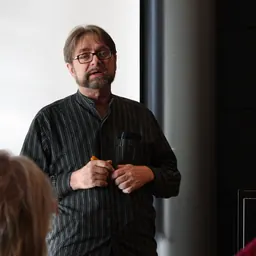
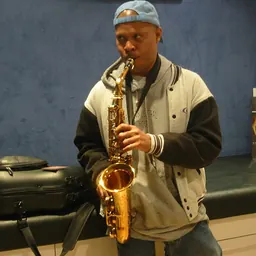

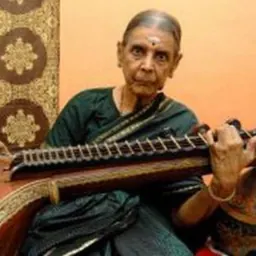


Related people
Same field, nearest in time

Contemporaries
People whose lives overlapped Karaikudi S. Subramanian's


Frequently asked questions
Who is Karaikudi S. Subramanian?
Indian musician
When was Karaikudi S. Subramanian born?
Karaikudi S. Subramanian was born on 23 October 1944 in Madurai.
What is Karaikudi S. Subramanian's occupation?
Karaikudi S. Subramanian is a musician.
What nationality is Karaikudi S. Subramanian?
Karaikudi S. Subramanian is Indian.
Sources & further reading
· Wikipedia: Karaikudi S. Subramanian
· DBpedia: Karaikudi S. Subramanian
Cite this page
APA: Biography.guide. (2026). Karaikudi S. Subramanian. https://biography.guide/karaikudi-s-subramanian/
MLA: "Karaikudi S. Subramanian." Biography.guide, https://biography.guide/karaikudi-s-subramanian/.
Chicago: "Karaikudi S. Subramanian." Biography.guide. https://biography.guide/karaikudi-s-subramanian/.
Data last updated: 2026-09-22 · Spot an error? Report a correction.
Portrait: Wikimedia Commons · author & licence
Page generated 2026-09-27 05:03 UTC