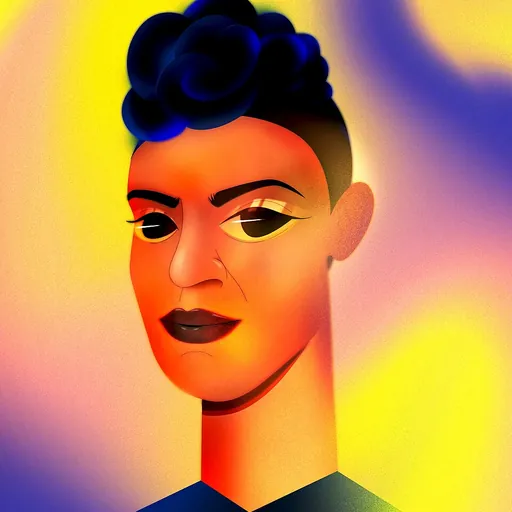
About Kapwani Kiwanga
Born 1978. Kapwani Kiwanga is a Canadian filmmaker, installation artist, video artist and performance artist.
Kapwani Kiwanga (born 1978) is a Canadian and French artist working in Paris, France. Her work is known for dealing with issues of colonialism, gender, and the African diaspora. She has said that she gained her perspective on colonialism and Canada's Indigenous people from her time in Brantford, which is situated on the Haldimand Tract in the traditional territories of the Anishinaabe and Haudenosaunee peoples. Kiwanga studied anthropology and comparative religion at McGill University in Montreal, and art at the "La Seine" program at the Ecole Nationale Supérieure des Beaux-Arts in Paris. As such, Kiwanga’s artistic practice is intensely research-based, and she often embodies the guise of a scientist, anthropologist, or archivist in the performative “happenings” that are an integral aspect of her overall work in sculpture, painting, video and mixed media installations. Prior to moving to Paris, Kiwanga lived in Scotland, in the United Kingdom, and worked as a documentary filmmaker for television, earning her two BAFTA nominations. She lives and works in Paris.
Work Kiwanga's work is shaped by her academic background, and often involves multiple formats and media in order to present a diversity of experiences for the viewer. Kiwanga explores the social and political aspects of the world by presenting these multiple perspectives, a skill she formed growing up in Canada, visiting family in Tanzania, and spending much of her adult life in France. She employs strategies of social scientific research and documentary modes of presentation in her work. In her Afrogalactica trilogy project (commenced 2011), Kiwanga plays the role of an anthropologist from the future, whose research draws upon Afrofuturism, African astronomy and gender. In Safe Passage, Kiwanga goes through the history of blackness in America, from slavery to contemporary time and the effect of technology on issues like visibility. It is a sculptural work that is researched-driven and based in Kiwanga's anthropological roots. This interdisciplinary collection stemmed from research into the Maji Maji War when, “in 1905, in what was then Tanganyika, now Tanzania, the Germans crushed a rebellion led by Kinjeketile Ngwale, who had convinced his followers he could magically transform German bullets into water, or maji in Swahili.” Kinjeketile Suite (2015) at South London Gallery was a multimedia installation also taking the Maji Maji Rebellion as a point of departure.
Power and social control, color and light In Linear Paintings (2017–) Kiwanga deploys research into the psychology and sociology of colour and architecture through paintings on drywall panels each featuring two coloured blocks. The colours selected by Kiwanga were sourced from technical manuals and social-architectural theory about the proposed effects of certain colours on prison populations, coastguards, industrial workers or hospital patients, among other contexts. Both the colours themselves and the height at which they meet on each panel when installed are drawn from research into the late-19th to early-20th century, when “interest in scientific methods and techniques to improve health care, control disease, and promote social and physical wellness surged with the rise of social hygiene movements and hospital reforms.” The relationship in this work between architectural decisions and social control are summarised by writer Iman Sultan: “It’s clear that aesthetics are in a constant, ever-evolving relationship with power. Shadow and light can be used to subvert and rebel, just as they are employed, institutionally, to subdue and command.”
In the exhibition Safe Passage, Kiwanga used sculptural works to communicate ideas about racialized surveillance and legislation in America. Glow (2019–) is a series of roughly human-sized sculptures taking the form of dark stone-clad, straight- edged shapes each inlaid with a light source, first included in Safe Passage. Art historian Elvan Zabunyan writes that the forms of the Glow series are “a reminder of those black bodies walking in the dark, lit to remain visible,” and how, “by shedding light on history, Kiwanga produces flashbacks and establishes trajectories in which ancient periods and current events coexist.”
For the installation Cloak (2022), commissioned for her solo exhibition Off-Grid at the New Museum, Kiwanga built on her research into visibility and control with a focus on the NYPD’s use of high-powered mobile floodlights for surveillance. In collaboration with the gallery, Kiwanga acquired a number of these floodlights, extracted and transformed their aluminium parts into a light absorbing paint that was applied to a beaded curtain and triangular wall panels interspersed with mirrored panels. As critic Aruna D'Souza writes, Kiwanga’s interest was in inverting the power dynamic that the material participated in, turning it from a tool for surveillance into something that absorbed light and obscured vision.
Material histories In Kiwanga’s oeuvre, particular materials have become significant strands of the artist’s research. Some recurring materials explored by the artist include sisal fibre, shade-cloth, other textiles, sand, glass, light, seeds and various plants.
Shady (2018), Line (2023) and Black Blue Hour (2023), among others, all utilise shade cloth; a woven fabric that is widely used to create shade and “protect crops in commercial farming which, due to foreign investment, now covers swathes of landscape from North America to Africa.”
Kiwanga also works with sisal, the fibre processed from the plant Agave sisalana, native to Central America. In works like White Gold: Morogoro (2016) and Maya Bantu (2021) the processed fibre is draped over metal structures as it might be seen drying in Tanzanian fields where the artist first encountered it and where the production of this fibre has become of major economic importance since its importation and use as a cash crop during the colonial era.
A recurring project that engages with archival collections and a living material is Flowers for Africa (2013–ongoing). While researching public archives in Dakar, Senegal, Kiwanga explored collections relating to the independence of Senegal from France including images of ceremonies and diplomatic events that happened to include floral arrangements. It is these reconstructed floral arrangements that are displayed, left to wilt and decay. In contrast to typical archives, like those in Dakar where the artist first encountered these images, Kiwanga writes that artworks of Flowers for Africa “slip away from the status of factual evidence and become fallible witnesses.” In January–March 2018, the Glenhyrst Art Gallery of Brant held a solo exhibition of her work entitled Kapwani Kiwanga: Clearing. In February–May 2018, the Esker Foundation put on A wall is just a wall (and nothing more at all). From 8 February 2019 to 21 April 2019, Kiwanga was exhibited at the MIT List Visual Arts Center in a solo show titled Safe Passage. examined the social history of light as a form of surveillance. The first major survey exhibition in Canada of the artist's work was held at the Museum of Contemporary Art, Toronto, from February 23 to July 23, 2023.
Also in 2024 Kiwanga presented her solo exhibition Where salt and freshwater meet and crooked trees filter the sun at Serralves Museum in Porto. In 2023, she was commissioned to produce a major new installation for the main hall of the CAPC Musée d’Art Contemporain de Bordeaux in southwestern France to mark the institution’s 50th anniversary. The site-specific artwork, Retenue (2023), consisted of indigo-dyed rope hung from the ceiling and arches of the former warehouse evoking the colonial purposes of the space for the accumulation and distribution of commodities through the global shipping trade. Water flowed along some of these ropes to fall into incisions in the ground metaphorically connecting the CAPC with the nearby Garonne river.
Awards Kiwanga has received two BAFTA nominations for her film and video works, 2018: Sobey Art Award 2018: ADAGP-Etant donnés 2020: Marcel Duchamp Prize 2025: Joan Miró Prize
Kiwanga’s work is found in major collections including Albertinum Staatliche Kunstsammlungen, Dresden; Kunsthaus Pasquart, Biel/Bienne; MIT List Visual Arts Center, Cambridge USA; MUSAC–Museo del Arte Contemporáneo de Castilla y Léon, Léon; Musée d’Art Contemporain, Montréal; Pérez Art Museum, Miami; National Gallery of Canada, Ottawa, Neuer Berliner Kunstverein, Berlin; Musée d’Art Moderne de la Ville de Paris, Paris, Solomon R. Guggenheim Museum, New York.
Don’t just read it —
keep it.
Full-length biographies made to live with: read them, listen on the way to work, watch them tonight.
- E-book
- Audio
- Video
Instant download · yours to keep · every purchase keeps this site free
Important facts
People in Kapwani Kiwanga's life
Named in this biography and alive at the same time

Related people
Same field, nearest in time


Contemporaries
People whose lives overlapped Kapwani Kiwanga's

Frequently asked questions
Who is Kapwani Kiwanga?
Canadian artist
When was Kapwani Kiwanga born?
Kapwani Kiwanga was born in 1978 in Hamilton.
What is Kapwani Kiwanga's occupation?
Kapwani Kiwanga is a filmmaker, installation artist, video artist and performance artist.
What nationality is Kapwani Kiwanga?
Kapwani Kiwanga is Canadian.
Sources & further reading
Cite this page
APA: Biography.guide. (2026). Kapwani Kiwanga. https://biography.guide/kapwani-kiwanga/
MLA: "Kapwani Kiwanga." Biography.guide, https://biography.guide/kapwani-kiwanga/.
Chicago: "Kapwani Kiwanga." Biography.guide. https://biography.guide/kapwani-kiwanga/.
Data last updated: 2026-09-22 · Spot an error? Report a correction.
Portrait: Wikimedia Commons · author & licence
Page generated 2026-09-27 05:04 UTC