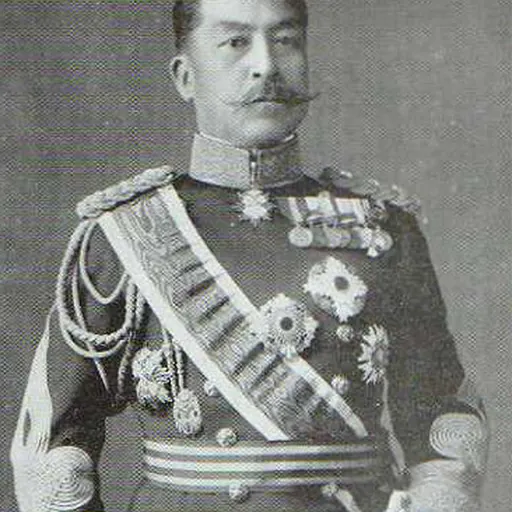
Kan'in Kotohito
Japanese prince and general
About Kan'in Kotohito
Lived 1865 – 1945 (aged 79). Kan'in Kotohito was a Japanese military personnel, politician, military officer and general field marshal.
Prince was the sixth head of a cadet branch of the Japanese imperial family, and a career army officer who served as Chief of the Imperial Japanese Army General Staff from 1931 to 1940. During his tenure as the Chief of the Imperial Japanese Army General Staff, the Imperial Japanese Army committed numerous war crimes against Chinese civilians including the Nanjing Massacre and the systemic use of chemical and bacteriological weapons. Prince Kan'in Kotohito died several months before the end of the Second World War.
Early years Prince Kotohito was born in Kyoto on November 10, 1865, as the sixteenth son of Prince Fushimi Kuniie (1802–1875). His father was the twentieth head of the Fushimi-no-miya, one of the four shinnōke, branches of the Imperial Family which were eligible to succeed to the throne if the main line should die out. Since the infant mortality rate in the main imperial household was quite high, Emperor Kōmei, the father of Emperor Meiji, adopted Prince Kotohito as a potential heir. Prince Kotohito was thus the adopted brother of Emperor Meiji and a great uncle to both Emperor Shōwa and his consort, Empress Kōjun.
Prince Kotohito was initially sent to Sambō-in monzeki temple at the age of three to be raised as a Buddhist monk, but was selected in 1872 to revive the Kan'in-no-miya, another of the shinnōke households, which had gone extinct upon the death of the fifth head, Prince Naruhito.
Marriage and family On December 19, 1891, Prince Kotohiko married Sanjō Chieko (January 30, 1872 – March 19, 1947), a daughter of Prince Sanjō Sanetomi. The couple had seven children: five daughters and two sons.
Early military career
Prince Kan'in entered the Imperial Japanese Army Academy in 1877 and graduated in 1881. Emperor Meiji sent him as a military attaché to France in 1882 to study military tactics and technology. He graduated from the Army Staff College in 1894, specializing in cavalry. He commanded the 1st Cavalry Regiment from 1897 to 1899.
Kan'in became a veteran of both the First Sino-Japanese War (1894–1895) and the Russo-Japanese War (1904–1905). He was appointed to command the 2nd Cavalry Brigade in 1901. He rose to the rank of lieutenant general in 1905 and became the commander of the IJA 1st Division in 1906, and the Imperial Guard Division in 1911. He was promoted to the rank of full general and became a Supreme War Councilor in 1912. He was further promoted to become the youngest field marshal in the Imperial Japanese Army in 1919. In 1921, he accompanied then-Crown Prince Hirohito on his tour of Western Europe.
Career in the Imperial General On December 1, 1931, Prince Kan'in became Chief of the Imperial Japanese Army General Staff, replacing General Kanaya Hanzo. During his tenure, the Imperial Japanese Army committed many war crimes against Chinese civilians including the Nanjing massacre and the systemic use of chemical and bacteriological weapons.
As Chief of the General Staff, Kan'in authorized the use of chemical weapons in China, such as tear gas, which were used sporadically in 1937. In the spring of 1938, he further authorized the use of sneezing gas. Later, in the summer of 1939, he approved the use of mustard gas against both Kuomintang and Communist Chinese troops. On 28 July 1937, Prince Kan'in transmitted to the Army the emperor's first directive (rinsanmei) authorizing the use of chemical weapons on July 28, 1937. He transmitted a second order on September 11 authorizing the deployment of special chemical warfare units to Shanghai. On April 11, 1938, Directive Number 11 was issued in his name, authorizing further use of poison gas in Inner Mongolia.
In Shanxi Province, poisonous gases were used to counter the guerilla warfare of the 8th Route Army of the National Revolutionary Army. Large amounts of sneezing gas were utilized against the Chinese National Revolutionary Army at the Battle of Wuhan and in the Central China region. Lethal blister gases, such as yperite and lewisite, were deployed by Japanese forces after 1939.
In July 1940, he forced the resignation of War Minister General Shunroku Hata (1879–1962), thus bringing down the cabinet of Prime Minister Mitsumasa Yonai. The Prince was also a participant in the liaison conferences between the military chiefs of staff and the second cabinet of Prince Fumimaro Konoe (June 1940–July 1941). Both he and the newly appointed War Minister, General Hideki Tojo, supported the Tripartite Pact and Anti-Comintern Pact between the Empire of Japan, Nazi Germany, and Fascist Italy.
Honours He received the following orders and decorations: Collar of the Order of the Chrysanthemum Order of the Golden Kite, 1st Class Grand Cross of the Legion of Honour, 5 October 1895 Knight of the Order of St. Alexander Nevsky, 2 November 1898 Grand Cordon of the Royal Order of Leopold, with Swords, 28 April 1900 Knight of the Order of the Annunciation, 20 May 1900 Order of Osmanieh, 1st Class, 29 May 1900 Grand Cross of the Order of St. Stephen, 7 June 1900 Grand Cross of the Order of the Red Eagle, 23 June 1900 Knight of the Order of Merit of the Prussian Crown, with Swords, 22 June 1906 Hohenzollern: Cross of Honour of the Princely House Order of Hohenzollern, 1st Class, with Swords, 18 November 1905 Order of the Double Dragon, Class I Grade II, 27 January 1904 Honorary Knight Grand Cross of the Order of St Michael and St George, 1921
Gallery
Don’t just read it —
keep it.
Full-length biographies made to live with: read them, listen on the way to work, watch them tonight.
- E-book
- Audio
- Video
Instant download · yours to keep · every purchase keeps this site free
Important facts
People in Kan'in Kotohito's life
Named in this biography and alive at the same time


Related people
Same field, nearest in time





Contemporaries
People whose lives overlapped Kan'in Kotohito's

Frequently asked questions
Who was Kan'in Kotohito?
Japanese prince and general (1865–1945)
When was Kan'in Kotohito born?
Kan'in Kotohito was born on 10 November 1865 in Kyoto.
When did Kan'in Kotohito die?
Kan'in Kotohito died on 21 May 1945 in Odawara.
What was Kan'in Kotohito's occupation?
Kan'in Kotohito was a military personnel, politician, military officer and general field marshal.
What nationality was Kan'in Kotohito?
Kan'in Kotohito was Japanese.
Sources & further reading
· DBpedia: Prince Kan'in Kotohito
Cite this page
APA: Biography.guide. (2026). Kan'in Kotohito. https://biography.guide/kan-in-kotohito/
MLA: "Kan'in Kotohito." Biography.guide, https://biography.guide/kan-in-kotohito/.
Chicago: "Kan'in Kotohito." Biography.guide. https://biography.guide/kan-in-kotohito/.
Data last updated: 2026-09-22 · Spot an error? Report a correction.
Portrait: Wikimedia Commons · author & licence
Page generated 2026-09-27 05:03 UTC