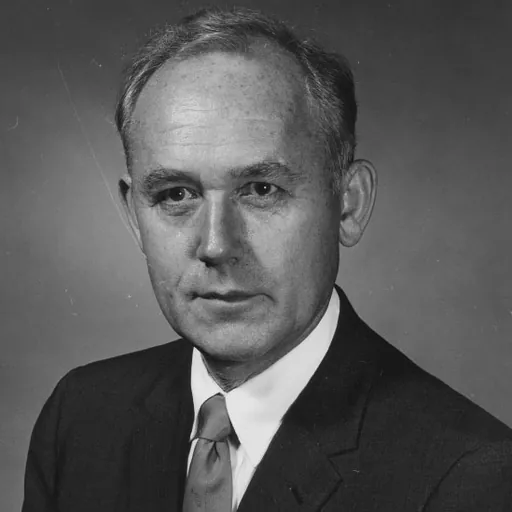
About Kaj Aage Gunnar Strand
Lived 1907 – 2000 (aged 93). Kaj Aage Gunnar Strand was an American astronomer, known for Astrometry.
Kaj Aage Gunnar Strand (27 February 1907 – 31 October 2000) was a Danish-born naturalized American astronomer known for his work in positional astronomy and for serving as the scientific director of the United States Naval Observatory from 1963 to 1977. His work focused especially on double stars and stellar distances.
Early life and education Kaj Strand was born on February 27, 1907, in Hellerup, on the outskirts of Copenhagen, Denmark, to Constance (née Malmgren) and Viggo Peter Strand, a goldsmith who owned a jewellery store. He entered the University of Copenhagen in 1926, majored in astronomy, and graduated in 1931 with Magister (Master's) and Candidate Magister degrees. At the invitation of Ejnar Hertzsprung, during the 1930s he worked at Leiden on a program of photographing double stars; he applied these results toward his doctorate from Copenhagen in 1938.
Career From 1938 to 1942 Strand worked under Peter van de Kamp as a research associate at Swarthmore College, and began the photographic double star program with the refractor telescope at the college's Sproul Observatory. During World War II he entered the U.S. Army, and then the U.S. Army Air Force, and flew as a Captain and chief navigator on B-29 Superfortress tests. As head of the Navigation Department he was involved in operational training of special air crews, including the first atomic bomb crew. and was primarily responsible for the design and construction of the Strand Astrometric Telescope, dedicated in 1964 at the United States Naval Observatory Flagstaff Station in Arizona.
Claim of extrasolar planets
Strand is also known for his 1942 and 1957 claims of a planetary system around the nearby star 61 Cygni while working under the direction of Peter van de Kamp at the Sproul Observatory. These claims were later refuted by Wulff Heintz, also of the Sproul Observatory.
Honors and awards Strand was awarded the Guggenheim Fellowship in 1946. The main-belt asteroid, 3236 Strand (1982 BH1), is named for him. It was discovered on January 24, 1982, by E. Bowell at Lowell Observatory, Anderson Mesa Station in Flagstaff, Arizona.
Personal life and death He died October 31, 2000, in Washington, D.C., at the age of 93.
Don’t just read it —
keep it.
Full-length biographies made to live with: read them, listen on the way to work, watch them tonight.
- E-book
- Audio
- Video
Instant download · yours to keep · every purchase keeps this site free
Important facts
People in Kaj Aage Gunnar Strand's life
Named in this biography and alive at the same time




Related people
Same field, nearest in time



Contemporaries
People whose lives overlapped Kaj Aage Gunnar Strand's


Frequently asked questions
Who was Kaj Aage Gunnar Strand?
Danish-American astronomer
When was Kaj Aage Gunnar Strand born?
Kaj Aage Gunnar Strand was born on 27 February 1907 in Hellerup.
When did Kaj Aage Gunnar Strand die?
Kaj Aage Gunnar Strand died on 31 October 2000 in Washington, D.C..
What was Kaj Aage Gunnar Strand's occupation?
Kaj Aage Gunnar Strand was an astronomer.
What was Kaj Aage Gunnar Strand known for?
Kaj Aage Gunnar Strand was known for Astrometry.
What nationality was Kaj Aage Gunnar Strand?
Kaj Aage Gunnar Strand was American.
Sources & further reading
· Wikipedia: Kaj Aage Gunnar Strand
· DBpedia: Kaj Aage Gunnar Strand
Cite this page
APA: Biography.guide. (2026). Kaj Aage Gunnar Strand. https://biography.guide/kaj-aage-gunnar-strand/
MLA: "Kaj Aage Gunnar Strand." Biography.guide, https://biography.guide/kaj-aage-gunnar-strand/.
Chicago: "Kaj Aage Gunnar Strand." Biography.guide. https://biography.guide/kaj-aage-gunnar-strand/.
Data last updated: 2026-09-23 · Spot an error? Report a correction.
Portrait: Wikimedia Commons · author & licence
Page generated 2026-09-27 05:07 UTC