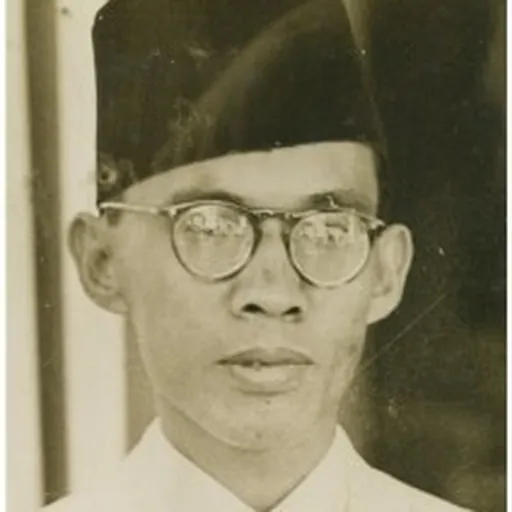
About Jusuf Wibisono
Lived 1919 – 1982 (aged 62–63). Jusuf Wibisono was an Indonesian civil servant, economist and politician.
Jusuf Wibisono (EVO: Joesoef Wibisono; 28 February 1909 – 15 June 1982) was an Indonesian politician and economist. A member of the Masyumi Party, he served as Minister of Finance from 1951 to 1952 and again from 1956 to 1957, under the Soekiman and Second Ali Sastroamidjojo cabinets. Born in Magelang, Wibisono took part in Islamic organizations in the nationalist movement from his school years. He joined Masyumi during the Indonesian National Revolution, and became a leading member within the party despite disagreements with other party leaders such as Mohammad Natsir. In both of his tenures as finance minister, Wibisono relaxed the tight budgetary controls of his predecessor, and provided favors to political parties.
An ardent opponent of the Communist Party of Indonesia, Wibisono attempted to organize the Masyumi to work with President Sukarno during the late 1950s to oppose the communists. Instead, he was sidelined in the party before being arrested by the government in crackdowns due to Masyumi involvement in the PRRI rebellion. Following the fall of Sukarno, he and former Prime Minister Soekiman Wirjosandjojo considered establishing their own political party, though they decided against it. Instead, Wibisono joined the ranks of the Indonesian Islamic Union Party (PSII), but the PSII's poor performance in the 1971 legislative election led to his retirement from politics. He died in 1982 at Dr. Cipto Mangunkusumo Hospital.
Early life and career
Jusuf Wibisono was born on 28 February 1909 in Magelang, today in Central Java, as the third child of four children. After completing his education at a Hollandsch-Inlandsche School (HIS), he continued to a Meer Uitgebreid Lager Onderwijs (MULO), although his father, Kunto Wibisono, had wanted him to study to be a teacher. Afterwards, he briefly studied at the STOVIA medical school before dropping out due to being unfit. Instead, he continued his education at a Algemene Middelbare School (AMS) in Bandung. Wibisono continued to the Rechtshogeschool in Batavia, graduating with a Meester in de Rechten in 1941, shortly before the Japanese invasion of the Dutch East Indies. During his studies, Wibisono became active in the Jong Islamieten Bond youth organization, and in 1934 along with Mohammad Roem he co-founded a branch that catered to secondary students, the Studenten Islam Studieclub. He had begun to work at the colonial government before completing his law degree, first at the economic department and then in the central statistics office. He became a commercial judge during the Japanese occupation of the Dutch East Indies. Following the proclamation of Indonesian independence, Wibisono was appointed into the Central Indonesian National Committee (KNIP), and became a member of the KNIP's working body. He was later appointed Junior Minister of Prosperity in the Third Sjahrir Cabinet.
Political career
Minister of Finance
After the conclusion of the Indonesian National Revolution, Wibisono joined the Provisional People's Representative Council as a member of the Masyumi Party. He made public statements calling for the increase of the work day (from seven hours to eight), and was briefly examined by prosecutors after criticizing members of the First Ali Sastroamidjojo Cabinet.
He made speeches denouncing communism and the Soviet Union, and led a Masyumi opposition to establishment of diplomatic relations in 1953–1954. In November 1954, he tabled a motion of no confidence against the Ali Cabinet, in particular attacking the policies of Economic Minister Iskaq Tjokroadisurjo, perceived to be favoring the Indonesian National Party (PNI). Iskaq proceeded to resign, and the motion of no confidence was defeated. He returned to his post as finance minister in the Second Ali Sastroamidjojo Cabinet. Disbursements to politically affiliated businesses continued, and in one case in July 1956, Wibisono provided favors for a Nahdlatul Ulama-affiliated business to ensure Sjafruddin Prawiranegara's reappointment as governor of Bank Indonesia. He also announced a reduction of 30 percent in the government headcount, to be implemented in stages, and the program was not executed during his tenure. He resigned on 9 January 1957 and was replaced with Djuanda Kartawidjaja. After the end of his ministerial tenure, he was arrested under corruption charges in April 1957, although he was released by March 1958 – officially for a lack of evidence.
Masyumi dissolution
Shortly before his release, in early 1958, Masyumi leaders including Natsir, Sjafruddin, and Burhanuddin Harahap became involved in the Revolutionary Government of the Republic of Indonesia, a shadow government contesting the Jakarta government. Wibisono himself was not involved, and once released wanted to condemn the actions of Natsir and others, but after discussions the party and its members elected to not issue any support or denouncements. In the ensuing political shifts, the Indonesian Communist Party gained significant powers and Wibisono wanted Masyumi to work with the PNI and Christian parties in order to prevent the Communists from entering government. Wibisono was willing to give significant concessions such as increasing President Sukarno's power to do this, but he was sidelined and instead the party under the new leadership of Prawoto Mangkusasmito opted to form a united front with other Islamic parties.
Masyumi was eventually dissolved in 1960, and Wibisono joined the People's Representative Council of Mutual Assistance (DPR-GR) in 1960 under the umbrella of SBII, which had by then separated from Masyumi. He cut ties with nearly all Masyumi leaders except Soekiman, but Wibisono was still arrested in late 1963 or early 1964 under conspiracy charges and was imprisoned for nearly three years without trial. In mid-1966, Wibisono and other former Masyumi leaders were released from prison following the fall of Sukarno. Alongside Soekiman, Wibisono considered establishing their own political party which would be founded on Islam but which "mustn't be too religious". However, both men decided against it after consulting with figures from the new regime. Instead, Wibisono joined the ranks of the Indonesian Islamic Union Party (PSII), but after the PSII's poor performance in the 1971 Indonesian legislative election, he opted to retire from politics. He died on 15 June 1982 at Dr. Cipto Mangunkusumo Hospital in Jakarta.
Footnotes
Don’t just read it —
keep it.
Full-length biographies made to live with: read them, listen on the way to work, watch them tonight.
- E-book
- Audio
- Video
Instant download · yours to keep · every purchase keeps this site free
Important facts
People in Jusuf Wibisono's life
Named in this biography and alive at the same time




Related people
Same field, nearest in time


Contemporaries
People whose lives overlapped Jusuf Wibisono's



Frequently asked questions
Who was Jusuf Wibisono?
Indonesian politician
When was Jusuf Wibisono born?
Jusuf Wibisono was born in 1919 in Dutch East Indies.
When did Jusuf Wibisono die?
Jusuf Wibisono died on 15 June 1982 in Indonesia.
What was Jusuf Wibisono's occupation?
Jusuf Wibisono was a civil servant, economist and politician.
What nationality was Jusuf Wibisono?
Jusuf Wibisono was Indonesian.
Sources & further reading
Cite this page
APA: Biography.guide. (2026). Jusuf Wibisono. https://biography.guide/jusuf-wibisono/
MLA: "Jusuf Wibisono." Biography.guide, https://biography.guide/jusuf-wibisono/.
Chicago: "Jusuf Wibisono." Biography.guide. https://biography.guide/jusuf-wibisono/.
Data last updated: 2026-09-21 · Spot an error? Report a correction.
Portrait: Wikimedia Commons · author & licence
Page generated 2026-09-27 04:59 UTC