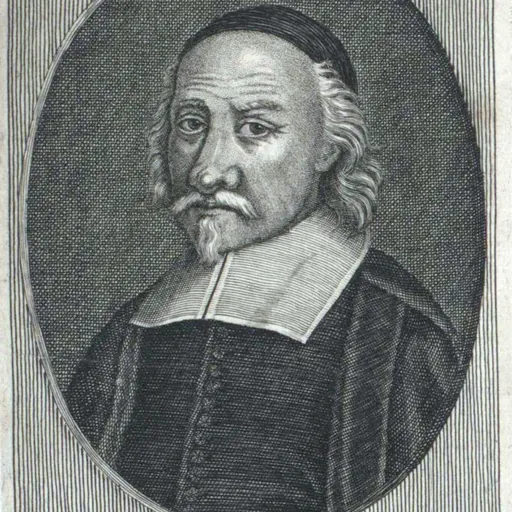
About Justus Gesenius
Lived 1601 – 1673 (aged 72). Justus Gesenius was a German poet, court chaplain, hymnwriter, superintendent, parson and protestant theologian.
Justus Gesenius (6 July 1601, Esbeck (near Elze), in the principality of Calenberg – 18 September 1673, Hanover) was a Lutheran theologian of the seventeenth century, known for his catechisms.
Biography Gesenius' father was a preacher at Esbeck. Having received his early education at the Adreanum in Hildesheim, he studied under Georg Calixtus and Conrad Horneius at University of Helmstedt. In 1628 he took his degree of master of philosophy in Jena and was called as pastor to the church of St. Magnus in Brunswick. After seven years there, he was called to Hildesheim, the seat of George, duke of Brunswick and Lunenburg, as court chaplain and preacher in the Collegiate of St. Blaise. After the duke's death in 1641, he and the rest of the consistory moved to Hanover, where Gesenius became chief court chaplain and general superintendent of the principality of Calenberg. Later, in 1665, he was general superintendent of Grubenhagen as well. He received the degree of doctor of divinity in 1643 for the dissertation De igne purgatorio.
With his friend David Denicke, Gesenius compiled a hymnal containing 222 hymns (Hanover, 1646), which was later enlarged and arranged for use in the churches. They also adapted many of the older hymns and may have added their own compositions. In 1631, Gesenius published his Kleine Katechismusschule, or " Brief Instruction as to how the Catechism Should be Taught to the Young and the Simple." In 1639, by order of Duke George and of the consistory, he issued an abridgment of this work under the title Kleine Catechismusfragen über den kleinen Catechismum Lutheri, which was republished several times. This work was introduced into all the schools of the principality of Calenberg and gained great repute in many parts of Lower Saxony. In 1723, King George I sought to introduce Gesenius' catechism into the duchies of Bremen and Verden
Gesenius was often the subject of criticism, especially by Statius Buscher in his Cryptopapismus novae theologiae Helmstadiensis (Hamburg, 1638). Gesenius justified himself in Grundliche Widerlegung (Lunenburg, 1641) and his innocence was established through an investigation by impartial theologians. He denied accusations of secretly being Catholic in Warum willst du nicht römisch-katholisch werden, wie deine Vorfahren waren? (4 parts, Hanover, 1669 72). He also published a manual of instruction in Biblical history, Biblische Historien Alten and Neuen Testaments, in 1656.
Don’t just read it —
keep it.
Full-length biographies made to live with: read them, listen on the way to work, watch them tonight.
- E-book
- Audio
- Video
Instant download · yours to keep · every purchase keeps this site free
Important facts
People in Justus Gesenius's life
Named in this biography and alive at the same time


Related people
Same field, nearest in time



Contemporaries
People whose lives overlapped Justus Gesenius's





Frequently asked questions
Who was Justus Gesenius?
Lutheran theologian
When was Justus Gesenius born?
Justus Gesenius was born on 6 July 1601 in Esbeck.
When did Justus Gesenius die?
Justus Gesenius died on 18 September 1673 in Hanover.
What was Justus Gesenius's occupation?
Justus Gesenius was a poet, court chaplain, hymnwriter, superintendent, parson and protestant theologian.
What nationality was Justus Gesenius?
Justus Gesenius was German.
Sources & further reading
Cite this page
APA: Biography.guide. (2026). Justus Gesenius. https://biography.guide/justus-gesenius/
MLA: "Justus Gesenius." Biography.guide, https://biography.guide/justus-gesenius/.
Chicago: "Justus Gesenius." Biography.guide. https://biography.guide/justus-gesenius/.
Data last updated: 2026-09-22 · Spot an error? Report a correction.
Portrait: Wikimedia Commons · author & licence
Page generated 2026-09-27 05:03 UTC