
About Jürgen Ahrend
Lived 1930 – 2024 (aged 94). Jürgen Ahrend was a German organ builder, musical instrument maker and restorer.
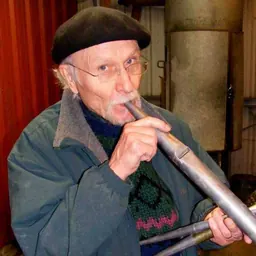
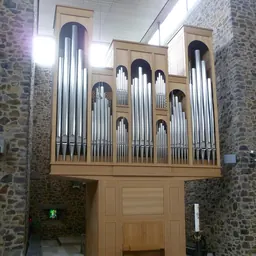
Jürgen Ahrend (; 28 April 1930 – 1 August 2024) was a German organbuilder and technician. He restored instruments such as the Gothic Rysum organ and the Arp Schnitger organs of the Martinikerk in Groningen, Netherlands, and of St. Jacobi in Hamburg as well as building organs of his own creation. He presided over his eponymous firm, Jürgen Ahrend Orgelbau in Leer, from 1972 to 2004, operating internationally.
Life and career
Early and personal life Ahrend was born in Treuenhagen, a village near Göttingen, on 28 April 1930. His father, Heinrich Ahrend, was an administrative employee by profession; however, he maintained a stringent passion for music, being a singer and choir director who also played various instruments. Following the destructive events of World War II, his mother Elisabeth became a single mother to her five children (including Jürgen). His first marriage was to Margarete Bartels; following their divorce, she married the Dutch organist Klaas Bolt. They had five children: two of them have taken up musical professions, Seivert and Heiko (musicians, composers, and music producers). His most famous child, Henrik (born 11 August 1963), is the current head of the organbuilding firm he founded.
Organbuilding and workshops From 1946 to 1948, he held an apprenticeship in the firm of , a Neo-Baroque organbuilding firm in Göttingen. He then worked for the firm as an employee. He undertook study travel with , who had also been an apprentice of Ott, to European organ builders, Metzler Orgelbau in Switzerland, Flentrop in the Netherlands and Marcussen & Søn in Denmark. The two formed a partnership in Leer–Loga, Lower Saxony in 1954, which they called Ahrend und Brunzema. They produced 54 new organs and restored nineteen, until Brunzema left the firm in 1972 to work in Canada. They restored the original tuning of organs from the Renaissance and Baroque eras, beginning with the , the and the Gothic Rysum organ. When they built a new organ in Baroque style for the Zorgvlietkerk in Scheveningen in 1958, they received international recognition. They built a new transept organ for the Oude Kerk in Amsterdam and a new organ for the Doopsgezinde Kerk in Haarlem, and restored instruments of the Waalse Kerk in Amsterdam and the Hooglandse Kerk in Leiden.
The workshop operated as Jürgen Ahrend Orgelbau from 1972. Ahrend was also commissioned to restore the organs and their tuning for the Arp Schnitger organs in the Martinikerk in Groningen (including the main organ in the west gallery), the organ of St. Jacobi in Hamburg and organ of St. Ludgeri in Norden. In Hamburg, the organ pipes had been removed from the organ case for safety in 1942. The church was destroyed by bombing. In the restored church, Ahrend used the historic pipes in a new case to revive the sound he had in mind.
Ahrend used several historic building techniques in his restoration work. He devoted about half of the workshop's time to restoration. He restored internationally, such as the organ of Frederiksborg Castle in Hillerød and the Martinikerk. He was interviewed extensively in the film Martinikerk Rondeau, released in 2009.
Since 2005 his son Hendrik Ahrend has run the workshop. Jürgen Ahrend became involved in the organ festival Orgelfrühling in Krummhörn from its beginning. The 2020 edition was dedicated to him to honour his 90th birthday, but it could not be held until 2022 due to the COVID-19 pandemic.
Ahrend died in Leer, Lower Saxony, on 1 August 2024, at the age of 94.
Awards 1962, Staatspreis für Kunsthandwerk Niedersachsen (State Prize for Craftsmanship in Lower Saxony) 2000, Honorary doctorate of law from the Monash University, Victoria, Australia 2007, The Buxtehude Prize from the city of Lübeck.
Works Roman number = number of manuals Arabian number = number of stops P = independent pedal p = pull down pedal R = restoration Rc = reconstruction NB = new built
Ahrend & Brunzema (1954–1971)
160x160px NB II/P 25 1962 29 Espel (NL) Ref. Church NB I 7 1962 30 Bremen (D) St. Martini center
Jürgen Ahrend (1972–2004)
year opus town church picture kind manuals stops information 1972 76 Eugene MarAbel B. Frohnmayer Music Building of the University of Oregon 160px NB IV/P 38 1966–73 79 Ochtersum (D) 160px R I/p 9 1972–75, 1993/94 81 Stade (D) St. Cosmae et Damiani 160px R III/P 42 1974 83 Taizé (F) (now in Lyon) 160px NB III/P 28 1975 84 Hamburg (D) Christengemeinschaft Johnsallee center 160x160px NB II/P 30 1981–85 116 Norden (D) 160px R III/P 46 organ 1985 118 Stellichte (D) 160x160px Rc II/p 12 1986 120 Tokyo (Japan) St. Gregory House NB II/p 13 1986/2007 121/178 Kantens (NL) Ref. Church 160px R/Rc II/p 15 1986/87 127 Vienna (A) Michaelerkirche center 160x160px R III/P 35 1990–93 139 Hamburg (D) St. Jacobi center
Hendrik Ahrend (from 2005)
Don’t just read it —
keep it.
Full-length biographies made to live with: read them, listen on the way to work, watch them tonight.
- E-book
- Audio
- Video
Instant download · yours to keep · every purchase keeps this site free
Important facts
People in Jürgen Ahrend's life
Named in this biography and alive at the same time

Related people
Same field, nearest in time



Contemporaries
People whose lives overlapped Jürgen Ahrend's


Frequently asked questions
Who was Jürgen Ahrend?
German organ builder (1930–2024)
When was Jürgen Ahrend born?
Jürgen Ahrend was born on 28 April 1930 in Geismar.
When did Jürgen Ahrend die?
Jürgen Ahrend died on 1 August 2024 in Leer.
What was Jürgen Ahrend's occupation?
Jürgen Ahrend was an organ builder, musical instrument maker and restorer.
What nationality was Jürgen Ahrend?
Jürgen Ahrend was German.
Sources & further reading
Cite this page
APA: Biography.guide. (2026). Jürgen Ahrend. https://biography.guide/jurgen-ahrend/
MLA: "Jürgen Ahrend." Biography.guide, https://biography.guide/jurgen-ahrend/.
Chicago: "Jürgen Ahrend." Biography.guide. https://biography.guide/jurgen-ahrend/.
Data last updated: 2026-09-25 · Spot an error? Report a correction.
Page generated 2026-09-27 05:08 UTC