
About Charles B. Fisk
Lived 1925 – 1983 (aged 57–58). Charles B. Fisk was an American organ builder and businessperson.
Death Fisk died on December 16, 1983, aged 58 years,
In tracker-action organs, the movement of the keys or pedals is mechanically linked to the valves, enabling air to flow through the organ pipes. In electro-pneumatic action, valves and keys are connected electrically, without the use of mechanical trackers. An organ manual is a set of keys that are played with the hands, similar to the keyboard on a piano. However, unlike a piano, an organ can have multiple manuals, which are arranged in tiers.
To further his understanding of traditional organs, Fisk studied features of historical European organs. Trips to Europe were common, with the first one being in 1959, where he traveled with Arthur Howes. He then tried to emulate them in his own designs.
In addition to building new organs, Fisk restored various historical organs.
Opus numbers Fisk gave his organs opus numbers. However, some were never built due to cancellations. Some were merely restorations or additions to existing organs. Opus 1 through 24 were not built by Fisk. This was because he continued the preexisting opus numbers of the Andover Organ Company, meaning those organs were built by Byers.
Jonathan Ambrosino, an organ historian, wrote that although Fisk was inspired by older organs, he added his own personal touches rather than exactly replicating historical organs.
In 1968, The Diapason published an article, written by Fisk and entitled "The Organ's Breath of Life", in which Fisk argued in favor of using historical organ wind systems. but now is an industry-standard. In September 1978, Fisk wrote the article "Some Thoughts on Pipe Metal", in which he described the differences between the tonal qualities of metals used in pipes. He described lead pipes as "a darkness, a hollowness, a sound as of deepest antiquity [and] a strength of sound." and that tin pipes embodied the "sound of refinement". It was published by The American Organist and was cited by organists Jonathan M. Gregoire and Hans Davidsson.
Noted organs 1964 Fisk organ in King's Chapel, Boston, Massachusetts (op. 44)
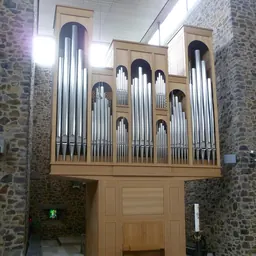
In 1958, Rice University commissioned the Andover Company to build a two-manual, 16 stop organ (op. 25) for its Rice Memorial Chapel at the price of $19,680. It was one of the first Fisk organs to be made completely from scratch. Opus 25 marks the last electric organ Fisk would ever make: all of his later works predominantly feature tracker actions. A historical feature found in this organ is the . Rückpositiv is a smaller section of organ pipes that can be played separately from the larger main pipes. Though Rückpositiv can be easily seen in old organs, they became essentially extinct in the 1960s when this organ was built. This organ is also known as the Andover-Fisk Organ. Its name, "Flentrop-Andover", was chosen because it was built when Fisk was still the president of the Andover Company. Andrew Johnson, an organist at Mount Calvary Church, described the organ as being "clear", "responsive", and as appearing to "shape the player". This organ includes two pedals that may be configured to activate specific stops to achieve a different tonal qualities, bypassing the need to manually pull the organ stops. These special pedals specifically affect the lower register section, called the Pedal division, of the main keyboard, called the Great. In American Record Guide, William Gatens wrote that the organ sounded "thin and strident" and felt "dry" compared to Fisk's later works. According to Boston Globe, this organ, along with his organs in Harvard University and Old West Church, are "considered to be landmarks" in the field of organbuilding. As for the completed organ, organist Christian Lane said that the control of the wind felt "amazing and voluptuous". According to The Diapason, it is considered to be one of "the most beautiful contemporary instrument in the world."
In 1976, Fisk and Fenner Douglass installed a French classic-style organ at the University of Vermont's then-newly constructed music building (op. 68). Douglass was hired by the university as a contractor, who in turn recommended Fisk. Tonal planning was completed in 1975, which included a 16' Montre in the Great division. It was tuned according to Werckmeister II, an unequal temperament system. The main facade was inspired by the Robert Clicquot organ of St. Louis des Invalides in Paris, featuring five pipe-containing towers. At Douglass's request, the Positive case protrudes from the main case. Fisk decided to cantilever the Positive case right above where the organist would sit, allowing for sound to pass through the airshaft unimpeded to the organist. The organ replicates many of Classical French designs, though the lack of the 4' Clarion is notable. Fisk built a large four-manual, mechanical-action organ for the House of Hope Presbyterian Church in St. Paul, Minnesota, One critic praised the suite,
From 1980 to 1981, a historical baroque organ (op. 72), tuned in mean-tone temperament, was recreated and installed in Houghton Chapel of Wellesley College. Additionally, it was designed so the air supply can be supplied electrically or through manual pedals.
In 1981, another organ was planned for Palmer Memorial Church, a de facto church of Rice University. Though Fisk was chosen as the builder, he died before the construction. Thus C.B. Fisk, Inc., continued to build the organ. The design commenced in 1989. Originally commissioned in 1973, financial and logistics issues caused a delay of 25 years. It is the largest organ in the Memorial Church and is named the "Fisk-Nanney" organ, referencing to the church's organist, Herbert Nanney. It is designed to accommodate two different tuning systems: meantone and well temperament. It is unique in that a lever above the manuals allows the organist to switch between the two systems. (See also Stanford Memorial Church § Organs)
In 1992, a Fisk organ was installed in Meyerson Symphony Center, Dallas, Texas. It was originally conceived in 1982. With a tonal design plan completed in 1983, this project was aided by architect I. M. Pei, acoustician Russell Johnson, and visual designer Charles Nazarian. Pei suggested that brass highlights be added to make the organ fit better with its surroundings. The Resonance division of the organ, which operates at high pressure, was made easier to play by using Fisk company's servopneumatic lever mechanism. The organ was well regarded by James Moeser, the former president of the American Guild of Organists, who described the organ as "one of the most important organs to have been built in this or any century".
After Fisk's death, two novels based on his life were published. One is titled The Organ Builder, written by Robert Cohen . It was inspired by Fisk's life and work as described in his obituary in The New York Times. A two-volume biography named Charles Brenton Fisk, Organ Builder was published two years after Fisk's death. It includes his writings and details about the Fisk organs.
Publications
Don’t just read it —
keep it.
Full-length biographies made to live with: read them, listen on the way to work, watch them tonight.
- E-book
- Audio
- Video
Instant download · yours to keep · every purchase keeps this site free
Important facts
People in Charles B. Fisk's life
Named in this biography and alive at the same time






Related people
Same field, nearest in time




Contemporaries
People whose lives overlapped Charles B. Fisk's


Frequently asked questions
Who was Charles B. Fisk?
American physicist and organ builder
When was Charles B. Fisk born?
Charles B. Fisk was born in 1925 in Washington, D.C..
When did Charles B. Fisk die?
Charles B. Fisk died in 1983.
What was Charles B. Fisk's occupation?
Charles B. Fisk was an organ builder and businessperson.
What nationality was Charles B. Fisk?
Charles B. Fisk was American.
Sources & further reading
· DBpedia: Charles Brenton Fisk
Cite this page
APA: Biography.guide. (2026). Charles B. Fisk. https://biography.guide/charles-b-fisk/
MLA: "Charles B. Fisk." Biography.guide, https://biography.guide/charles-b-fisk/.
Chicago: "Charles B. Fisk." Biography.guide. https://biography.guide/charles-b-fisk/.
Data last updated: 2026-09-20 · Spot an error? Report a correction.
Page generated 2026-09-27 05:03 UTC