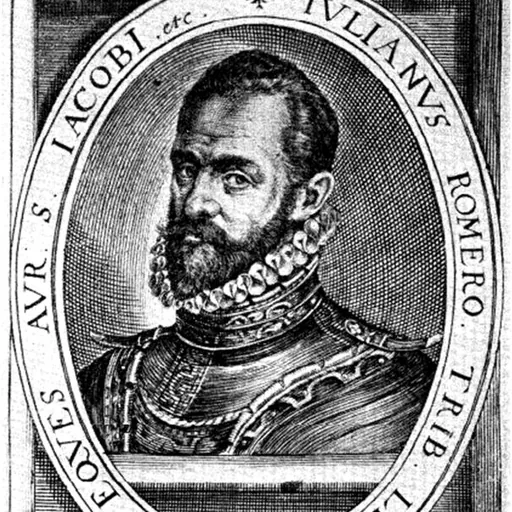
Julián Romero
Spanish military commander
About Julián Romero
Lived 1518 – 1577 (aged 58–59). Julián Romero was a Spanish military personnel, soldier and general field marshal.
Julián Romero de Ibarrola (Huélamo (Cuenca), 1518 – Felizzano, 1577) was a Spanish military commander in the 16th century. He participated in various conflicts in England, Italy, the Holy Roman Empire, the Mediterranean and the Spanish Netherlands.
His long and active career, in which he lost an eye, an arm, a leg and an ear, earned him international notoriety as an heroic, unbreakable soldier. Of undistinguished birth, he also stood out for being an unusual example of a common man rising from footsoldier to maestre de campo for merit alone. He was celebrated in Spain as El de las Hazañas ("He of the Feats").
Biography Romero was born in Huélamo, Province of Cuenca (Spain). Nothing more is known about his youth. He entered the Spanish army at the age of 16, and was stationed in Flanders. By 1547 he was part of Pedro de Gamboa's Spanish mercenary force commanding a unit as sergeant or captain at the Battle of Pinkie, as ally of the English in their war with Scotland known as the Rough Wooing. King Henry VIII of England was so impressed by his performance, that he made him a banneret, with a yearly pension of £150. Romero's unit was captured during the siege of Haddington at Coldingham in the spring of 1549. He was released and stationed at Cheswick in Northumberland in May 1549.
On July 15, during the signing of peace between Henry VIII and Francis I of France in the Palace of Fontainebleau, Romero represented Henry VIII in a duel against Cristóbal de Mora, a soldier from his unit who had defected to Francis I. During the three-hour duel, Romero lost his sword and lance and had his horse killed under him, but he managed to force Moura to dismount and wrestled him to the ground, where he subdued him with his dagger. He received gifts from both kings for his victory.
Romero fought in the Italian War of 1551–1559, where he distinguished himself in the Battle of St. Quentin (1557), for which he was made a Knight in the Order of Santiago.
In 1565 he was stationed in Sicily, but the following year, the Duke of Alba made him Maestre de campo, and he accompanied the Duke to the Low Countries to crush the Dutch Revolt. In 1568 he commanded the guard at the execution of Counts Egmont and Horn.
Romero fought in the Siege of Mons (1572), where he nearly succeeded in killing William the Silent in a daring raid against the Dutch camp. He was also present at the Massacre of Naarden and the Siege of Haarlem, where he lost an eye. In 1574, he failed to relieve Middelburg after losing the Battle of Reimerswaal, and in 1576 he was present at the Sack of Antwerp.
By the Edict of 1577, most Spanish troops were withdrawn from the Low Countries and Romero was stationed in Cremona. He died of a stroke in Felizzano near Alessandria while he was in charge of transferring Spanish troops back to the territories of the Spanish crown. He was buried in Alessandria in the church of San Giacomo della Vittoria.
After his death
After his death, Julian Romero became in Spain a military hero who gave his life for his country.
He was painted by El Greco around 1612 and José de Cañizares dedicated a play to him (El guapo Julián Romero) in the 18th century.
Don’t just read it —
keep it.
Full-length biographies made to live with: read them, listen on the way to work, watch them tonight.
- E-book
- Audio
- Video
Instant download · yours to keep · every purchase keeps this site free
Important facts
People in Julián Romero's life
Named in this biography and alive at the same time
Related people
Same field, nearest in time


Contemporaries
People whose lives overlapped Julián Romero's






Frequently asked questions
Who was Julián Romero?
Spanish military commander (1518–1577)
When was Julián Romero born?
Julián Romero was born in 1518 in Torrejoncillo del Rey, Huélamo.
When did Julián Romero die?
Julián Romero died on 13 October 1577 in Solero, Felizzano.
What was Julián Romero's occupation?
Julián Romero was a military personnel, soldier and general field marshal.
What nationality was Julián Romero?
Julián Romero was Spanish.
Sources & further reading
Cite this page
APA: Biography.guide. (2026). Julián Romero. https://biography.guide/julian-romero/
MLA: "Julián Romero." Biography.guide, https://biography.guide/julian-romero/.
Chicago: "Julián Romero." Biography.guide. https://biography.guide/julian-romero/.
Data last updated: 2026-09-22 · Spot an error? Report a correction.
Portrait: Wikimedia Commons · author & licence
Page generated 2026-09-27 05:04 UTC