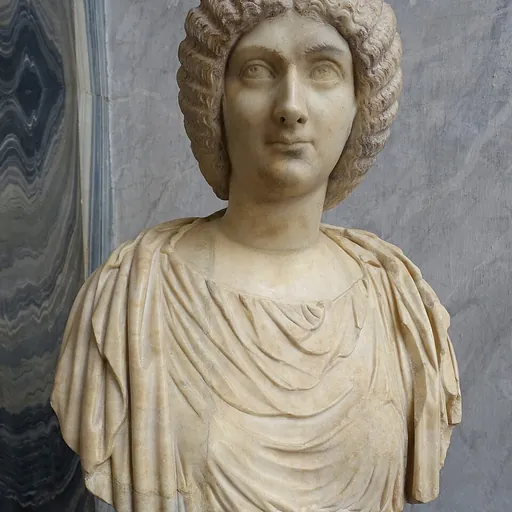
About Julia Domna
Lived 165 – 217 (aged 51–52). Julia Domna was a Roman philosopher.
Family background Julia Domna was born in Emesa (modern day Homs) in Syria around 160 AD to an Arab family that was part of the Emesene dynasty. Her name, Domna, is an archaic Arabic word meaning "black", referencing the nature of the sun god Elagabalus which took the form of a black stone. She was the youngest daughter of the high priest of Baal, Julius Bassianus, and sister to Julia Maesa. Through Maesa and her husband Julius Avitus, Domna had two nieces: Julia Soaemias and Julia Mamaea, the respective mothers of future Roman emperors Elagabalus and Severus Alexander .
Domna's ancestors were priest kings of the temple of Elagabalus. The family had enormous wealth and was promoted to Roman senatorial aristocracy. Before her marriage, Domna inherited the estate of her paternal great-uncle Julius Agrippa, a former leading centurion. politician Septimius Severus heard a foretelling of a woman in Syria who would marry a king. So Severus sought her as his wife. This woman was Domna. Bassianus accepted Severus' marriage proposal in early 187, and in the summer the couple married in Lugdunum (modern-day Lyon, France), of which Severus was the governor. The marriage proved happy, and Severus cherished Domna and her political opinions. Domna built "the most splendid reputation" by applying herself to letters and philosophy. She gave birth to their two sons, Lucius Septimius Bassianus in 188 in Lugdunum, and Publius Septimius Geta the following year in Rome.
Civil war
After the Roman emperor Commodus was murdered without an heir in 192, many contenders rushed for the throne, including Domna's husband Severus. An elder senator, Pertinax, was appointed by the Praetorian Guard as the new emperor of Rome. But when Pertinax would not meet the Guard's demands, he too was murdered. Another politician, Didius Julianus, was called to Rome and appointed emperor. Severus, coming from the north into Rome, overthrew Julianus and had him executed.
Severus claimed the title of emperor in 193. By offering Clodius Albinus, a powerful governor of Britannia, the rank of Caesar (successor), Severus could focus on his other rival to the throne, Pescennius Niger, whom he defeated at the Battle of Issus in 194.
Power and influence
Unlike most imperial wives, Domna remarkably accompanied her husband on his military campaigns and stayed in camp with the army. As worded by Barbara Levick, Domna "was to exceed all other empresses in the number and variety of her official titles." Honorary titles were granted to Domna similar to those given to Faustina the Younger, including "Mother of the Invincible Camps", and Mater Augustus (Mother of Augustus). She was respected and viewed positively for most of her tenure, as indicated by coins minted with her portrait that mention her titles or simply refer to her as "Julia Augusta". The title Pia Felix Augusta which she received after Severus' death was "perhaps a way of implying that Domna had absorbed and was continuing her husband's attributes" after his death.
Several medallions for Domna were issued by Severus as early as 207, on the reverses of which is "Vesta Mater" (Mother Vesta), which, according to Molly M. Lindner, "could refer to an invocation to Vesta during prayers and supplications that the Vestal Virgins made whenever they prayed publicly". According to Lindner,
Transition of power
When Severus died in 211 in Eboracum (York), Domna became the mediator between their two sons, Caracalla and Geta, who were supposed to rule as joint emperors, according to their father's wishes expressed in his will. However, the two young men had a discordant relationship, and Geta was murdered by Caracalla's soldiers in December of the same year. Geta's name was then removed from inscriptions and his image erased as the result of a damnatio memoriae. As explained by Caillan Davenport:
Death Lady with her hair dressed in the fashion first set by Julia Domna. The disguised legend reads Amo te ego. In 217, Caracalla began a new war with Parthia. Domna went with Caracalla as far as Antioch. There she stayed, helping to deal with his correspondence, while he went on to the frontier. During the campaign, Caracalla was assassinated by a Roman soldier. Domna chose to commit suicide after hearing about the rebellion, perhaps a decision hastened by the fact that she was suffering from breast cancer, as well as a reluctance to return to private life. Her sister, Julia Maesa, restored the Severan dynasty in 218. Domna's body was brought to Rome and placed in the Sepulcrum C. et L. Caesaris (perhaps a separate chamber in the Mausoleum of Augustus). Later, however, both her bones and those of Geta were transferred by Maesa to the Mausoleum of Hadrian.
Legacy Domna encouraged Philostratus to write the Life of Apollonius of Tyana, but is thought to have died before he finished the eight-volume work. She also influenced Roman fashion: the hairstyle that she used would later be worn by Roman empress Cornelia Salonina and Palmyran queen Zenobia. Domna seems to have made the wearing of wigs, a custom of Assyrians, popular among Romans.
The scholar C.T. Mallan remarks upon the analysis of Domna's career given by Cassius Dio, a contemporary observer who "held the former Augusta in high esteem": "Dio concludes that Julia's life was ultimately an unhappy one, a life without pleasure or enduring good fortune... [it] is noteworthy, and perhaps significant that the only other individual to attract a similar eulogy in [Dio's] Roman History was Marcus Aurelius". According to Mallan, Dio may have seen a parallel between Domna and Aurelius, both virtuous philosophers whose later lives were troubled by the bad character of their sons.
Severan dynasty family tree
Don’t just read it —
keep it.
Full-length biographies made to live with: read them, listen on the way to work, watch them tonight.
- E-book
- Audio
- Video
Instant download · yours to keep · every purchase keeps this site free
Important facts
Family & relationships
People in Julia Domna's life
Named in this biography and alive at the same time
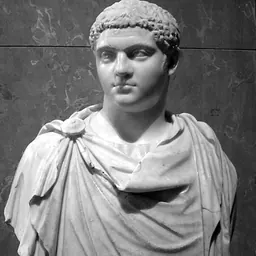

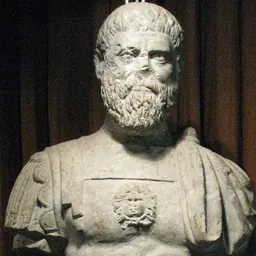

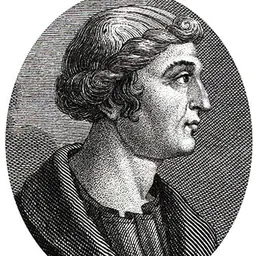

Related people
Same field, nearest in time





Contemporaries
People whose lives overlapped Julia Domna's




Frequently asked questions
Who was Julia Domna?
ancient Roman empress
When was Julia Domna born?
Julia Domna was born in 165 in Homs.
When did Julia Domna die?
Julia Domna died in 217 in Antioch.
What was Julia Domna's occupation?
Julia Domna was a philosopher.
What nationality was Julia Domna?
Julia Domna was Roman.
Sources & further reading
Cite this page
APA: Biography.guide. (2026). Julia Domna. https://biography.guide/julia-domna/
MLA: "Julia Domna." Biography.guide, https://biography.guide/julia-domna/.
Chicago: "Julia Domna." Biography.guide. https://biography.guide/julia-domna/.
Data last updated: 2026-09-24 · Spot an error? Report a correction.
Portrait: Wikimedia Commons · author & licence
Page generated 2026-09-27 05:08 UTC