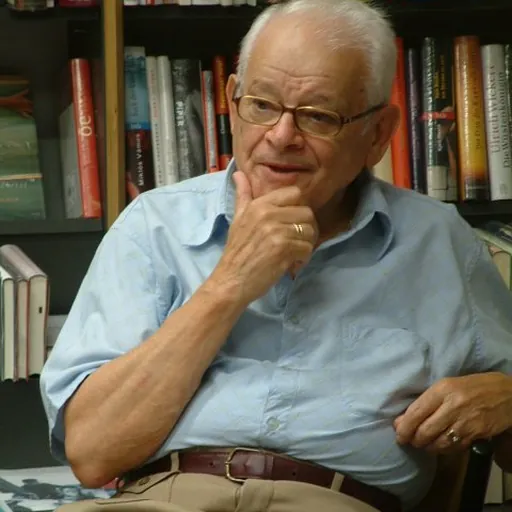
About Jules Schelvis
Lived 1921 – 2016 (aged 95). Jules Schelvis was a Dutch historian, diarist, writer, printer and nazi hunter.
Jules Schelvis (7 January 1921 – 3 April 2016) was a Dutch Jewish historian, writer, printer, and Holocaust survivor. Schelvis was the sole survivor of the 3,006 people that were on the 14th transport from Westerbork to Sobibor extermination camp, having been selected to work at nearby Dorohucza labour camp. He is known for his memoirs and historical research about Sobibor, for which he earned an honorary doctorate from the University of Amsterdam, Officier in the Order of Orange-Nassau, and Order of Merit of the Republic of Poland.
Schelvis was born in Amsterdam, part of a secular Jewish family. After high school, he trained as a printer and worked for Printing Office Lindenbaum in Amsterdam. He worked at various newspapers and participated in a local youth labour organization, where he met and courted a woman named Rachel Borzykowski(1923-1943) who was a seamstress by profession. Schelvis grew close to Borzykowski and her family, whose residence was a local center of Yiddish culture. Schelvis and Borzykowski married on 18 December 1941. It was a double wedding since Borzykowski's sister Hella married Abraham Stodel at the same place and time. Each couple thought it would be a good opportunity to bring their friends and families close together through the occasion of a matrimonial wedding. They opted for this because the times were uncertain. No one knew if such a gathering would be possible if they delayed.
The measures of the German occupation authorities initially began to target 'foreign Jews' with the intention of sowing discord within the Jewish community. After the strikes organised by the Dutch Underground in February 1941 the situation began to radicalise. The Germans carried out an impromptu raid inside the Jewish quarter of Amsterdam on 22 February 1941, and arrested 427 men who were sent to Mauthausen concentration camp. Against this backdrop of fear Schelvis and Borzykowski decided to marry in the hope that this would protect her and her Polish Jewish immigrant family from deportation.
However, Schelvis and his family, including his wife Rachel Borzykowski and her sister Hella and her husband Abraham Stodel were rounded up in Amsterdam on 26 May 1943. They were deported to Westerbork transit camp, where they spent six days before being sent to Sobibor extermination camp. They were among the 3,006 Dutch Jews on the 14th transport to Sobibor which left Westerbork on 1 June 1943.
The transport from Westerbork to Sobibor took three days. At the Sobibor arrival ramp, Schelvis was selected with Abraham Stodel to join a work unit (Arbeitskommando) sent to Dorohucza labor camp. The rest of his family and the Borzykowskis were gassed immediately, including his wife Rachel Borzykowski and her sister Hella. how severe the work conditions were. Also he mentions the daily intake consisted of 300g of bread and 2 litres of watery soup. The newly arrived had to work in an underground site for aircraft production.
Schelvis tells of the brutality of the regime in Vaihingen. The camp commandant SS-Oberscharführer Kurt Möller (1918-1948) was a vicious sadist and went by the nickname of 'Bonebreaker' ('Knochenbrecher'). A typhus epidemic broke out and hundreds died. Between 35 and 40 died on a daily basis. Schelvis estimates how the eventual death toll in Vaihingen at that time was perhaps around 1800. There was much work to do for the 'Totenkommando,' the brigade consisting of Jewish prisoners that had to clear away the dead. Schelvis recalls some of their names: Zelik Potaznik (1917-*), Mayer Lebowski (1922-2007) and Jakub Finkelstein (1921-*).
At the beginning of April 1945 the SS decreed the 'evacuation' of the camp. Those too weak and no longer able to work were left in the barracks to their own fate as the typhus epidemic took its toll. Schelvis was among 500 men left able to work. As the SS prepared yet another 'death march', the Free French Army arrived on 8 April 1945 and liberated the camp. After the war he returned to Amsterdam, arriving there on 30 June, 1945, although he could never forget his terrible experiences, especially the loss of his wife Rachel. Later he did manage to remarry and tried to begin his life anew whilst accepting the need to comprehend his experiences. He turned to writing and from the beginning of the 1980s devoted his research to the memory of those who died in the extermination camp of Sobibor.
Schelvis has written the standard work over the history of the camp.In 2005 there appeared an edition in German ('Eine Reise durch die Finsternis' - 'A Journey through the Darkness'). During his last years he gave talks and lectures and held informal gatherings with German teenagers through visiting schools and university establishments. He was a plaintiff and expert witness during the trials of Karl Frenzel, John Demjanjuk and of other Holocaust perpetrators. His earlier tormentor, the sadist SS-Oberscharführer Kurt Möller, responsible for countless deaths in Oranienburg, Sachsenhausen, Auschwitz, Lublin, Radom and Vaihingen, was brought to trial in 1948. He was convicted of his crimes and hanged in Lublin.
Schelvis was the founder of Stichting Sobibor as well as the author of several memoirs and historical studies about Sobibor.
Notable works Sobibor: A History of a Nazi Death Camp (2014) Bloomsbury Academic. Vernietigingskamp Sobibor (1993) Amsterdam: Bataafsche Leeuw. Binnen de poorten, 1995, Amsterdam: Bataafsche Leeuw. Sobibor. Transportlijsten, 2001, Amsterdam: Bataafsche Leeuw.
Don’t just read it —
keep it.
Full-length biographies made to live with: read them, listen on the way to work, watch them tonight.
- E-book
- Audio
- Video
Instant download · yours to keep · every purchase keeps this site free
Important facts
People in Jules Schelvis's life
Named in this biography and alive at the same time

Related people
Same field, nearest in time




Contemporaries
People whose lives overlapped Jules Schelvis's




Frequently asked questions
Who was Jules Schelvis?
Dutch historian (1921–2016)
When was Jules Schelvis born?
Jules Schelvis was born on 7 January 1921 in Amsterdam.
When did Jules Schelvis die?
Jules Schelvis died on 3 April 2016 in Amstelveen.
What was Jules Schelvis's occupation?
Jules Schelvis was a historian, diarist, writer, printer and nazi hunter.
What nationality was Jules Schelvis?
Jules Schelvis was Dutch.
Sources & further reading
Cite this page
APA: Biography.guide. (2026). Jules Schelvis. https://biography.guide/jules-schelvis/
MLA: "Jules Schelvis." Biography.guide, https://biography.guide/jules-schelvis/.
Chicago: "Jules Schelvis." Biography.guide. https://biography.guide/jules-schelvis/.
Data last updated: 2026-09-22 · Spot an error? Report a correction.
Portrait: Wikimedia Commons · author & licence
Page generated 2026-09-27 05:00 UTC