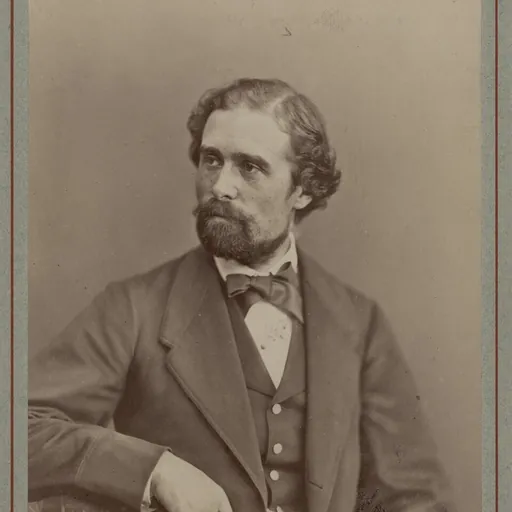
About Jules Lefort
Lived 1822 – 1898 (aged 75–76). Jules Lefort was a French opera singer and composer.
Jules Lefort (27 January 1822 – 7 September 1898), was a French lyrical singer of the Victorian era who in a career that spanned three decades regularly sang in the salons of wealthy and aristocratic patrons and in fashionable concert rooms both in Paris and London and across Europe. During his early singing career he was a tenor and a baritone but by the time of his later career in 1871 his voice had lowered to bass.
Early life Jules François René Lefort was born in Paris in 1822, the son of Jean François Hubert Lefort, a merchant, and Elisabeth Adèle née Dezedde. The family originated from Laboissière-en-Thelle, a commune in the Oise department in northern France. During much of his career Lefort sang mainly in Parisian salons, occasionally venturing further afield to venues across Europe and to London and the British provinces. Kurt Gänzl, the writer on musical theatre, has described him as, "a very clever artist, able to interpret the romances and songs of his age with delicacy and point, with intelligence and expression, in a manner which was highly effective... time and again, he was hailed as the outstanding male singer of romances and ballads in Paris and in London." Gänzl believes he was a light baritone. In the next few years he was a regular on the concert platform. By 1846 the musical press was calling him the 'baryton en vogue’, and by November 1846 he was a leading player in the ‘opéra de salon’ - performing operas and musical comedies privately in the homes of aristocrats and the rich. In the same year he sang in Tout est bien qui finit bien before the Emperor Napoleon III and the Empress Eugénie at the Tuileries Palace; while shortly after he sang before Queen Victoria. while at the Théâtre Lyrique in 1861 he played the title role in Henry Boisseaux and Théodore Lajarte's Le Neveu de Gulliver but the piece was not a success and Lefort turned his back on dramatic works for the rest of his career, returning to salon singing. He was Claudio in the premiere in the Theater Baden-Baden of Béatrice et Bénédict (1862) by Hector Berlioz, under the direction of the composer. In 1862 he sang the title role of the King of Cocagne in Pauline Thys's le Pays de Cocagne. He appeared in Jules d'Aoust's one-act comic opera Une partie de dominos (1863). In 1866 Lefort was singing in Berlin, in Spain and toured Europe in a concert party alongside the operatic soprano Carlotta Patti, the Belgian composer and violinist Henri Vieuxtemps, the Dutch composer and cellist Alexandre Batta and the pianist Eugène Ketterer.
In June 1867 Lefort was back in London where he sang at a state concert before Queen Victoria at Buckingham Palace. At the same concert Charles Gounod gave his ‘Chanson de printemps’, and Lefort sang the duet 'Je suis alsacienne, je suis alsacien' from Offenbach’s Lischen et Fritzchen with Amélie Deméric-Lablache, joining in the quintet from Cosi fan tutte. A further tour commenced in 1868 with the soprano Carlotta Patti, the violinist Henri Vieuxtemps, the French actor and singer Jean-François Berthelier and the Belgian harpist Félix Godefroid. In March 1871 in London Lefort made his first appearance with the Royal Philharmonic Society, while later that year he made an extensive concert tour with Helen Lemmens-Sherrington and her husband, Jacques-Nicolas Lemmens and Sherrington’s sister, the soprano Jose Sherrington, together with the tenor Nelson Varley and the violinist Alexandre Cornelis. Following the success of the tour the Lemmenses and Lefort appeared together for several further seasons with their repertoire including a performance of Rossini's Stabat Mater in which Lefort sang the bass part. In London in June 1872 before the Emperor Napoleon III and the Empress Eugénie he sang opposite Marie Dumas in her Une soirée perdue to a score by Pauline Viardot.
After a few final performances in London and Paris in about 1875 he became a singing teacher in Paris, and was the author of De l'émission de la voix (1868), Méthode de Chant (1874) and Grammaire de la parole (1891).
Jules Lefort died in Paris aged 76.
Personal life Jules Lefort married three times: firstly, in 1848 to Charlotte Jeanne Judlin (1820 – 1883); they divorced in December 1872. Their son Pierre Louis Adrien Lefort (1856 – 1925), who, under the nom de plume Robert Charvay, was a journalist, playwright and lyricist of opérettes. Secondly, in 1883 he married Célinie Zénaïde Dupont (1829 – 1892). Lastly, in 1896 he married Victoria Caroline Gum (1859 -).
Don’t just read it —
keep it.
Full-length biographies made to live with: read them, listen on the way to work, watch them tonight.
- E-book
- Audio
- Video
Instant download · yours to keep · every purchase keeps this site free
Important facts
People in Jules Lefort's life
Named in this biography and alive at the same time




Related people
Same field, nearest in time


Contemporaries
People whose lives overlapped Jules Lefort's



Frequently asked questions
Who was Jules Lefort?
French opera singer
When was Jules Lefort born?
Jules Lefort was born in 1822 in Paris.
When did Jules Lefort die?
Jules Lefort died in 1898.
What was Jules Lefort's occupation?
Jules Lefort was an opera singer and composer.
What nationality was Jules Lefort?
Jules Lefort was French.
Sources & further reading
Cite this page
APA: Biography.guide. (2026). Jules Lefort. https://biography.guide/jules-lefort/
MLA: "Jules Lefort." Biography.guide, https://biography.guide/jules-lefort/.
Chicago: "Jules Lefort." Biography.guide. https://biography.guide/jules-lefort/.
Data last updated: 2026-09-22 · Spot an error? Report a correction.
Portrait: Wikimedia Commons · author & licence
Page generated 2026-09-27 05:04 UTC