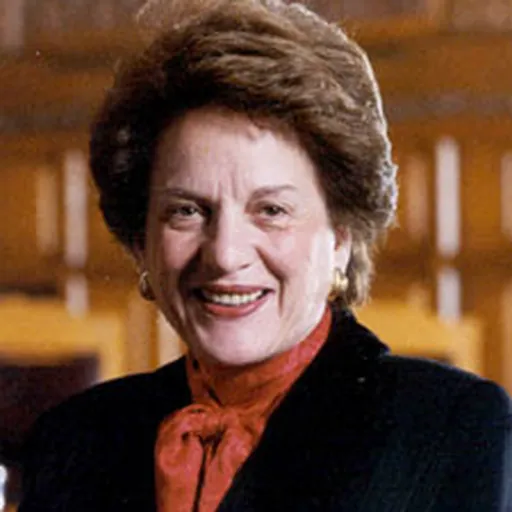
About Judith S. Kaye
Lived 1938 – 2016 (aged 77). Judith S. Kaye was an American lawyer, judge and jurist.
Judith Ann Kaye (; August 4, 1938 – January 7, 2016) was an American lawyer, jurist and the longtime Chief Judge of the New York Court of Appeals, serving in that position from 1993 to 2008.
She was the first woman to serve as chief judge,
She skipped two grades, graduating from Monticello High School (New York) aged fifteen. Kaye was admitted to the New York State Bar in 1963.
In November 1992, Chief Judge Sol Wachtler resigned after being arrested on charges that he extorted money from a former lover. Cuomo nominated Kaye to fill the chief judge vacancy on February 22, 1993. She was confirmed unanimously by the senate on March 17, and then sworn in on March 23, 1993. With her term set to expire, Governor Eliot Spitzer renominated Kaye as chief judge on February 7, 2007. She was confirmed by the senate on March 6, and sworn in on March 19, 2007.
The chief judge of New York has both an administrative role (overseeing the entire state court system, which in 2016 had about 16,000 employees In 2008, as Kaye approached mandatory retirement age, The New York Times editorial board praised her, writing: "In her 15 years as chief, Judith Kaye has excelled at both, earning national praise for her jurisprudence and as a court reformer."
As court reformer
In the late 1990s, Kaye spearheaded a drive to make jury duty in New York State more efficient and convenient. She also sought to improve prospective jurors' working conditions and selection process in assembly rooms and courtrooms, and to decrease the intrusive frequency of jury duty (now no more frequent than every six years throughout the state).
Kaye later helped establish the Center for Court Innovation, a non-profit think tank that although independent of the court system, serves as the judiciary's research and development arm.
Jurisprudence and notable opinions Kaye emphasized civil liberties and interpreted the Constitution of New York as providing broader protections in some areas than those provided for by the federal Constitution.
According to judge Jonathan Lippmann who was her chief administrative judge and successor as chief judge "Judith Kaye essentially started a revolution, that has redefined the traditional role of the judiciary in addressing the difficult social problems reflected in our record-breaking court dockets: drug abuse, family violence and dysfunction, mental illness and so many more"
Kaye voted four times against capital punishment in New York. In In re Robert T. Johnson (1997), however, Kaye wrote for the court in holding that Governor George Pataki had the right to replace Bronx County District Attorney Robert T. Johnson over a case involving the murder of a police officer, since it appeared that Johnson would never seek to impose the death penalty. In an important libel case, Kaye dissented from the court's 4-2 opinion in Hernandez v. Robles (2006), in which the majority held that the state constitution did not compel recognition of marriage between same-sex partners. In a sharply written dissenting opinion, Kaye (joined by Carmen Beauchamp Ciparick) wrote that the ruling was "an unfortunate misstep" and compared a prohibition of same-sex marriage to a prohibition of interracial marriage. Kaye wrote: "The long duration of a constitutional wrong cannot justify its perpetuation, no matter how strongly tradition or public sentiment might support it."
Retirement and career after leaving the bench Kaye retired on December 31, 2008, after reaching the age of 70, the state's mandatory retirement age for judges. Kaye had "made occasional negative references to the mandatory retirement requirement, once saying experienced jurists were being forced from the bench to the 'great detriment' of the courts."
Kaye gave her farewell speech on November 12, 2008, and formally retired on the last day of that year. She was the longest-serving chief judge in New York history.
On March 11, 2010, then-New York Attorney General Andrew Cuomo appointed Kaye as an independent counsel to investigate Governor David Paterson's alleged violation of ethics laws, due to Cuomo's conflict of interest. In that role, she was granted the authority to investigate various charges against the governor, and to bring criminal charges. Her final determination pertaining to her investigation of Paterson was to not refer charges to the prosecutor's office against the sitting governor.
Governor Paterson appointed Kaye to the twelve-member Commission on Judicial Nomination for a four-year term beginning March 31, 2009. Kaye was elected as the commission's chair on May 21, 2009, and she continued in that role until her death.
Personal life Kaye married Stephen Rackow Kaye, a commercial litigator who had been her colleague at Sullivan & Cromwell and later a partner at the law firm of Proskauer Rose, on February 11, 1964. He died in 2006. They had three children: Luisa (Hagemeier), Jonathan and Gordon.
Memberships, awards and honors Kaye received many honorary Doctor of Laws degrees from various universities. President Jimmy Carter appointed Kaye to the U.S. Nominating Commission for Judges of the Second Circuit. Kaye received the Barnard Medal of Distinction from Barnard College, the college's highest honor, in 1987.
Kaye was a longtime member of Congregation Shearith Israel, a Sephardic synagogue in New York. Benjamin Cardozo, one of Kaye's predecessors as chief judge of the Court of Appeals of New York, was a congregant at the same synagogue.
Don’t just read it —
keep it.
Full-length biographies made to live with: read them, listen on the way to work, watch them tonight.
- E-book
- Audio
- Video
Instant download · yours to keep · every purchase keeps this site free
Important facts
People in Judith S. Kaye's life
Named in this biography and alive at the same time








Related people
Same field, nearest in time



Contemporaries
People whose lives overlapped Judith S. Kaye's



Frequently asked questions
Who was Judith S. Kaye?
American judge (1938-2016)
When was Judith S. Kaye born?
Judith S. Kaye was born on 4 August 1938 in Monticello.
When did Judith S. Kaye die?
Judith S. Kaye died on 7 January 2016 in Manhattan.
What was Judith S. Kaye's occupation?
Judith S. Kaye was a lawyer, judge and jurist.
What nationality was Judith S. Kaye?
Judith S. Kaye was American.
Sources & further reading
Cite this page
APA: Biography.guide. (2026). Judith S. Kaye. https://biography.guide/judith-s-kaye/
MLA: "Judith S. Kaye." Biography.guide, https://biography.guide/judith-s-kaye/.
Chicago: "Judith S. Kaye." Biography.guide. https://biography.guide/judith-s-kaye/.
Data last updated: 2026-09-23 · Spot an error? Report a correction.
Portrait: Wikimedia Commons · author & licence
Page generated 2026-09-27 05:07 UTC